


What is social media marketing? Essential 2026 SMB guide
- Pawan Samarakoon
- a few seconds ago
- 9 min read

Many small business owners think social media marketing is just paid ads or something only big brands can afford. That’s a costly misconception. Social media marketing is a diverse, high-ROI channel that includes organic content, community building, and strategic engagement across platforms like Facebook, Instagram, LinkedIn, and TikTok. For SMBs in 2026, mastering these tactics drives measurable growth in sales, reach, and customer retention. This guide explains what social media marketing truly is, why it matters for your business, and how to apply proven strategies to accelerate your brand’s success.
Table of Contents
What Is Social Media Marketing And Why Does It Matter For Small Businesses?
Understanding Roi And Engagement: What Social Media Marketing Delivers In 2026
Key Strategies For Smbs: Authenticity, Community, And Optimizing Platform Use
How To Apply Social Media Marketing: Practical Steps For Smb Brand Growth
Key takeaways
Point | Details |
Definition and scope | Social media marketing uses platforms like Facebook, Instagram, LinkedIn, and TikTok to promote products, engage customers, and drive sales for small businesses. |
High ROI potential | Average return is $5.78 per dollar spent, with B2C seeing 6.1x and Facebook ads delivering $8.17 ROI in 2026. |
Authenticity wins | User-generated content outperforms branded content by 6.9x, making community building and genuine engagement critical for success. |
Strategic platform use | Each platform serves different goals: Facebook for reach, Instagram for visual storytelling, TikTok for viral engagement, and LinkedIn for B2B connections. |
Full funnel measurement | Track awareness, engagement, and conversion metrics together to optimize ROI and adapt strategies effectively. |
What is social media marketing and why does it matter for small businesses?
Social media marketing is the use of social platforms like Facebook, Instagram, LinkedIn, and TikTok to promote products or services, build brand awareness, engage customers, and drive sales for SMBs. Unlike traditional advertising, social media marketing enables two-way conversations, community building, and direct customer feedback. Each platform serves distinct purposes: Facebook excels at broad reach and community groups, Instagram focuses on visual storytelling and product discovery, TikTok drives viral engagement through short videos, and LinkedIn connects B2B audiences with professional content.
For small businesses, social media marketing is no longer optional. Studies confirm significant positive impacts on sales growth (β=0.687), market reach (β=0.721), and customer retention, explaining 73% of performance variance. These platforms level the playing field, allowing SMBs to compete with larger brands through authentic engagement and targeted content. In 2026, consumers expect businesses to maintain active social presences where they can ask questions, read reviews, and connect with brand values.
Social media marketing serves multiple functional goals for SMBs:
Brand awareness and visibility in crowded markets
Customer engagement through comments, messages, and interactive content
Direct sales via shoppable posts and platform commerce features
Customer retention through ongoing relationship building
Market research by monitoring conversations and feedback
The beauty of social media marketing lies in its accessibility. You don’t need massive budgets to start. Organic content, strategic community engagement, and smart use of platform features can deliver substantial returns. As you grow, layering in paid advertising and influencer partnerships amplifies results. Understanding how to integrate social media marketing with your broader digital marketing strategy creates a cohesive approach that drives sustainable business growth.
Understanding ROI and engagement: What social media marketing delivers in 2026
The financial returns from social media marketing are compelling. Average ROI reaches $5.78 per dollar spent, with B2C businesses seeing 6.1x returns compared to B2B at 3.2x. Facebook ads specifically deliver $8.17 ROI, making them particularly valuable for small businesses with limited budgets. These numbers reflect both paid advertising and the compound effects of organic engagement, community building, and customer loyalty developed through consistent social presence.
Engagement rates vary significantly by platform, directly impacting your business results. TikTok leads with 2.5% average engagement, while Instagram ranges from 0.5% to 1%, and Facebook typically sees lower rates but compensates with massive reach. Engagement matters because it signals algorithm favor, increases organic visibility, and builds trust with potential customers. When followers comment, share, or save your content, they’re actively participating in your brand story and more likely to convert.
Platform | Average ROI | Engagement Rate | Best For |
$8.17 per $1 | 0.3-0.5% | Broad reach, community groups, local targeting | |
$5-6 per $1 | 0.5-1% | Visual products, lifestyle brands, younger demographics | |
TikTok | $4-5 per $1 | 2.5% | Viral content, brand personality, Gen Z audiences |
$3-4 per $1 | 0.4-0.6% | B2B services, professional networking, thought leadership |
Several factors influence your actual ROI:
Content type and quality, with video and interactive formats outperforming static images
Authenticity and human perspective over overly polished corporate messaging
Platform fit with your target audience demographics and behavior patterns
Consistency in posting schedule and community engagement
Strategic mix of organic content, paid advertising, and influencer partnerships
Pro Tip: Focus on interactive content like polls, questions, and user-generated content campaigns to boost engagement. Measure your full marketing funnel from awareness through engagement to conversion rather than isolated metrics. A post with lower reach but higher conversion rate often delivers better ROI than viral content that doesn’t drive sales. Track which content types move followers through your funnel and double down on what works.
Integrating social media setup and SEO optimization ensures your profiles appear in search results and your content reaches the right audiences. This technical foundation amplifies the ROI of every piece of content you create.
Key strategies for SMBs: Authenticity, community, and optimizing platform use
In 2026, authenticity trumps polish. Consumers increasingly distrust overly produced content that feels artificial or AI-generated. Human perspective content outperforms branded messaging, and user-generated content delivers 6.9x better ROI than traditional advertising. Small businesses have a natural advantage here because you can showcase real team members, genuine customer stories, and behind-the-scenes moments that build emotional connections.

User-generated content and community building form the foundation of modern social media marketing strategy. When customers share photos using your products, post reviews, or tag your business, they create social proof that influences purchasing decisions far more effectively than your own promotional content. Encourage UGC by creating branded hashtags, running contests, featuring customer stories, and making it easy for satisfied customers to share their experiences. This approach builds trust while reducing your content creation burden.
Platform | Pros for SMBs | Cons for SMBs |
Largest reach, robust ad targeting, community groups, local business tools | Declining organic reach, older demographic skew, algorithm changes | |
Visual storytelling, shopping features, influencer partnerships, Stories engagement | Requires consistent visual content, younger demographic focus, algorithm complexity | |
TikTok | Highest engagement, viral potential, authentic content performs well, younger audiences | Reputation risks if managed poorly, time-intensive content creation, uncertain regulatory environment |
B2B networking, professional credibility, thought leadership, decision-maker access | Limited B2C value, slower engagement, requires industry expertise content |
Modern strategy priorities for SMB success:
Community first mindset, treating social media as relationship building rather than broadcasting
Algorithm understanding to optimize posting times, content formats, and engagement tactics
Content type diversity mixing educational posts, entertainment, user stories, and promotional messages
Strategic influencer partnerships with micro-influencers who share your target audience
Platform-specific optimization rather than cross-posting identical content everywhere
Pro Tip: Balance organic UGC and community engagement with paid advertising and influencer partnerships. Start with 70% organic community building to establish authentic presence, then layer in 20% strategic paid promotion and 10% influencer collaboration. This ratio maximizes ROI while protecting your brand reputation. As you scale, adjust the mix based on what drives conversions for your specific business.
Your social media marketing should align with your overall branding strategy to create consistent messaging across all customer touchpoints. When your social presence reflects your core brand values and visual identity, you build recognition and trust more effectively.
How to apply social media marketing: practical steps for SMB brand growth
Implementing effective social media marketing requires a structured approach. Follow these steps to build a sustainable strategy:
Define clear goals and audience. Identify whether you’re prioritizing brand awareness, lead generation, sales, or customer retention. Map your ideal customer demographics, interests, and platform preferences.
Choose the right platforms. Don’t spread yourself thin across every network. Start with one or two platforms where your target audience actively engages. B2C product businesses often succeed on Instagram and Facebook, while B2B services gain traction on LinkedIn.
Build an authentic content calendar. Plan 60% educational content that solves customer problems, 30% community engagement and UGG, and 10% direct promotion. Schedule posts consistently but leave room for timely, spontaneous content.
Engage your community and encourage UGG. Respond to every comment and message promptly. Ask questions, run polls, and create opportunities for customers to share their experiences. Feature customer content regularly to build loyalty.
Use paid ads and influencers strategically. Once organic content establishes your presence, amplify top-performing posts with targeted ads. Partner with micro-influencers whose audiences match your customer profile.
Track full funnel metrics and adapt. Monitor awareness metrics like reach and impressions, engagement metrics like comments and shares, and conversion metrics like click-through rates and sales. Measure complete funnel performance to identify where prospects drop off and optimize accordingly.
Best practices for content and engagement:
Post frequency varies by platform: Instagram 4 to 7 times weekly, Facebook 3 to 5 times weekly, TikTok daily for growth, LinkedIn 2 to 3 times weekly
Video content outperforms static images across all platforms, with short-form video seeing highest engagement
Interactive content like polls, quizzes, and questions boosts algorithm favor and community participation
Respond to comments within the first hour to maximize engagement and signal active community management
Use platform analytics to identify your audience’s active times and schedule posts accordingly
Pro Tip: Set up measurable objectives from the start using SMART goals. Instead of “increase engagement,” aim for “achieve 5% average engagement rate on Instagram posts within 90 days.” Track progress weekly and adjust tactics based on data. Interactive content consistently yields strong returns, so experiment with different formats to discover what resonates with your specific audience.
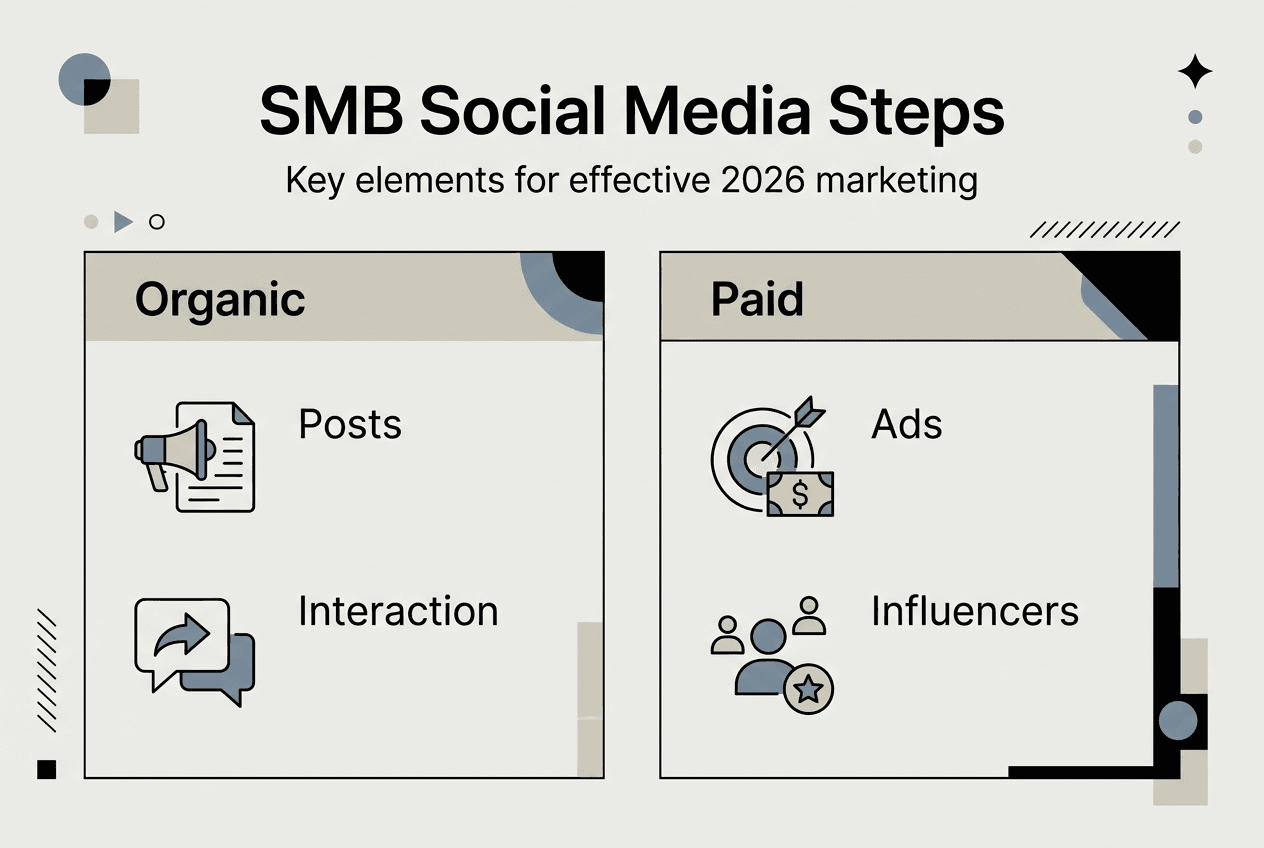
Balancing organic and paid strategies ensures sustainable growth. Organic content builds authentic community and long-term loyalty, while paid promotion accelerates reach and targets specific customer segments. Most successful SMBs invest 60% to 70% of effort in organic community building, using paid advertising to amplify proven content and reach new audiences.
Streamline your social media marketing by leveraging social media setup essentials that optimize your profiles and content strategy. When combined with strong brand touchpoints, your social presence becomes a powerful driver of business growth.
Enhance your social media marketing with LOOM Brand Designs
Executing a comprehensive social media marketing strategy takes time and expertise. LOOM Brand Designs offers tailored packages that accelerate your social media success while you focus on running your business. Our Social Growth Accelerator combines platform optimization, content strategy, and community management to deliver measurable results for SMBs in 2026.
We understand the unique challenges small businesses face with limited resources and competing priorities. Our team develops authentic, data-driven strategies that maximize ROI through the right mix of organic engagement, strategic paid advertising, and influencer partnerships. From foundational branding that ensures consistent messaging across platforms to advanced AI-powered brand intelligence that optimizes performance, we provide solutions scaled to your growth stage. Partner with experts who deliver measurable results and help your brand connect meaningfully with customers.
Frequently asked questions
What exactly is social media marketing for small businesses?
Social media marketing is using platforms like Facebook, Instagram, TikTok, and LinkedIn to promote your business, engage customers, and drive sales through both organic content and paid advertising. It encompasses posting valuable content, building community relationships, responding to customer inquiries, and strategically amplifying your message to reach target audiences.
How can small businesses measure social media marketing success?
Track three metric categories: awareness (reach, impressions, follower growth), engagement (likes, comments, shares, saves), and conversions (website clicks, lead form submissions, sales attributed to social). Use platform analytics and UTM parameters to connect social activity directly to business outcomes like revenue and customer acquisition cost.
Which social media platforms work best for different small business types?
Retail and consumer products succeed on Instagram and Facebook for visual storytelling and shopping features. Professional services and B2B companies gain traction on LinkedIn for thought leadership. Restaurants and local businesses thrive on Facebook for community engagement and local targeting. Creative and entertainment brands leverage TikTok for viral reach and younger demographics.
Should small businesses start with paid ads or organic content?
Begin with organic content to establish authentic presence, understand your audience, and identify what resonates before spending on ads. Once you have proven content that generates engagement and conversions, use paid advertising to amplify your best-performing posts and reach new audiences. This approach maximizes ROI and prevents wasted ad spend on untested content.
How can SMBs maintain consistent engagement without large budgets?
Focus on community interaction by responding to every comment and message, which costs only time. Encourage user-generated content through branded hashtags and customer features, reducing your content creation burden. Repurpose existing content across platforms and formats. Use free scheduling tools to maintain consistent posting. Prioritize quality over quantity, posting less frequently with higher-value content that sparks genuine conversations.
Recommended