


Cross-Platform Branding: Build Recognition Everywhere
- Pawan Samarakoon
- 2 days ago
- 8 min read

TL;DR:
Consistent cross-platform branding increases recognition, trust, and revenue by up to 23%.
Key elements include logos, colors, typography, voice, imagery, and experience, adapted per platform.
Regular audits and team training are essential to maintain brand consistency and avoid fragmentation.
Brands that show up consistently across every channel aren’t just more recognizable. They’re more profitable. Consistent branding can increase revenue by up to 23%, and 60% of customers trust brands that keep their visuals and messaging aligned. Yet most small and mid-sized businesses still treat each platform as its own isolated project, rebuilding their identity from scratch on every channel. This guide breaks down what cross-platform branding actually means, which elements matter most, and how to build a system that keeps your brand sharp whether a customer finds you on Instagram, Google, or a printed flyer.
Table of Contents
Key Takeaways
Point | Details |
Consistency drives trust | Keeping your brand consistent across platforms increases customer trust and recognition. |
Style guides are essential | A documented guide ensures your brand’s visual and messaging elements remain cohesive everywhere. |
Adaptation beats one-size-fits-all | Customize your brand’s voice and visuals for each platform while staying true to your identity. |
Regular audits protect your brand | Quarterly reviews catch inconsistencies and keep your branding sharp as platforms evolve. |
Persistence outperforms shortcuts | Ongoing effort and platform-specific adjustments give small brands a lasting edge. |
What is cross-platform branding?
Cross-platform branding is the practice of keeping your brand identity, which includes your visuals, messaging, and tone, consistent across every platform and channel where your business appears. That means your website, social media profiles, email campaigns, mobile apps, and even traditional media like print ads all feel like they belong to the same company.
It’s easy to confuse this with multi-channel marketing. Multi-channel marketing is about being present on multiple platforms. Cross-platform branding is about being recognizable on all of them. You can run ads on Facebook and send email newsletters and still have a fragmented brand if each one looks and sounds different. As cross-platform branding is defined, consistent brand identity across digital and traditional platforms is the essence of the practice.
Here’s why this distinction matters for your business:
Trust: Customers who see the same logo, colors, and tone everywhere feel more confident in your brand.
Recognition: Repetition across channels builds memory. People start to recognize you before they even read your name.
Revenue: Consistency directly connects to the 23% revenue increase that research benchmarks show.
Efficiency: A unified brand system means your team spends less time reinventing assets and more time executing.
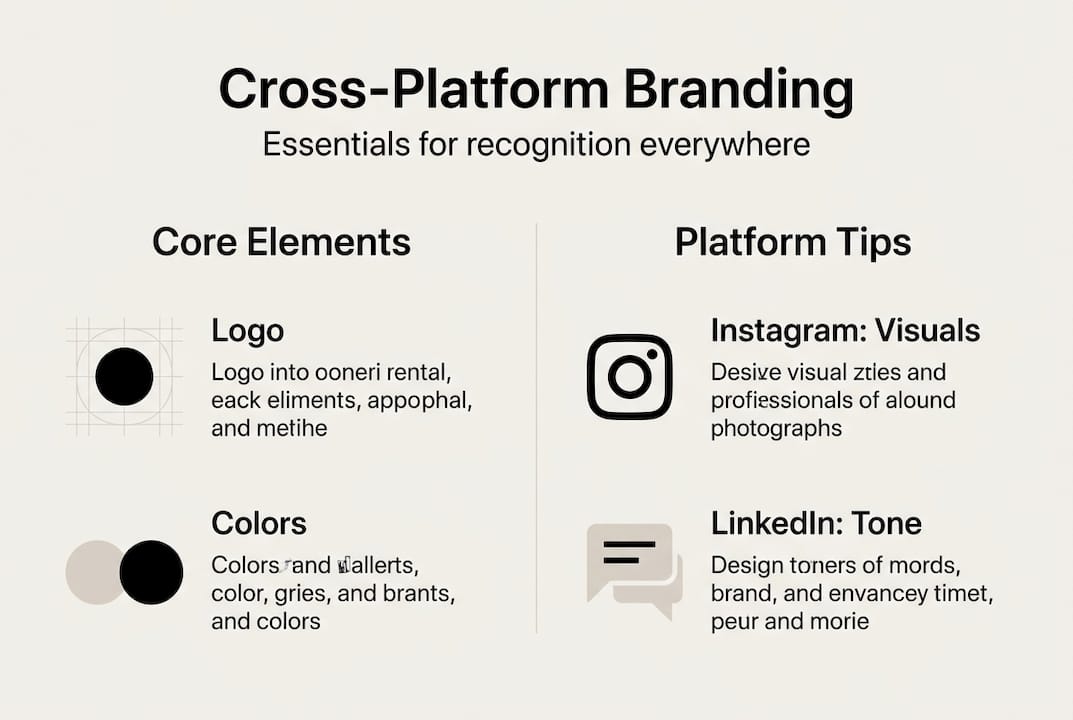
One of the most persistent misconceptions is that adapting your brand for each platform means diluting it. It doesn’t. Adaptation means adjusting the format and tone while keeping the core identity intact. Your Instagram post might be bold and visual while your LinkedIn article is measured and professional. But both should feel unmistakably like you.
“Cross-platform branding is not about saying the same thing everywhere. It’s about being the same brand everywhere.”
If you’re working to build a cohesive digital identity, this is the foundation. Done well, it helps you build trust and recognition with every touchpoint, and it helps you avoid branding mistakes that quietly erode customer confidence over time. The goal is to align branding and marketing so they reinforce each other at every stage of the customer journey.
The core elements of a cross-platform brand
Knowing what cross-platform branding is and actually executing it are two different things. The execution starts with identifying the specific elements that must stay consistent, and understanding how each one can flex without breaking.
Here are the core elements every brand needs to define and document:
Logo: Primary, secondary, and icon versions for different use cases.
Color palette: Primary and accent colors with exact hex, RGB, and CMYK codes.
Typography: Specific fonts for headings, body text, and captions.
Voice and tone: The personality behind your words (friendly, authoritative, playful) and how it shifts slightly by platform.
Messaging: Core value propositions and taglines that stay consistent.
Imagery style: Photography filters, illustration styles, or graphic treatments that feel unified.
Brand experience: How customers feel when they interact with you, whether online or offline.
Here’s how those elements adapt across key platforms:
Element | |||
Tone | Casual, visual | Professional, insightful | Direct, personal |
Logo use | Icon or wordmark | Full logo | Header logo |
Imagery | Bold, lifestyle | Clean, corporate | Product or value-focused |
Copy length | Short captions | Long-form articles | Medium, scannable |
A comprehensive brand style guide is foundational to making this work. It documents every element above so your team, your freelancers, and your agency partners are all working from the same playbook. Understanding why brand guidelines matter is the first step toward building one that actually gets used.
Pro Tip: Small teams don’t need expensive software to start. A simple Google Doc with your colors, fonts, logo files, and tone examples is enough to get everyone aligned. Use free Canva templates to build out your first asset library before scaling up.
Once you have your elements documented, the brand design process becomes much more repeatable and scalable across your entire team.

Building and enforcing your brand’s consistency
Having a style guide is only useful if your team actually follows it. Here’s a practical step-by-step approach to building and maintaining real consistency across every channel.
Create your brand style guide. Document every visual and verbal element. Include do’s and don’ts with real examples. Make it a living document, not a PDF that gets forgotten.
Build templates for every platform. Use tools like Canva to create pre-approved social post templates, email headers, and presentation decks. Templates cut production time and eliminate off-brand improvisation.
Choose the right tools. Hootsuite or Buffer for social scheduling, Google Drive or Dropbox for asset storage, and Canva for design keep small teams organized without enterprise-level costs.
Train your team and partners. Run a short onboarding session every time a new team member, contractor, or agency joins. Even a 20-minute walkthrough of your style guide prevents months of brand drift.
Schedule quarterly brand audits. Set a calendar reminder every three months to review your profiles, website, email templates, and any printed materials. Compare everything against your style guide.
“60% of customers trust brands that present a consistent experience across every channel.”
For distributed or remote teams, the key is centralized access. Store all brand assets in one shared folder with clear naming conventions. If someone has to search for the right logo version, they’ll use the wrong one.
Pro Tip: Audit branding quarterly rather than annually. Platform interfaces change, algorithms shift what content gets seen, and your brand assets can look outdated faster than you think. A quarterly check keeps you ahead of the curve.
Learning how to boost consistency through systematic processes is what separates brands that stay sharp from those that slowly fragment. When you develop your brand design with scalability in mind, enforcement becomes much easier down the line.
Adapting and optimizing your brand across platforms
Consistency doesn’t mean rigidity. Each platform has its own culture, algorithm, and audience expectation. The brands that win are the ones that adapt their format while protecting their identity.
Here’s a comparison of how branding should flex across key channels:
Platform | Primary strength | Brand adaptation |
Visual storytelling | Bold imagery, short copy, brand colors front and center | |
Thought leadership | Long-form content, professional tone, data-driven posts | |
Website | Conversion and trust | Full brand experience, consistent UX, clear messaging |
Personalization | Brand header, conversational tone, value-first content | |
Tangibility | High-res logo, CMYK colors, premium feel |
The challenges are real. Tech silos mean your social team and your email team might not communicate. Algorithm changes on Instagram or LinkedIn can make previously effective content invisible overnight. Regional localization adds another layer, especially if you serve diverse U.S. markets or expand internationally.
Here’s how to course-correct when things drift:
Run a visual audit: Screenshot every active platform and line them up side by side. Inconsistencies become obvious immediately.
Review copy tone: Read three recent posts from each channel out loud. Do they sound like the same brand?
Check your assets: Are you using the correct logo version, the right font, and the approved color palette everywhere?
Platform-specific adaptations like leaning into visuals on Instagram and thought leadership on LinkedIn, combined with quarterly audits, keep your brand relevant as platforms evolve. And the business case is clear: 75% of Instagram users shop on social, and diversifying across platforms can boost sales by 2 to 5%.
Strong content marketing for branding ties all of these adaptations together with a narrative thread. And if you want to work faster, learning to streamline digital marketing workflows will help you execute across channels without burning out your team.
The hidden edge: Most brands aren’t persistent enough
Here’s the uncomfortable truth most branding articles skip over. The brands that win at cross-platform consistency aren’t the ones with the biggest budgets or the most sophisticated tools. They’re the ones that refuse to let standards slip when things get busy.
We’ve seen this pattern repeatedly. A business launches with a tight style guide and beautiful templates. Six months in, a new hire starts posting off-brand graphics. A year in, the website hasn’t been updated to reflect the new logo variant. Two years in, the brand looks like three different companies depending on where you find it.
The real competitive edge is treating every platform as an evolving storefront, not a set-it-and-forget-it channel. That means building cross-platform branding reviews into your weekly marketing meetings, not just your annual strategy sessions. It means holding vendors and freelancers to the same standards as your in-house team.
Tools and templates make consistency easier, but they don’t create it. Leadership commitment does. Growing brand recognition is a compounding process. Every consistent touchpoint adds to the total. Every inconsistent one subtracts from it.
Pro Tip: Add a five-minute brand check to your weekly marketing review. Ask one question: does everything we published this week look and sound like the same brand? That habit alone will catch drift before it becomes a problem.
Bring your brand to every platform with expert help
Building a consistent cross-platform brand takes strategy, the right assets, and a system your team can actually follow. If you’re ready to scale your presence, expert support can accelerate the entire process.

At LOOM Brand Designs, we help small and mid-sized businesses audit, design, and launch cohesive brand identities across every channel. Whether you’re starting from scratch or tightening up an existing brand, our Basic Branding Package gives you a strong, scalable foundation. We also offer custom graphic design for platform-specific assets and full website branding and development to make sure your most important digital storefront reflects your brand at its best. Reach out for a free consultation and let’s build something that shows up everywhere.
Frequently asked questions
How does cross-platform branding differ from multi-channel marketing?
Cross-platform branding ensures a consistent brand identity across all channels, while multi-channel marketing focuses on presence, not consistency, on various platforms. One is about recognition; the other is about reach.
What tools are best for small businesses to manage brand consistency?
Free tools like Canva and affordable options like Hootsuite aid efficient brand management by helping small teams maintain templates and schedule brand-aligned content without a large budget.
How often should a brand audit its cross-platform presence?
Quarterly audits allow timely adaptation to evolving platforms and algorithm changes, and they help catch visual or messaging inconsistencies before they erode customer trust.
What impact can cross-platform branding have on sales and trust?
Consistent cross-platform branding can deliver a 23% revenue boost and 60% of customers trust brands that keep their message and visuals aligned across every channel they use.
Is it necessary to localize brand content for different regions?
Yes, but localization with core identity retention is key. Adjust language and cultural references while keeping your logo, colors, and core messaging consistent so customers recognize you regardless of where they are.
Recommended
Comments