


How to write a brand story that captivates customers
- Pawan Samarakoon
- 12 minutes ago
- 8 min read

TL;DR:
Effective brand stories focus on customer transformation, authenticity, and emotional connection.
Structuring stories with clear rising action, challenge, solution, and results boosts engagement.
Most small businesses succeed by simplifying their message and genuinely understanding their customers’ needs.
Most small businesses have a story worth telling. The problem is that too many tell it in a way that puts customers to sleep. Generic taglines, founder-focused timelines, and jargon-heavy copy flood the market. Customers scroll past because nothing resonates. The truth is, a compelling brand story is not a luxury reserved for big corporations. It is the single most powerful tool you have to differentiate your business, build trust, and turn strangers into loyal fans. This guide breaks down exactly how to craft a brand story that feels real, connects emotionally, and drives results for your small business.
Table of Contents
Key Takeaways
Point | Details |
Emotional resonance is essential | The best brand stories create a genuine connection grounded in authenticity and customer needs. |
Preparation drives clarity | Define your brand values and audience before writing to give your story power and focus. |
Structure matters | Craft your story with a clear step-by-step narrative that centers on the customer journey. |
Avoid common traps | Steer clear of jargon, over-complication, and self-focus to keep your story engaging and effective. |
Apply your story everywhere | Use your brand story on websites, pitches, and social profiles to build consistent recognition. |
What makes a great brand story?
A brand story is not your company’s history or a list of your achievements. It is a narrative that captures why you exist, who you serve, and what changes when your customers choose you. The best brand stories feel less like marketing and more like a conversation between two people who understand each other.
Meaningful stories share three key elements: resonant meaning, archetypal plots or characters, and authenticity. These are not abstract concepts. They are the building blocks that make a customer stop scrolling and actually read.
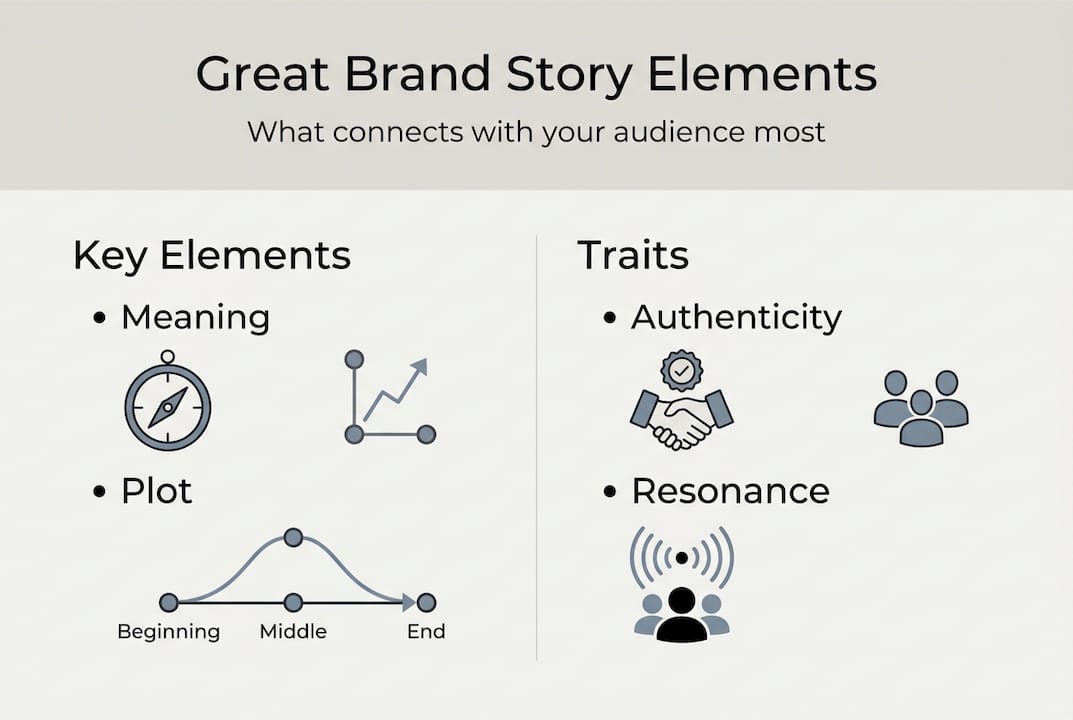
Here is a quick comparison of what separates a weak brand story from a strong one:
Attribute | Weak brand story | Strong brand story |
Focus | The brand’s achievements | The customer’s transformation |
Language | Jargon and buzzwords | Simple, human language |
Emotion | Absent or generic | Specific and relatable |
Structure | Random or no order | Clear beginning, middle, end |
Authenticity | Polished and corporate | Honest and real |
The four core elements you need to nail are:
Resonant meaning: Your story should stand for something your audience cares about, not just what you sell.
Structure: A clear narrative arc keeps readers engaged and makes your message stick.
Authenticity: Real struggles, real wins, and real people are far more compelling than manufactured perfection.
Relevance: Your story must speak directly to your customer’s world, not yours.
When you are leveraging storytelling for branding, you have two main structural templates to consider: the founder story (why you started) and the customer journey (your customer as the hero). Both can work, but they require different focuses and tones.
Pro Tip: Write your first draft of the brand story from your customer’s point of view. Swap “we” for “you” and see how different it feels. That shift in perspective often unlocks the emotional connection that was missing.
Understanding brand archetypes and personas can also help you identify which narrative structure fits your brand’s personality naturally. A brand that embodies the “hero” archetype will tell a very different story than one that embodies the “caregiver.”
Preparing to write your brand story
Before you type a single word of your story, you need to do some honest groundwork. Skipping this step is why so many brand stories end up generic. You cannot write something authentic if you have not clearly defined what you stand for and who you are talking to.

Here is what to clarify before you start writing:
Element | Key question to answer |
Brand mission | Why does your business exist beyond making money? |
Core values | What principles guide every decision you make? |
Unique selling point | What do you offer that no one else does in quite the same way? |
Customer pain points | What problems keep your ideal customer up at night? |
Desired transformation | What does life look like for your customer after they work with you? |
Audience research is non-negotiable here. Brand storytelling best practices consistently show that aligning your story with customer needs and using plain language builds far stronger emotional connections. You might think you know your customers, but assumptions are dangerous. Read their reviews, study their social media posts, and pay attention to the exact words they use to describe their problems.
When identifying your brand’s persona, you will naturally uncover the emotional tone that should run through your entire story. This is not about copying a persona template. It is about understanding the emotional space your brand occupies in your customer’s life.
Pro Tip: Call or email three to five of your most loyal customers and ask them one question: “What was going on in your life when you first found us?” Their answers will give you raw, authentic material that no brainstorming session can produce.
Keep a running “story bank” in a notes app or document. Every customer testimonial, every behind-the-scenes moment, every mistake you learned from belongs in there. Raw material is gold when it comes time to write. A strong brand strategy gives you the foundation to pull all of these pieces together into something coherent and powerful.
How to structure your brand story: A step-by-step guide
With your groundwork done, it is time to build the actual story. The structure below works for both the founder-why narrative and the customer-hero format. Follow these five steps:
Set the scene. Open with the world as it was before your business existed. Paint a picture of the problem or gap in the market. Make it specific and grounded in reality, not abstract.
Introduce the challenge. Name the core conflict. Who was struggling, and what was at stake? This is where emotional investment begins. Be honest about real friction, not a sanitized version of events.
Show the turning point. Describe the moment everything changed. This could be a realization, a failure, a customer conversation, or a breakthrough. This is the heart of your story.
Present the solution. Explain how your business addresses the challenge. Keep the focus on benefit and transformation, not features and specs. The customer should see themselves receiving the value.
Highlight results and vision. Close with proof of impact and a forward-looking statement. Where are your customers now? Where are you taking them next?
Here is how the two most common structures compare:
Structure | Focus | Best used for |
Founder-why | Your personal motivation | Building trust and relatability |
Customer-hero journey | Customer’s transformation | Conversion and emotional pull |
Research shows that customer-focused narratives that use simple language and position the customer as hero outperform brand-centric stories in engagement and conversion. This means your instinct to talk about yourself needs to take a back seat.
Use real customer quotes when you can. Nothing validates your story like someone else’s words. If a client said, “Working with this team changed how I see my entire business,” that one sentence does more work than three paragraphs of your own copy.
For guidance on the visual layer that brings your story to life, explore the brand design process and how impactful brand copywriting translates your narrative into every customer touchpoint. Also consider how the customer-hero journey maps across your full marketing funnel.
Common pitfalls to avoid in brand storytelling
Knowing the steps is only half the battle. Plenty of business owners follow the structure and still end up with a story that falls flat. Here are the five most common mistakes to avoid:
Making the brand the hero. Your business is the guide, not the protagonist. Your customer is the hero. Shift the spotlight.
Over-complexity. Too many details, too many characters, and too many plotlines lose the reader. One clear thread wins every time.
Lack of authenticity. Customers can smell a manufactured story. If it does not reflect your real experience and values, it will not connect.
Using jargon. Industry terms and buzzwords create distance. Plain, conversational language builds trust.
Boring, irrelevant details. Not every fact about your company belongs in your story. Include only what serves the reader’s emotional journey.
“Common pitfalls in brand storytelling mistakes include making the brand the hero, over-complexity, inauthenticity, and excessive jargon, all of which dilute the emotional core of your narrative.”
Pro Tip: After writing your first draft, cut 20 percent of the words. Ruthless editing is what turns a decent story into a great one. If a sentence does not serve the reader, remove it.
Always test your story with a real audience before publishing. Share it with a few trusted customers or colleagues and ask: “Does this sound like us? Does it connect with your experience?” Feedback at this stage is far less costly than launching a story that misses the mark. For more on building a cohesive digital identity and using content marketing for branding to amplify your story, there are real tactics that make the work pay off.
Why most small business brand stories get ignored (and what actually works)
Here is the uncomfortable truth: most brand stories fail not because of poor writing, but because of misplaced focus. Business owners spend hours refining their founder origin story, polishing timelines, and crafting mission language, all while their customers are asking a completely different question. They are not asking, “Who are you?” They are asking, “Do you understand me?”
Template frameworks are useful, but they become traps when you fill them in mechanically without addressing the emotional core. A five-step structure with no real human truth at its center is just organized noise.
Customer journey-focused narratives are empirically more effective for small business growth. But the reason goes deeper than structure. It is because these narratives require you to genuinely understand your customer’s inner world, their fears, frustrations, and aspirations, and that level of understanding shows.
The brands that stand out have the courage to simplify. They resist the urge to say everything and instead say the one thing that matters most. They accept imperfection in their story because real beats polished every single time. If your brand storytelling examples feel hollow, the fix is almost never more words. It is more honesty.
Build your unforgettable brand story with expert help
Crafting a brand story that truly connects takes clarity, strategy, and the right creative partners. If you have been struggling to put your story into words or are not sure where to start, you do not have to figure it out alone.

At LOOM Brand Designs, we help entrepreneurs and small business owners turn their vision into a brand that resonates. Whether you need a complete identity through our basic branding package or a powerful digital presence through website design and development, our team is here to bring your story to life with strategy, design, and marketing built around your goals.
Frequently asked questions
What is the difference between a brand story and a brand mission statement?
A brand story is a narrative that captures emotional journey and unique value, while a mission statement is a static declaration of purpose and goals. As research confirms, a brand story is connection-focused, not just directional.
Should I focus my brand story on myself or the customer?
Focus primarily on the customer’s journey and transformation with your brand. Customer-centric stories consistently outperform founder-centric narratives in engagement and conversion.
How long should my brand story be?
Have a concise version of two to four sentences for quick introductions and an extended version for your website or pitch materials. Short brand stories work well when used consistently across platforms.
What are the most common mistakes in brand storytelling?
Top mistakes include making the brand the hero, using jargon, lacking authenticity, and skipping emotional connection. Avoiding these common pitfalls is what separates forgettable stories from memorable ones.
Can I use my brand story in marketing materials?
Absolutely. Use your brand story across product pages, social media, and sales pitches for maximum impact. Stories shared consistently across platforms drive significantly better engagement and brand recall.
Recommended
Comments