


B2B Branding Process: Step-by-Step Guide for SME Success
- Pawan Samarakoon
- 7 days ago
- 8 min read

TL;DR:
Strong branding relies on thorough research and strategic alignment before execution.
Consistent visual identity and messaging significantly boost client retention and brand credibility.
B2B branding efforts require long-term commitment with measurable KPIs to realize ROI.
Weak branding costs SMEs real deals. When 74% of B2B buyers rank brand reputation as a top vendor selection factor, showing up with inconsistent messaging or a vague value proposition is not a minor oversight. It’s a revenue leak. Many marketing directors at small to medium-sized enterprises know branding matters but treat it like a creative exercise rather than a structured business process. This guide changes that. You’ll walk away with a clear preparation checklist, a step-by-step execution framework, identity and messaging standards, and a measurement model built for the real constraints SMEs face.
Table of Contents
Key Takeaways
Point | Details |
Start with ICP clarity | Defining your ideal customer profile and decision committee sets the foundation for your branding process. |
Follow a proven step-by-step process | Structured branding steps—from research to rollout—keep your efforts focused and measurable. |
Consistency boosts results | Unified messaging and visuals increase retention and reduce client churn. |
Commit for long-term ROI | Brand building delivers the highest returns for SMEs who stick with it more than a year. |
Expert help accelerates success | Professional guidance can save costly mistakes and speed up brand transformation. |
What you need to start your B2B branding process
Before you design a single logo or write a single tagline, you need the right inputs. Jumping into execution without preparation is the single biggest reason SME branding efforts stall or produce results that feel generic. ICP research and competitor audits should always come first for US SMEs, and skipping them leads to costly mispositioning that takes months to undo.
Here’s what you need to gather before you start:
Ideal Customer Profile (ICP): Define the specific company size, industry, revenue range, and geography of your best-fit buyers. Don’t stop there. Map the buying committee, including who initiates, who influences, and who signs off.
Competitor and category research: Audit at least five direct competitors. Note their positioning, visual identity, messaging tone, and where they show up. Look for gaps you can own.
Internal stakeholder alignment: Identify who inside your organization needs to approve or contribute to the branding process. Sales, product, and leadership all need a seat at the table early.
Tools and data sources: You’ll need branding templates, a customer data platform or CRM, design software like Figma or Adobe, and access to your web and social analytics.
Prerequisite | Why it matters | Where to get it |
ICP definition | Shapes all messaging and channel choices | CRM data, sales interviews |
Competitor audit | Reveals positioning gaps | SEMrush, LinkedIn, direct research |
Stakeholder map | Prevents costly late-stage revisions | Internal org chart |
Brand audit (existing) | Baseline for measuring change | Website, social, sales collateral |
Design and data tools | Enables consistent execution | Figma, HubSpot, Google Analytics |
Use our SME branding checklist to make sure you haven’t missed a critical input before moving forward.
Pro Tip: The ICP and competitor audit stages feel slow, but they are the fastest path to a brand that actually converts. SMEs that skip this step spend twice as long fixing positioning problems later.
Step-by-step: Executing your B2B branding process
With your prerequisites in place, it’s time to move through the process with discipline. A structured 8-10 step methodology is the standard for effective B2B branding, and each step builds on the last. Rushing or reordering them creates gaps that show up as inconsistency later.
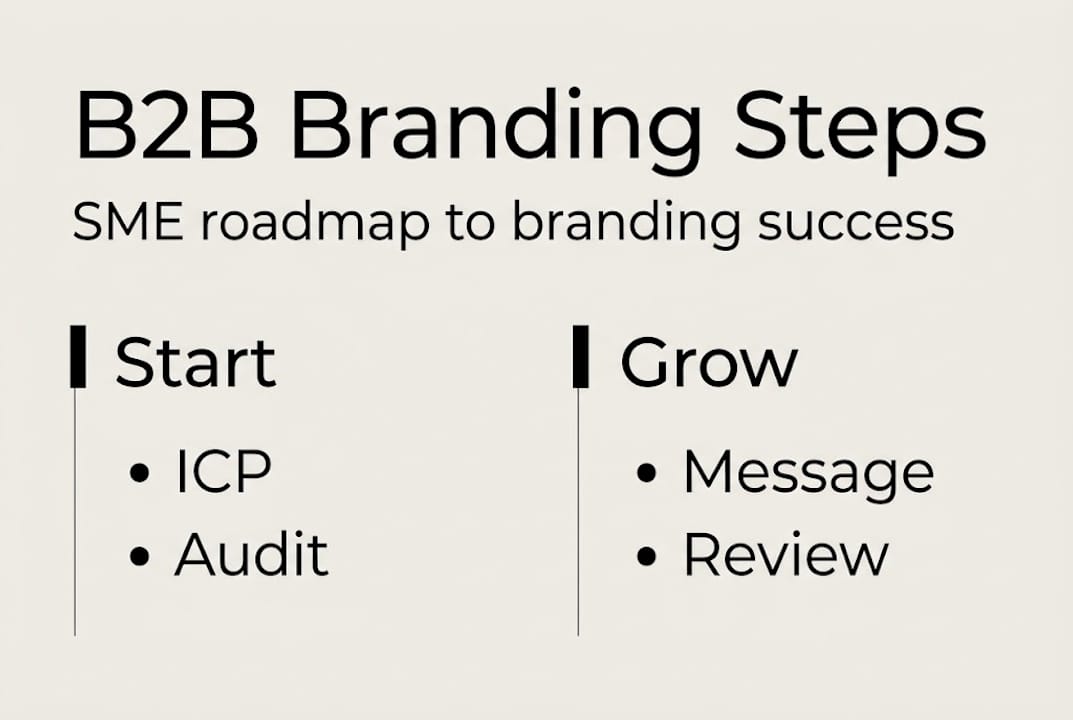
Here are the core steps in order:
Define your ICP and buying committee — Use your research to write a one-page ICP document that your whole team references.
Analyze competitors — Map their strengths, weaknesses, and the positioning territory they own.
Build your positioning statement — Articulate who you serve, what you do, and why you’re different in one or two clear sentences. Learn more about brand positioning for market edge.
Develop your value proposition — Translate positioning into specific, buyer-relevant language that speaks to outcomes, not features.
Define brand personality and tone — Choose three to five adjectives that describe how your brand sounds and feels across every touchpoint.
Build visual identity — Logo, color palette, typography, and imagery style. All rooted in your positioning.
Create messaging frameworks — Taglines, elevator pitches, LinkedIn headlines, and email subject line formulas.
Develop brand guidelines — Document everything so your team executes consistently.
Launch and activate — Roll out across your website, LinkedIn, outreach, and sales decks simultaneously.
Measure and iterate — Set a 90-day review cycle from day one.
One critical modern upgrade: tie brand strategy to buying situations, also called Category Entry Points (CEPs). This means showing up in the specific contexts where buyers are actively thinking about a problem you solve, not just when they’re already comparing vendors.
Traditional approach | Modern (CEP-focused) approach |
Brand awareness campaigns only | Brand linked to specific buying triggers |
One generic value proposition | Messaging adapted to buying stage |
Manual brand tracking | AI-assisted sentiment and share-of-voice tools |
Annual brand refresh | Continuous iteration based on data |
For AI-powered brand tracking and competitive intelligence, explore AI Brand Intelligence Pro to keep your brand sharp in real time.
Pro Tip: Assign a named owner to each step with a deadline. Branding projects without accountability stall at step three almost every time.
Building consistent brand identity and messaging
Positioning is strategy. Identity and messaging are how that strategy shows up in the real world. Once your process steps are underway, the work shifts to making sure your brand looks, sounds, and feels the same everywhere your buyers encounter it.

Start with your visual identity. Your logo, color palette, and typography should all reflect the personality and positioning you defined in step five. These aren’t aesthetic choices. They are trust signals. A buyer who sees a polished, consistent visual identity on your LinkedIn page, your website, and your proposal deck subconsciously registers you as credible and organized.
Here’s what consistent brand identity requires in practice:
A brand style guide that covers logo usage, color codes, font pairings, and image guidelines
Messaging templates for LinkedIn posts, email outreach, case study formats, and sales decks
Tone of voice guidelines that tell your team how to write, not just what to say
A content review process so nothing goes out that breaks the brand standards
Regular audits of your website, social profiles, and sales materials every quarter
The stakes are high. Inconsistent messaging causes 55% of B2B clients to switch vendors. That’s not a branding problem. That’s a retention problem with a branding root cause. On the flip side, consistent branding boosts retention by 23%, which compounds over time as your customer lifetime value grows.
LinkedIn deserves special attention. For B2B SMEs, it’s the highest-leverage channel for brand visibility. Your company page, your leadership team’s personal profiles, and your content cadence all need to reflect the same brand voice. Read our brand identity guide for a deeper look at building identity that holds up at scale.
For practical frameworks on keeping your brand coherent across teams and channels, our guides on brand consistency strategies and cohesive digital identity tips are worth bookmarking.
Measuring, iterating, and avoiding common B2B branding pitfalls
A brand without measurement is just opinion. Once your identity and messaging are live, you need a clear system for tracking what’s working and catching problems before they become expensive.
Start with these baseline KPIs:
Brand awareness: Unaided recall surveys, share of voice in your category
Net Promoter Score (NPS): Tracks how likely clients are to recommend you
Customer Lifetime Value (CLV): Rising CLV signals that your brand is building loyalty
Inbound lead volume: Branded search traffic and direct inbound inquiries
Sales cycle length: Strong brands shorten the time from first contact to closed deal
The financial case for investing in branding is clear. B2B branding ROI averages 5.4:1, with top performers reaching 11:1. That’s not a soft metric. That’s a return that competes with your best-performing paid channels.
“Brand building is a long-term play. Commit 12 to 18 months before drawing conclusions about ROI. SMEs that abandon branding at month four because pipeline hasn’t spiked are measuring the wrong thing at the wrong time.”
The most common pitfalls to watch for:
Short-termism: Expecting branding to produce leads in 60 days and pulling budget when it doesn’t
Copycat branding: Mirroring a competitor’s look and feel instead of owning a distinct position
Neglecting performance marketing: Brand and demand generation work together. Neither replaces the other.
No internal adoption: A brand that sales and customer success teams don’t use is a brand that doesn’t exist
Set a quarterly review cadence. Compare your KPIs to baseline. Adjust messaging, not positioning, unless your market has fundamentally shifted. For a deeper look at connecting brand investment to growth outcomes, explore how to align branding and marketing and review the fundamentals of SME brand strategy and growth.
Our take: What most B2B branding advice gets wrong
Most B2B branding frameworks are built for enterprises with large teams, long timelines, and dedicated brand managers. When SMEs try to apply them directly, the result is a brand that looks borrowed rather than built. Generic advice produces generic brands, and generic brands lose to whoever has the bigger ad budget.
The real opportunity for SMEs is specificity. Your niche, your founder’s voice, and your direct relationships with clients are advantages that no enterprise competitor can replicate. Leading B2B marketers achieve 11% revenue growth compared to just 1% for laggards, and the gap is almost always rooted in how well they connect brand to buyer context, not how much they spend.
We’ve also seen over-reliance on AI tools erode credibility fast. AI can accelerate research, generate first drafts, and track sentiment. But when it replaces strategic thinking, the brand starts to sound like everyone else’s AI-generated brand. Use it as a tool, not a substitute for judgment.
The boldest move most SMEs can make is integrating founder voice into brand content. It builds trust faster than any campaign. Pair that with branding content marketing that speaks directly to your buyer’s specific situation, and you have a brand that earns attention rather than buying it.
Enhance your B2B branding with expert support
Building a B2B brand that drives real pipeline takes more than a style guide. It takes strategic clarity, consistent execution, and the right expertise at each stage of the process.
At LOOM Brand Designs, we work with SME marketing directors who are ready to stop guessing and start building brands that win deals. Our Basic Branding Package is a strong starting point for teams building from the ground up, while the Standard Branding Package covers the full identity and messaging build for growing businesses. If you’re ready for a strategic overhaul that connects brand to your entire digital presence, our Enterprise Website Design & Digital Strategy Consultation gives you the roadmap and the team to execute it.
Frequently asked questions
What is the first step in the B2B branding process?
Prioritize ICP research and competitor audits before anything else. Defining your ideal customer profile and mapping your buying committee gives every downstream branding decision a clear target.
How long does it take to see results from B2B branding?
Plan for 12 to 18 months before drawing firm conclusions. Brand recognition and trust build gradually, and pulling back too early is one of the most common SME mistakes.
What ROI can SMEs expect from branding investments?
Branding ROI averages 5.4:1 across B2B companies, with top-performing brands reaching up to 11:1. These returns grow as brand recognition compounds over time.
How is B2B branding different from B2C branding?
B2B branding prioritizes reputation, relationship continuity, and speaking to multiple decision-makers. B2B buyers prioritize brand reputation and navigate complex approval processes that B2C brands rarely encounter.
Which channels are most effective for SME B2B branding?
LinkedIn is the top channel for B2B SMEs, generating 80% of leads via branded content. Consistent presence on LinkedIn, paired with a strong website, drives the most measurable brand impact.
Recommended
Comments