


Brand strategy for SMEs: growth and market impact explained
- Pawan Samarakoon
- Mar 30
- 8 min read

Most small business owners think branding means picking a logo and choosing a color palette. That belief costs them real money. Brand strategy is actually the long-term plan that defines your company’s identity, purpose, positioning, and market relationships. It shapes every decision you make, from how you price your services to how customers talk about you after they leave. This guide breaks down the full picture of brand strategy for SME owners, with evidence-based frameworks and practical steps you can act on right now.
Table of Contents
Key Takeaways
Point | Details |
Brand strategy definition | Brand strategy is a long-term plan guiding your business identity, purpose, and market positioning. |
Visible impact on growth | Empirical data shows clear brand strategies boost business visibility and financial returns. |
Practical frameworks | SMEs benefit from choosing the right architecture and tracking their brand’s success with tailored metrics. |
Actionable steps | Applying brand strategy principles helps small businesses differentiate and scale consistently. |
Expert support | Partnering with branding professionals accelerates effective strategy implementation for SME owners. |
What is a brand strategy?
A brand strategy is not a mood board or a tagline. It is a roadmap that tells your business where it stands, where it is going, and how it will get there. Think of it as the operating system running underneath every customer interaction, marketing campaign, and product launch.
According to Harvard Business School, a brand strategy defines your company’s identity, purpose, positioning, and the relationships between your brands to differentiate you in the market. That definition matters because it tells you what brand strategy actually does: it guides decisions.
For SMEs, the core components of a brand strategy include:
Brand purpose: Why your business exists beyond making money
Brand positioning: The specific space you occupy in your customers’ minds
Brand architecture: How your products or services relate to each other and to your main brand
Brand voice and visuals: The consistent look, tone, and personality across every touchpoint
Portfolio management: How you plan to grow your offerings over time without losing coherence
The key mechanics of a strong brand strategy include purpose, positioning, architecture models like a branded house or house of brands, portfolio management, and consistent elements like voice and visuals. Each one reinforces the others.
“Your brand is not what you say it is. It is what your customers say it is after every interaction they have with your business.”
If you want to go deeper on building your visual and verbal identity, our brand identity guide walks through every layer. For positioning specifically, the brand positioning guide gives you a step-by-step framework.
Core mechanics of brand strategy for SMEs
Now that you know what brand strategy is, let’s break down its building blocks and show you exactly how each one applies to a small or medium business.
Brand purpose defines why you exist. It is the answer to the question your best customers are really asking: “Why should I trust you?” A clear purpose attracts loyal customers and filters out the wrong ones.
Brand positioning tells the market where you fit. It is not about being the best at everything. It is about owning a specific, credible, and valuable position that competitors cannot easily copy.
Brand architecture organizes your offerings. A branded house puts everything under one master brand (think Apple). A house of brands keeps each product line separate (think Procter and Gamble). Most SMEs benefit from a branded house because it concentrates trust and marketing spend.
Consistency is the multiplier. Every email, social post, invoice, and customer service interaction either builds or erodes your brand. Unified voice and visuals compound over time.
Portfolio management is your long-term lens. As you add services or products, a clear strategy keeps your brand coherent instead of scattered.
The numbers back this up. Clear brand architecture yields 3.5 times more market visibility, 93% of marketers agree long-term branding is essential for growth, and strong brands deliver 2 times the shareholder return compared to weaker ones.
Stat callout: Businesses with clear brand architecture are 3.5x more visible in their market.
Pro Tip: Before you invest in any marketing channel, write a one-page brand strategy document. Include your purpose, your positioning statement, your target customer, and your brand voice. This single page will save you thousands of dollars in wasted ad spend.
Use our branding checklist to audit where your brand stands today. If you want to explore different strategic models, the branding strategies types guide covers the full range.
Brand architecture models: comparison for SMEs
Choosing the right architecture is one of the most important decisions you will make as your business grows. Get it wrong and you confuse customers. Get it right and every new product or service you launch benefits from the trust you have already built.

Brands use architecture frameworks like a branded house or house of brands to scale effectively and clarify market relationships. Here is how the two main models compare for SMEs:
Feature | Branded house | House of brands |
Brand focus | Single master brand | Multiple independent brands |
Marketing spend | Concentrated, efficient | Spread across brands |
Customer trust | Builds fast under one name | Slower, built per brand |
Flexibility | Lower for niche targeting | Higher for diverse markets |
Best for SMEs | Most small businesses | Multi-market or diverse product lines |
Risk | One brand issue affects all | Isolated brand issues |
For most SMEs, the branded house model wins. Your marketing budget is limited, and concentrating every dollar behind one recognizable name builds equity faster. A house of brands makes sense only when your product lines serve completely different audiences with conflicting brand expectations.
“The best brand architecture is the one your customers never have to think about. Clarity is the goal.”
Explore the full range of branding strategy models to find the right fit. For a practical SME-focused breakdown, the branding strategy for SMEs guide goes deeper on implementation.
Measuring brand strategy success: benchmarks and pitfalls
After selecting your architecture, you need to measure whether it is actually working. Many SME owners skip this step and end up guessing.
Success requires resolving strategic tradeoffs early, measuring via visibility, equity, and revenue growth, and adapting your architecture as your business expands. Here are the key metrics to track:
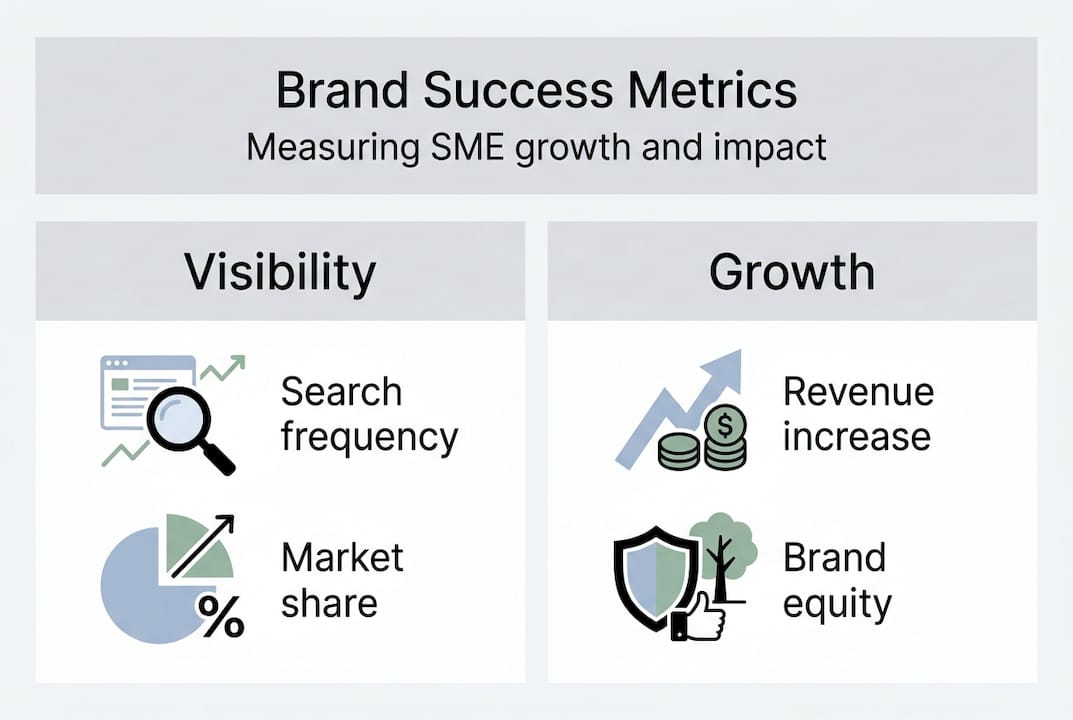
Metric | What it measures | How to track it |
Market visibility | How often your brand appears in searches and conversations | SEO rankings, share of voice tools |
Brand equity | The premium customers will pay for your brand | Price sensitivity surveys, repeat purchase rate |
Revenue growth | Direct business impact of brand investment | Monthly revenue trends, customer lifetime value |
Customer trust | Loyalty and advocacy levels | Net Promoter Score, reviews, referrals |
Strong brands deliver 3.5 times more visibility and 2 times the shareholder return, so these metrics are not vanity numbers. They are leading indicators of real business value.
Common pitfalls to avoid:
Overestimating your uniqueness: Most SMEs think they are more differentiated than their customers do. Test your positioning with real customers before committing.
Lack of coherence: Mixing brand voices across channels confuses customers and weakens trust.
Unresolved tradeoffs: Trying to be premium and budget-friendly at the same time sends mixed signals.
No measurement cadence: Reviewing brand metrics once a year is not enough. Set a quarterly review rhythm.
Pro Tip: Run a simple brand audit every quarter. Ask five recent customers to describe your business in three words. If their answers do not match your intended positioning, you have a gap to close.
For a broader view of performance benchmarks, the branding strategy benchmarks resource is worth bookmarking. Pair it with the digital marketing checklist to align your brand and marketing efforts.
Applying brand strategy: real-world SME scenarios
Theory is useful. Action is what grows your business. Here is a practical process for building and applying your brand strategy as an SME owner.
Step-by-step brand strategy process:
Audit your current brand. Gather all your existing materials, messaging, and customer feedback. Identify gaps between how you present yourself and how customers perceive you.
Define your purpose and positioning. Write a clear positioning statement: “For [target customer], [your brand] is the [category] that [key benefit] because [reason to believe].”
Choose your architecture model. Decide whether a branded house or house of brands fits your current and future offerings.
Build your brand system. Create consistent visual and verbal guidelines covering logo use, color, typography, tone of voice, and messaging.
Activate across channels. Apply your brand consistently across your website, social media, email, packaging, and in-person touchpoints.
Measure and adapt. Use the metrics from the previous section to track progress and refine your approach quarterly.
For USA-based SMEs, local positioning and SEO combined with strategic partnerships deliver high ROI even on small budgets. Local search visibility is often the fastest win for small businesses with limited marketing spend.
One of the most common debates in marketing is brand building versus performance marketing. Research by Binet and Field suggests a 60/40 split is optimal, with 60% of budget on brand building and 40% on performance. The key insight is that all marketing activities build your brand, so avoid treating them as separate silos.
Dos and don’ts for sustainable brand growth:
Do invest in brand before you need it. Brand equity takes time to build.
Do align your team around your brand values so every customer interaction is consistent.
Don’t chase every new marketing trend without filtering it through your brand strategy.
Don’t ignore negative customer feedback. It is free brand research.
For positioning tactics that work at the local level, the brand positioning for SMEs guide is a practical next step. To connect brand strategy with search visibility, explore the local SEO brand strategy resource.
Partner with experts for your brand strategy
Building a brand strategy from scratch takes time, expertise, and the right tools. Most SME owners are already stretched thin running their business, and brand strategy often gets pushed to the back burner until a competitor starts eating into their market share.

At LOOM Brand Designs, we work with small and medium businesses across the USA to build brand strategies that drive real, measurable growth. Whether you are starting from zero or refreshing an existing brand, our basic branding package gives you a solid foundation, while the standard branding package covers the full strategic and visual build-out. Our graphic design services ensure every visual element reinforces your positioning with precision. Let us help you turn your brand strategy into a competitive advantage.
Frequently asked questions
What is the main purpose of a brand strategy for SMEs?
A brand strategy guides how your business communicates, builds trust, and stands out to drive consistent growth. It is the long-term plan that connects your identity, purpose, and positioning into one coherent direction.
How does a strong brand strategy impact small business growth?
Clear brand architecture makes businesses 3.5 times more visible in their market and strong brands deliver 2 times the shareholder return compared to weaker competitors.
What are the main types of brand architecture?
The two main models are a branded house, where one master brand covers all offerings, and a house of brands, where each product line operates as a separate brand. Most SMEs benefit most from the branded house model.
What’s the difference between brand building and performance marketing?
Brand building drives long-term recognition and trust while performance marketing focuses on immediate conversions. Research supports a 60/40 budget split favoring brand building for sustainable growth.
How can a small business measure brand strategy effectiveness?
Track market visibility, brand equity, revenue growth, and customer trust on a quarterly basis, and adapt your architecture as your business expands into new markets or product lines.
Recommended
Comments