


How AI transforms digital marketing: ROI, tools & results
- Pawan Samarakoon
- Mar 29
- 9 min read

87% of enterprises now use AI in digital marketing, and the results are hard to ignore: up to 3.2x ROI and cost reductions reaching 96%. Yet most marketing professionals and small business owners still treat AI as a future investment rather than a present-day advantage. That gap is expensive. This guide cuts through the noise and gives you a clear, practical breakdown of how AI works in digital marketing right now, what results you can realistically expect, which tools to start with, and what pitfalls to avoid before you scale.
Table of Contents
Key Takeaways
Point | Details |
AI boosts ROI fast | AI-driven digital marketing can deliver up to three times the return on investment and cut costs dramatically for brands of all sizes. |
Accessible tools work | Affordable, easy-to-use AI solutions empower small businesses to automate marketing, save time, and boost leads quickly. |
Start small and measure | Beginning with basic applications and tracking results ensures safe, steady progress and proves AI’s impact without high risk. |
Prioritize clean data | Clean, well-organized data is critical for AI success—garbage in will lead to poor or even harmful outputs. |
Trust and governance matter | Ethical use and transparency build long-term customer trust and prevent pitfalls with AI adoption. |
Why AI matters in digital marketing today
Marketing used to run on gut instinct and broad targeting. You picked a demographic, ran a campaign, and hoped the numbers moved. AI flips that model entirely. Instead of guessing, you’re working with real-time data signals that tell you exactly who to reach, when to reach them, and what message will land. That shift alone changes everything about how campaigns are planned and executed.
The business case is no longer theoretical. AI delivers up to 3.2x higher ROI for enterprises and 340% lead increases for small businesses. Those aren’t outlier numbers from tech giants. A local bakery in the US used AI-powered tools and cut costs 50% while doubling ad ROI, saving 10 hours per week in the process. That’s the kind of result that changes how a small team operates.
Here’s what AI is actively doing for marketers right now:
Replacing manual audience segmentation with automated, behavior-based targeting
Personalizing ad creative and email content at scale without extra headcount
Optimizing ad spend in real time so budgets go further
Predicting which leads are most likely to convert before you spend a dollar on them
Generating content drafts, social captions, and campaign copy in minutes
“AI is no longer a competitive edge. It’s the baseline. Brands not using it are competing with one hand tied behind their back.”
If you want to stay current on where this is heading, the 2026 marketing trends shaping the industry show AI at the center of nearly every major shift. And if you’re ready to see what AI-powered insights look like for your specific brand, AI marketing insights can give you a concrete starting point.
Core functions of AI in digital marketing
AI doesn’t do one thing in marketing. It operates across four major functions, each of which delivers measurable value on its own and compounds when combined.
1. Personalization at scale AI analyzes user behavior, purchase history, and browsing patterns to deliver the right message to the right person at the right moment. This isn’t just email subject line tweaks. It’s dynamic landing pages, individualized ad creative, and product recommendations that feel genuinely relevant.
2. Marketing automation Repetitive tasks like scheduling social posts, sending triggered emails, and managing SMS sequences run automatically. Your team focuses on strategy while the system handles execution. Digital marketing automation at this level used to require enterprise budgets. Now it’s accessible to solo operators.
3. Campaign and creative optimization AI runs rapid A/B tests across headlines, images, and calls to action simultaneously. It identifies winners faster than any human team could and reallocates budget toward what’s working. AI can improve conversion rates by 25% compared to traditional approaches.

4. Predictive analytics Instead of reacting to what happened last month, AI forecasts what’s likely to happen next. You can anticipate churn, identify high-value prospects, and time campaigns around predicted buying windows.
Function | Traditional approach | AI-powered approach |
Audience targeting | Manual segmentation | Behavior-based, real-time |
Content creation | Human-only drafting | AI-assisted, personalized |
Ad optimization | Weekly manual review | Continuous automated testing |
Analytics | Historical reporting | Predictive forecasting |
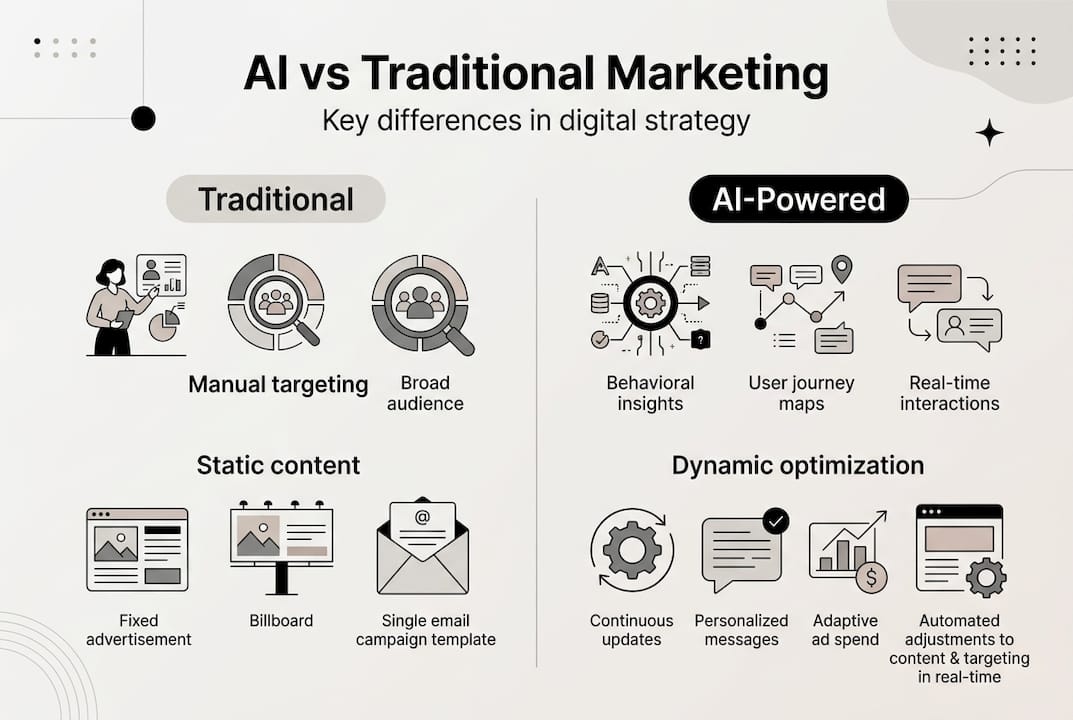
For AI-powered analytics that go beyond surface-level dashboards, the right tools make these functions accessible even without a data science team. Quick wins like automated email, chatbots, and predictive analytics are affordable even for solo businesses.
Pro Tip: Don’t try to implement all four functions at once. Pick the one that addresses your biggest current bottleneck, prove the ROI, then expand.
Proven results: ROI and business impact benchmarks
Numbers tell the story better than any pitch. Here’s what AI-driven marketing actually delivers across business sizes:
Business type | ROI improvement | Cost reduction | Lead increase |
Enterprise | Up to 3.2x | Up to 96% | 30% higher conversions |
Small business (SMB) | 2x ad ROI | 50% cost cut | Up to 340% more leads |
Solo marketer | 10+ hrs/week saved | 50%+ ad spend efficiency | Significant lift |
The US bakery case study is worth examining closely. The owner used ChatGPT for content creation and Google Smart Bidding for ad management. No agency. No large budget. The result was costs halved and leads up 340%. That’s not a fluke. It’s a repeatable framework.
“AI-driven campaigns consistently achieve 25 to 30% better conversion rates than traditional methods, across industries and business sizes.”
For larger organizations, the gains scale differently but remain substantial. Enterprise AI performance benchmarks show that companies integrating AI across their full marketing stack see compounding returns over time, not just one-time lifts. Pairing that with strong AI SEO strategies creates a durable growth engine rather than a short-term spike.
How to use AI in your marketing: Practical steps and best tools
Starting with AI doesn’t require a six-figure tech budget. The most effective entry points are simple, affordable, and fast to implement.
Step-by-step starter plan:
Audit your current workflow and identify the three most time-consuming manual tasks
Set up an AI chatbot on your website to handle FAQs and capture leads around the clock
Use ChatGPT or a similar tool to draft email sequences, social captions, and ad copy
Switch your Google Ads campaigns to Smart Bidding to let the algorithm optimize spend
Connect your CRM to an email automation platform with AI-driven send-time optimization
Track results weekly: time saved, leads generated, cost per acquisition, and conversion rate
For small US businesses, tools like ChatGPT or Google Smart Bidding deliver major gains at under $50 per month. That’s a realistic entry point for any budget.
Key tools worth testing:
ChatGPT or Claude for content drafting and campaign ideation
Google Smart Bidding for automated PPC optimization
Klaviyo or Mailchimp AI for email personalization and automation
ManyChat for chatbot flows on Instagram and Facebook
Canva AI for fast creative production
For a deeper look at how automation fits into a full marketing workflow, AI marketing automation covers the integration side in detail. If personalization is your priority, the AI personalization guide walks through how to build 1:1 experiences at scale. Growing teams should also explore SME AI automation options built specifically for that stage.
Pro Tip: Clean your data before you automate anything. AI amplifies what’s already in your system. Messy contact lists and inconsistent tagging will produce messy results, no matter how good the tool is.
Challenges and cautions: AI bias, trust, and pitfalls
AI is powerful, but it’s not neutral. Every system learns from historical data, and if that data reflects past biases, the AI will scale those biases efficiently. That’s not a hypothetical risk. It’s a documented pattern across ad targeting, content recommendations, and customer scoring models.
Key risks to manage:
Data bias: AI trained on skewed data produces skewed outputs. Audit your training data regularly.
Privacy compliance: CCPA and other US regulations require clear consent and data handling policies. AI tools that process customer data must meet these standards.
Accountability gaps: When an AI makes a bad decision, who owns it? Define governance before you scale.
Consumer skepticism: Only 45% of Gen Z and Millennials view AI ads positively, and that number is trending down. Transparency about AI use is becoming a brand differentiator.
“AI scales flawed data quickly. Liability needs strong governance. Consumer trust is slipping, and brands that ignore this will pay for it.”
The good news is that AI is not intended to replace human marketers. It shifts focus away from admin and toward strategic work. Your judgment, creativity, and ethical standards are what keep AI outputs aligned with your brand values. Understanding the AI marketing pitfalls before you scale is what separates brands that grow sustainably from those that create expensive messes.
Expert strategies for successful AI adoption
The marketers seeing the best results from AI aren’t the ones who moved fastest. They’re the ones who moved smartest. Here’s what field-tested adoption actually looks like:
Pilot before you scale. Run AI on one campaign or channel first. Measure it against your business-as-usual baseline. Only expand when you have proof.
Clean your data first. Best-in-class marketers segment pilot campaigns and focus on clean data before scaling. This is the single most common mistake teams skip.
Balance speed with transparency. Customers notice when something feels off. Be upfront about AI-generated content where it matters.
Review results on a fixed schedule. Monthly at minimum. AI models drift over time and need recalibration.
Focus on trackable wins first. For small brands, affordable personalization and automation with clear metrics build the internal case for bigger investments.
“Governance and trust are more vital than the latest tech. The brands winning with AI aren’t the ones with the biggest tools. They’re the ones with the clearest strategy.”
Staying current on the latest digital marketing trends helps you anticipate where AI is heading next, not just where it is today. And when you’re ready to put a real campaign behind your strategy, AI campaign setup gives you a structured launch path with expert support.
Pro Tip: Set a 90-day AI pilot goal with one specific metric to improve. Vague goals produce vague results. Specific targets create accountability and make it easy to know when something is working.
Take your marketing further with expert-backed AI solutions
You now have the framework. The next step is putting it into motion with the right support behind you. At LOOM Brand Designs, we work with digital marketers and business owners who are ready to move from experimenting with AI to building it into a repeatable growth system. Whether you’re starting from scratch or looking to scale what’s already working, we build strategies around your specific goals, not generic templates.
Explore the AI Brand Insights Starter to get a data-driven read on where your brand stands and where AI can move the needle fastest. If you’re building or refreshing your brand identity alongside your marketing strategy, our branding package gives you a strong visual foundation to work from. And for brands that want to bring campaigns to life with compelling content, our video design services add the creative layer that makes AI-driven campaigns actually convert. Book a no-obligation strategy session and let’s map out what AI-powered marketing looks like for your business.
Frequently asked questions
How does AI increase digital marketing ROI?
AI enables ultra-targeted campaigns, automates repetitive work, and continuously optimizes spend, delivering up to 3.2x ROI and a 30% conversion lift compared to traditional methods.
What is the easiest way for small businesses to start with AI in marketing?
Start with one affordable tool, such as a chatbot or Google Smart Bidding, and track results weekly. Small businesses doubled ad ROI and boosted leads 340% using basic AI tools without large upfront costs.
Are there risks to using AI for customer targeting?
Yes. Poor data quality, privacy gaps, and algorithmic bias can damage brand trust and campaign performance. AI scales both insights and data flaws quickly, so governance must come before speed.
Can AI fully replace human marketers?
No. AI handles routine execution, but strategy, creativity, and brand judgment still require human oversight. AI shifts marketers to higher-value work rather than eliminating the role entirely.
What performance benchmarks should I track with AI-driven marketing?
Focus on ROI versus your traditional baseline, time saved per week, conversion rate, and cost per acquisition. Benchmarks include 3x ROI and measurable hours saved as the clearest indicators of real value.
Recommended
Comments