


Leverage storytelling in branding: engage customers
- Pawan Samarakoon
- Mar 24
- 10 min read

Storytelling in branding is often misunderstood as simply telling stories about your business. Many entrepreneurs believe that sharing anecdotes or company history alone will build their brand. However, effective storytelling functions as a strategic framework that connects your brand identity to customer engagement and business performance. This guide reveals how you can leverage storytelling strategically to differentiate your brand, create emotional connections, and drive measurable results in competitive markets.
Table of Contents
Key Takeaways
Point | Details |
Strategic and tactical storytelling | Storytelling functions as a framework that aligns brand identity with customer engagement and measurable results. |
Positioning links identity and performance | A clear strategic narrative guides tactical messages to build recognition and trust across channels. |
Hero’s Journey adaptation | Entrepreneurs can tailor the framework for both B2C and B2B contexts to resonate with diverse audiences. |
Test stories with experiments | Surveys and A/B tests improve storytelling impact and marketing ROI. |
Small business storytelling | Story driven branding helps small firms forge authentic connections that differentiate them in competitive markets. |
Understanding storytelling’s strategic and tactical roles in branding
Storytelling in branding operates on two distinct but interconnected levels that entrepreneurs must grasp to build effective brand narratives. The strategic dimension positions your brand as an overarching story that shapes every aspect of your messaging, visual identity, and customer experience. This foundational narrative defines who you are, what you stand for, and why customers should care about your business. The tactical dimension involves individual stories you tell about your products, customer successes, company values, or brand journey through specific marketing campaigns and content.
These two levels work together to bridge brand identity and brand performance through clear positioning. Your strategic story provides the consistent framework that guides all tactical storytelling decisions, ensuring coherence across channels and touchpoints. For example, if your strategic brand story positions you as an innovative problem solver for overwhelmed entrepreneurs, your tactical stories might showcase specific client transformations, product innovations, or behind-the-scenes problem-solving processes that reinforce this identity.
Research confirms this dual framework: “Storytelling in branding for SMEs distinguishes strategic (brand as story) and tactical (stories about brand) dimensions, mediating brand identity to performance via positioning.” Understanding this distinction helps you avoid the common mistake of creating disconnected marketing stories that fail to build cumulative brand equity. When your tactical stories consistently express your strategic brand narrative, you create a powerful multiplier effect that strengthens recognition, trust, and customer loyalty over time.
Consider how strategic storytelling differs from tactical execution:
Strategic storytelling defines your brand’s core narrative, values, and positioning that remain consistent over years
Tactical storytelling creates specific campaigns, social media content, or marketing messages that express the strategic story in timely, relevant ways
Strategic elements include your brand archetype, origin story, mission, and unique value proposition
Tactical elements include customer testimonials, product launch stories, seasonal campaigns, and content marketing pieces
Small business owners who master both levels gain significant advantages. Your strategic story provides the authentic foundation that resonates with customers seeking genuine connections, while tactical flexibility lets you respond to market changes and customer needs without losing brand coherence. This approach proves especially valuable for resource-constrained businesses where every marketing dollar must work harder. By aligning all storytelling efforts with a clear strategic framework, you maximize impact while building lasting brand positioning that competitors cannot easily replicate.
Adapting classic story frameworks to small business branding
The Hero’s Journey narrative structure offers entrepreneurs a proven template for crafting compelling brand stories that resonate across different business contexts. Originally identified by mythologist Joseph Campbell, this framework describes a universal story pattern where a hero faces challenges, transforms through trials, and returns with valuable wisdom. You can adapt this framework for both B2C and B2B branding by positioning your customer as the hero and your brand as the guide who helps them succeed.
This adaptation creates powerful emotional engagement because it mirrors the psychological journey your customers actually experience when facing business challenges or personal needs. Instead of making your brand the hero, you acknowledge your customer’s struggles and position your solutions as tools that empower their transformation. This approach builds relatability and trust while avoiding the self-promotional tone that turns customers away.
Here’s how to structure your brand narrative using adapted Hero’s Journey stages:
Ordinary World: Describe the customer’s current situation before discovering your solution, including pain points and limitations they accept as normal
Call to Adventure: Present the opportunity or problem that motivates them to seek change, such as business growth goals or competitive pressures
Meeting the Mentor: Introduce your brand as the knowledgeable guide who understands their challenge and offers proven solutions
Crossing the Threshold: Show the decision point where customers commit to working with you or adopting your solution
Tests and Trials: Acknowledge implementation challenges while demonstrating your support and expertise throughout the process
Transformation: Highlight the tangible results and personal growth customers achieve through your partnership
Return with Wisdom: Show how customers become advocates who share their success and help others in their community
This framework adapts differently for B2C versus B2B contexts. Consumer brands often emphasize emotional transformation and lifestyle benefits, while B2B storytelling focuses on business outcomes, risk mitigation, and measurable ROI. However, both contexts benefit from acknowledging the human element, whether that’s the entrepreneur seeking growth or the consumer pursuing personal goals.

Pro Tip: Test individual story elements with your target audience using A/B tests or customer surveys before committing to a full narrative rollout. This validation prevents costly misalignment between your intended message and actual customer perception.
The synergy between story frameworks and brand archetypes deepens customer connection. If your brand embodies the Sage archetype, your Hero’s Journey narrative might emphasize knowledge transfer and wisdom gained. A Rebel archetype brand would frame the journey as breaking conventions and challenging the status quo. This alignment ensures consistency between your strategic brand identity and tactical storytelling execution, reinforcing the authentic personality that attracts your ideal customers.
Understanding the customer journey alongside your brand story creates additional opportunities for strategic touchpoints. Each stage of your customer’s decision process can feature story elements that address specific concerns, build trust, and move them toward conversion while maintaining narrative coherence.
Practical approaches to testing and refining brand stories
Untested storytelling represents a significant risk for small businesses with limited marketing budgets. Stories that fail to resonate waste resources and can even damage brand perception if they misalign with customer values or expectations. Entrepreneurs who prioritize testing gain crucial insights that transform good stories into exceptional brand assets that drive measurable engagement and conversion.
Several practical methods let you validate storytelling effectiveness before full deployment. A/B testing compares different story versions across email campaigns, landing pages, or social media ads to identify which narratives generate better response rates. Customer surveys gather qualitative feedback about story resonance, clarity, and emotional impact. Focus groups provide deeper exploration of how target audiences interpret your brand narratives and what elements create the strongest connections.
Each testing method offers distinct advantages and limitations:
Testing method | Best for | Typical cost | Time required | Key limitation |
A/B testing | Quantifying story performance on specific metrics | Low to moderate | 2 to 4 weeks | Requires sufficient traffic volume for statistical significance |
Online surveys | Gathering broad feedback on story elements | Low | 1 to 2 weeks | Response quality depends on question design and incentives |
Focus groups | Deep qualitative insights on story interpretation | Moderate to high | 2 to 3 weeks | Small sample size limits generalizability |
Social listening | Understanding organic reactions to story themes | Low | Ongoing | Indirect feedback requires interpretation |
Analytics review | Measuring engagement with story-driven content | Very low | Ongoing | Shows behavior but not underlying motivations |
Pro Tip: Use AI-powered brand intelligence platforms to analyze customer sentiment, identify story themes that resonate, and uncover gaps between your intended narrative and audience perception across multiple channels simultaneously.
Interpreting feedback requires looking beyond surface reactions to understand underlying patterns. If customers consistently misunderstand a story element, the problem likely lies in clarity rather than audience comprehension. When emotional responses fall flat, examine whether your narrative authentically reflects your brand values or relies on generic appeals. Strong negative reactions to specific story components signal potential misalignment with customer expectations or values that requires immediate adjustment.
Iteration transforms testing insights into storytelling improvements. Start with small refinements to underperforming elements rather than complete narrative overhauls. Test adjusted versions against your original baseline to measure improvement. Document what works and why, building a knowledge base that informs future storytelling decisions. This systematic approach compounds over time, continuously strengthening your brand narrative’s effectiveness.
The role of data in refining brand stories continues expanding as analytics tools become more sophisticated. Modern platforms track not just whether customers engage with story-driven content, but how they move through narratives, where they lose interest, and which story elements correlate with conversion actions. Smart entrepreneurs leverage these insights to create increasingly targeted, effective brand storytelling that delivers measurable business results.
Leveraging storytelling to differentiate and emotionally connect with customers
Effective storytelling creates emotional bonds that transform casual customers into loyal brand advocates. These connections stem from authentic narratives that reflect shared values, acknowledge customer challenges, and demonstrate genuine understanding of their aspirations. Research shows that storytelling mediates brand identity to performance through positioning, making it especially critical for small and medium enterprises competing against larger competitors with bigger advertising budgets.
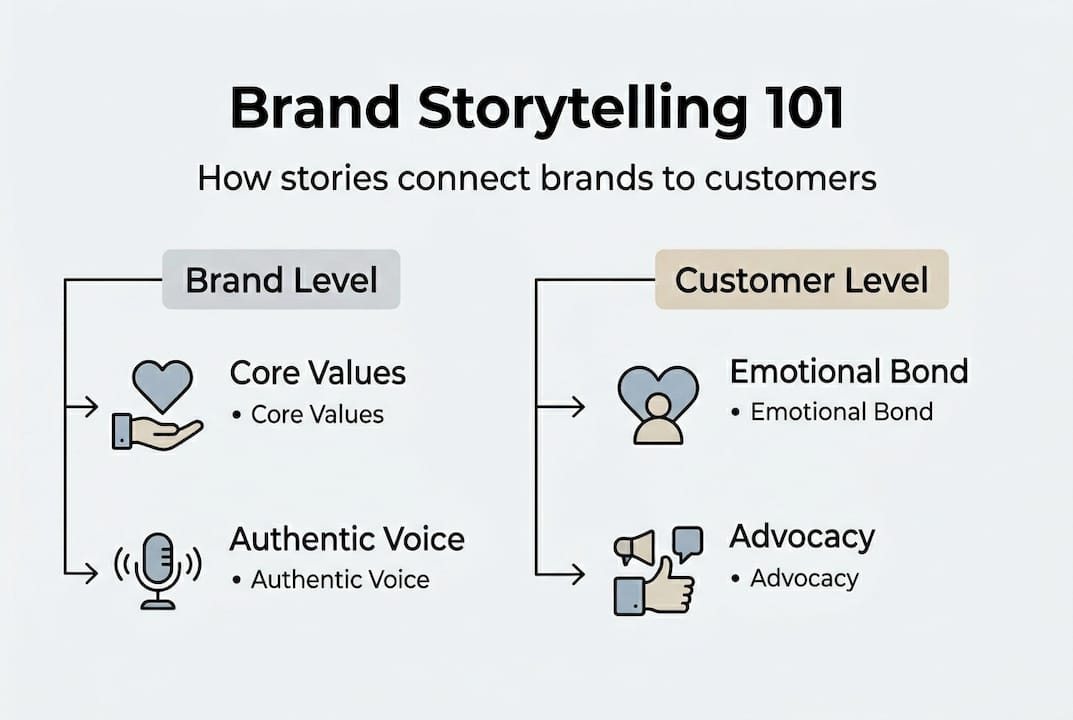
Emotional connection serves as the foundation for customer loyalty because purchasing decisions involve far more than rational feature comparisons. When your brand story resonates at an emotional level, customers feel understood, validated, and aligned with your mission. This psychological investment makes them more likely to choose your solutions repeatedly, forgive occasional missteps, and recommend your business to others facing similar challenges.
The contrast between storytelling-driven and non-story-driven branding reveals significant performance differences:
Branding approach | Customer engagement | Brand recall | Loyalty and retention | Differentiation | Emotional connection |
Storytelling-driven | High interaction with content, social sharing, active community participation | Strong recognition through memorable narratives and consistent themes | Repeat purchases, referrals, brand advocacy | Clear positioning through unique narrative identity | Deep emotional bonds based on shared values and authentic communication |
Non-story-driven | Passive consumption, transactional interactions, limited engagement | Weak recall based primarily on visual identity or product features | Price-sensitive behavior, easy switching to competitors | Commodity positioning vulnerable to feature comparison | Minimal emotional investment, purely functional relationships |
Small businesses gain specific advantages through strategic storytelling implementation:
Increased trust through authentic narratives that showcase real expertise, values, and customer commitment
Memorable brand experiences that help customers remember and recommend your business over competitors
Stronger customer relationships built on emotional connection rather than transactional exchanges
Competitive differentiation that positions you uniquely even in crowded markets
Higher perceived value that justifies premium pricing compared to commodity alternatives
Storytelling positions brands uniquely by highlighting what makes you different at a fundamental level. Rather than competing solely on features, price, or convenience, story-driven positioning emphasizes your distinctive perspective, values, and approach to solving customer problems. This creates defensible market space that competitors cannot easily replicate because authentic stories emerge from your genuine business identity and experience.
Consider how successful brands use storytelling for differentiation. A local coffee roaster might share stories about direct relationships with farmers, sustainable sourcing practices, and the craft of roasting that transforms raw beans into exceptional coffee. These narratives differentiate them from commodity coffee brands while creating emotional connections with customers who value craftsmanship, sustainability, and authentic relationships. The stories provide reasons to care beyond caffeine delivery, building loyalty that survives price competition and market changes.
Your branding strategy should integrate storytelling at every customer touchpoint, from initial discovery through post-purchase engagement. Consistency across these interactions reinforces your narrative identity while giving customers multiple opportunities to connect emotionally with your brand. Visual storytelling through graphic design amplifies narrative impact by creating memorable imagery that supports and extends your verbal stories.
Enhance your brand storytelling with expert design services
Building a compelling brand story requires more than words. You need visual identity, strategic positioning, and consistent execution across all customer touchpoints to bring your narrative to life effectively. LOOM Brand Designs specializes in helping entrepreneurs transform strategic storytelling concepts into tangible brand assets that drive engagement and business growth.

Our Basic Branding Package provides the foundational elements you need to express your brand story visually, including logo design, color palettes, and typography that reflect your narrative identity. For businesses ready to leverage advanced insights, our AI Brand Intelligence Enterprise solution analyzes customer sentiment, tests story themes, and uncovers opportunities to refine your brand narrative based on real market data. Our graphic design services create story-driven marketing materials that consistently reinforce your brand identity across digital and print channels.
Key benefits of partnering with brand storytelling experts:
Strategic guidance that aligns your story with business goals and target audience values
Professional design execution that brings your narrative to life through cohesive visual identity
Data-driven insights that validate story effectiveness and identify optimization opportunities
Consistent brand expression across all marketing channels and customer touchpoints
Explore our comprehensive branding packages to discover how professional storytelling support can elevate your small business brand and create lasting customer connections that drive sustainable growth.
Frequently asked questions
What is the difference between strategic and tactical storytelling in branding?
Strategic storytelling defines your brand’s overarching narrative that shapes identity, values, and positioning consistently over time. Tactical storytelling creates specific marketing stories about products, customers, or campaigns that express the strategic narrative in timely, relevant ways. Both levels work together to build cohesive brand equity, with strategic elements providing the foundation and tactical stories delivering flexible, responsive marketing execution.
How can small businesses adapt the Hero’s Journey for their brand story?
Simplify the Hero’s Journey stages to focus on customer challenges and your brand’s role as a guide rather than hero. Position your customer as the protagonist facing obstacles, with your business providing tools, expertise, and support for their transformation. Test narrative elements with target audiences through surveys or A/B tests to ensure resonance before full implementation across marketing channels.
What are effective methods to test brand storytelling?
A/B testing compares story versions across emails, landing pages, or ads to measure performance differences. Customer surveys gather qualitative feedback about story clarity, emotional impact, and alignment with values. Focus groups provide deeper exploration of how audiences interpret narratives. Digital analytics and social listening tools reveal engagement patterns and sentiment around story-driven content, enabling data-informed refinement.
Why does storytelling create stronger customer loyalty than feature-based marketing?
Storytelling builds emotional connections by acknowledging customer challenges, reflecting shared values, and demonstrating genuine understanding of their aspirations. These psychological bonds create investment beyond rational feature comparisons, making customers more likely to choose your brand repeatedly, forgive occasional issues, and recommend your business to others. Emotional engagement transforms transactional relationships into lasting partnerships.
How does storytelling help small businesses compete against larger competitors?
Authentic narratives showcase the unique perspective, values, and customer commitment that differentiate small businesses from corporate competitors. Story-driven positioning creates defensible market space based on genuine identity rather than features or price alone. This emotional differentiation levels the playing field by highlighting advantages like personalized service, local expertise, or mission-driven values that resonate with customers seeking meaningful brand relationships.
Recommended
Comments