


Master graphic design in marketing: 650% engagement boost
- Pawan Samarakoon
- Mar 21
- 9 min read

Posts with images generate 650% higher engagement than text-only posts, yet many marketing professionals still underestimate design’s role in campaign success. Graphic design isn’t just decoration; it’s a strategic tool that shapes customer perception, drives brand differentiation, and delivers measurable business results. This guide reveals practical strategies to leverage graphic design effectively for superior brand messaging and customer engagement, from understanding psychological triggers to navigating 2026 design trends and implementing data-driven visual strategies that convert.
Table of Contents
Key Takeaways
Point | Details |
Images boost engagement | Posts with images generate 650% higher engagement than text-only posts across digital platforms. |
Brand differentiation | Design investment differentiates brands from competitors and strengthens perceived value. |
Visual branding boosts revenue | Consistent visual branding increases revenue by creating memorable customer touchpoints. |
Track design ROI | Track engagement metrics before and after design improvements to quantify ROI. |
Why graphic design is essential in modern marketing
Graphic design drives tangible business outcomes that directly impact your bottom line. Marketing campaigns incorporating visual elements consistently outperform text-only approaches, with 73% of companies investing in design specifically to differentiate their brand from competitors. This investment reflects a fundamental shift in how businesses approach customer engagement.
The numbers tell a compelling story about design’s marketing power:
Visual posts generate 650% higher engagement than text-only content across digital platforms
Design-driven companies report significantly higher success rates in achieving marketing objectives
Consistent visual branding increases revenue by creating memorable customer touchpoints
Professional design elements reduce bounce rates and improve conversion metrics
These statistics reveal why digital marketing essentials now prioritize visual strategy alongside content and SEO. Design isn’t an optional enhancement; it’s the foundation of effective brand communication.
Consider the competitive landscape. When potential customers scroll through feeds saturated with content, visual design determines which messages capture attention and which disappear into the noise. Your brand’s visual identity serves as an instant recognition signal, communicating professionalism, values, and differentiation before a single word is read.
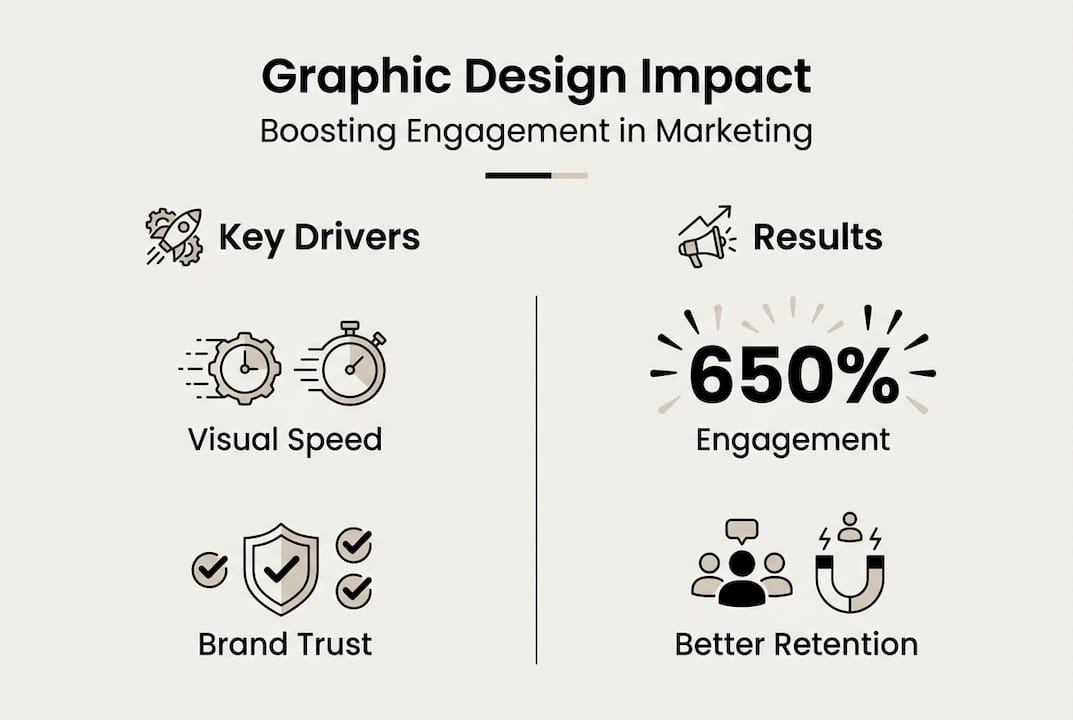
The business case extends beyond engagement metrics. Strategic design investment correlates with improved customer retention, higher perceived value, and stronger emotional connections to brands. Companies that treat design as a core marketing function rather than an afterthought consistently outperform competitors in customer acquisition and loyalty metrics.
Pro Tip: Track engagement metrics before and after design improvements to quantify ROI. Compare click-through rates, time on page, and conversion rates between generic versus professionally designed marketing materials to build your internal business case for design investment.
Modern consumers process visual information 60,000 times faster than text, making design your first and often most important marketing message. This cognitive reality shapes how customers perceive and interact with your brand across every touchpoint.

How graphic design influences consumer perception and behavior
Graphic design operates on psychological principles that guide customer attention and decision-making in predictable patterns. Eye-tracking studies show design elements influence gaze patterns and preferences, revealing how visual hierarchy steers customers toward specific information and actions.
Visual hierarchy creates a roadmap for customer attention. Size, color contrast, whitespace, and positioning direct eyes to key messages in a predetermined sequence. When you understand these patterns, you can architect customer journeys through your marketing materials, ensuring critical information receives attention while secondary details support without overwhelming.
Design impacts purchasing decisions through multiple psychological mechanisms:
Color psychology triggers emotional responses that influence brand perception and buying intent
Typography communicates brand personality and affects readability and trust
Layout patterns guide eye movement toward calls-to-action and key value propositions
Imagery creates aspirational connections and product understanding
These elements work together to shape subconscious preferences. Customers form opinions about your brand’s credibility, quality, and relevance within milliseconds of visual exposure. This snap judgment occurs before rational evaluation begins, making design your primary tool for creating positive first impressions.
Packaging and advertising design particularly demonstrate this influence. Studies consistently show that visual presentation affects perceived product quality, value, and desirability independent of actual product attributes. Two identical products presented with different design treatments generate dramatically different customer responses and willingness to pay.
The visual branding process leverages these psychological triggers systematically. Strategic color selection, consistent typography, and deliberate imagery choices create cohesive brand experiences that build recognition and trust over time.
Pro Tip: Map your customer journey and identify key decision points where visual design can reduce friction or highlight value. Apply visual hierarchy principles at these critical moments to guide customers toward desired actions while maintaining a natural, uncontrived experience.
Accessibility considerations amplify design’s impact. Inclusive design that accounts for color blindness, visual impairments, and cognitive differences expands your addressable audience while improving usability for all customers. Clear contrast, readable fonts, and intuitive layouts benefit everyone, not just those with specific accessibility needs.
Understanding these psychological foundations prepares you to evaluate emerging design trends strategically rather than following them blindly.
Navigating graphic design trends in marketing for 2026
Design trends in 2026 present a strategic choice between established minimalism and emerging maximalist approaches, each offering distinct advantages for brand differentiation and customer engagement. The shift to maximalist utility and decorative typography improves brand recall by creating memorable visual friction that stands out in saturated markets.
Design Approach | Strengths | Considerations |
Minimalism | Clean, professional, fast-loading, accessible | Risk of appearing generic, limited differentiation |
Maximalism | Distinctive, memorable, emotionally engaging | Requires careful execution to avoid overwhelming |
Decorative Typography | Strong personality, instant recognition | Must balance creativity with readability |
Hybrid Approaches | Combines clarity with originality | Demands sophisticated design expertise |
Minimalism dominated the past decade by offering clarity, fast load times, and universal accessibility. However, as minimalist design became ubiquitous, it paradoxically reduced differentiation. When every brand adopts similar clean aesthetics, visual identity blurs and brand recall suffers.
Maximalist and decorative approaches counter this homogenization by embracing visual complexity, bold color combinations, and expressive typography. These techniques create cognitive friction that aids memory formation. Customers remember distinctive visual experiences more readily than safe, predictable designs.
The key trends shaping 2026 marketing design include:
Decorative and experimental typography that communicates brand personality instantly
Layered visual compositions that reward attention and create depth
Bold color palettes that break from safe, corporate neutrals
Custom illustrations and graphics that replace generic stock imagery
Animated and interactive elements that engage rather than simply inform
These trends reflect a broader shift toward originality as a competitive advantage. Generic design, regardless of technical execution quality, fails to create the memorable brand experiences that drive customer loyalty and word-of-mouth marketing.
Your branding strategy for 2026 should evaluate these trends through your specific brand personality and target audience preferences. A law firm and a creative agency require fundamentally different visual approaches, even when both aim for distinctiveness.
Pro Tip: Test trend adoption incrementally rather than overhauling your entire visual identity overnight. Introduce maximalist elements in social media graphics or email headers while maintaining core brand consistency, then measure engagement and feedback before broader implementation.
Accessibility remains non-negotiable regardless of aesthetic choices. Decorative typography must maintain readability standards. Bold colors require sufficient contrast for visibility. Visual complexity should enhance rather than obscure key messages and calls-to-action.
The most successful 2026 design strategies balance innovation with usability, creating distinctive visual identities that remain functional across devices, platforms, and customer contexts. This balance requires intentional design thinking rather than trend-chasing.
Applying graphic design strategies for effective brand messaging and engagement
Implementing graphic design strategically requires understanding your audience’s psychographics and systematically testing visual elements to optimize engagement and conversion. Visual hierarchy and psychographics enable targeted engagement when combined with A/B testing and personalization.
Follow this systematic approach to leverage design for measurable marketing results:
Identify target audience psychographics including values, aspirations, pain points, and visual preferences through surveys, interviews, and behavioral data analysis
Develop visual brand guidelines that align design choices with audience preferences while maintaining authentic brand personality and differentiation
Implement A/B testing protocols for key visual elements including color schemes, typography, imagery styles, and layout patterns across landing pages and campaigns
Personalize visual content based on customer segments, using dynamic design elements that adapt to individual preferences and behavioral patterns
Design sales collateral that reinforces brand identity consistently across touchpoints from social media graphics to presentation decks and email templates
Analyze performance metrics regularly to identify which design elements drive engagement, conversion, and retention, then iterate based on data
Psychographic targeting transforms generic design into precision marketing tools. Understanding whether your audience values innovation versus tradition, simplicity versus sophistication, or emotion versus logic guides every design decision from color psychology to imagery selection.
A/B testing removes guesswork from design effectiveness. Test button colors, headline treatments, image selections, and layout variations systematically. Small visual changes often produce surprisingly large engagement differences. Document results to build institutional knowledge about what resonates with your specific audience.
AI-powered hyper-personalization enables dynamic visual adaptation at scale. Modern marketing platforms can serve different design variations to customer segments automatically, optimizing visual experiences based on behavior, demographics, and preferences without manual intervention.
Sales collateral design deserves particular attention. Presentation decks, one-pagers, case studies, and proposal templates represent critical customer touchpoints where professional design directly impacts conversion. Consistent, polished visual treatment across these materials builds credibility and reinforces brand positioning.
Pro Tip: Create a design decision matrix that maps specific visual elements to desired customer emotions and actions. When choosing between design options, reference this matrix to ensure aesthetic choices serve strategic objectives rather than personal preferences.
Accessibility testing should accompany A/B testing. Ensure design variations meet WCAG standards for contrast, readability, and navigation. Inclusive design expands your audience while improving overall usability and user experience.
Measurement completes the strategic design cycle. Track engagement metrics, conversion rates, time on page, bounce rates, and customer feedback for each design implementation. Quantify design’s impact on business objectives to justify continued investment and refinement.
Leverage expert graphic design services from LOOM Brand Designs
Transforming design strategy into execution requires expertise that balances creativity with marketing effectiveness. Professional graphic design services elevate your brand messaging by applying proven visual principles tailored to your specific audience and business objectives.
LOOM Brand Designs specializes in creating impactful visual solutions that drive measurable engagement and differentiation. Our professional graphic design services combine strategic thinking with creative execution to deliver marketing materials that capture attention and convert.
Whether you need comprehensive brand identity development or targeted campaign graphics, our packages scale to your requirements. The basic branding package provides essential visual foundations for emerging businesses, while the standard branding package delivers complete visual systems for established brands seeking differentiation.
Our approach integrates the psychographic targeting, trend awareness, and testing methodologies outlined throughout this guide. We don’t just create beautiful designs; we build visual strategies that align with your marketing objectives and resonate with your specific audience.
Frequently asked questions
What role does graphic design play in brand recognition?
Consistent graphic design creates memorable visual cues that enhance brand recognition through repeated exposure across customer touchpoints. Color schemes, typography, logo placement, and imagery styles combine to form a distinctive visual signature that customers associate with your brand. This consistency builds familiarity and trust over time, making your brand instantly recognizable even without reading accompanying text.
How can marketers measure the effectiveness of graphic design in campaigns?
Use engagement rates, A/B testing results, and customer feedback to quantify design effectiveness across marketing channels. Track metrics including click-through rates, time on page, conversion rates, social media engagement, and bounce rates before and after design implementations. Compare performance between design variations systematically to identify which visual elements drive desired customer actions and business outcomes.
Should businesses prefer minimalist or maximalist graphic design approaches?
Choice depends on brand personality and target market preferences, with 2026 trends favoring originality balanced with clarity. Minimalism works well for brands emphasizing simplicity, efficiency, and professionalism, while maximalism suits brands showcasing creativity, energy, and boldness. Most successful strategies blend approaches, using clean layouts for usability while incorporating distinctive visual elements for memorability and differentiation.
What are the benefits of integrating AI with human graphic design?
AI-human design collaboration enhances innovation and relevance in marketing visuals by combining computational efficiency with creative intuition. AI tools accelerate repetitive tasks, generate design variations for testing, and personalize visual content at scale, while human designers provide strategic direction, emotional intelligence, and brand consistency. This partnership allows designers to focus on high-level creative strategy while AI handles execution and optimization.
What practical tips should business owners follow when leveraging graphic design?
Understand audience psychographics to guide design choices that resonate emotionally and practically with your target customers. Prioritize accessibility by ensuring sufficient contrast, readable typography, and intuitive navigation that serves all users regardless of abilities. Embrace distinctiveness through original visual elements that differentiate your brand from competitors while maintaining consistency across touchpoints. Test designs consistently using A/B testing and performance metrics to validate effectiveness and guide iterative improvements based on data rather than assumptions.
Recommended
Comments