


Strategic role of logos in branding success
- jayanipiumika
- Mar 8
- 11 min read

A logo isn’t just a pretty symbol. It’s your brand’s visual cornerstone, capable of increasing brand recognition by up to 80%. For entrepreneurs and small business owners, understanding how logos strategically shape brand identity and drive measurable business outcomes transforms them from decorative elements into powerful competitive assets. This article reveals the strategic importance of logos and how to leverage them effectively.
Table of Contents
Key takeaways
| Point | Details | |-------|---------|| | Logos boost brand recognition and trust | Well-designed logos increase recognition by 80% and improve customer trust through consistent visual identity. | | Design simplicity improves memorability | Simple logos are recalled 60% more accurately than complex designs, enhancing brand recall. | | Logos require comprehensive brand strategy | A logo alone doesn’t build a brand; it must integrate with messaging, customer experience, and marketing. | | Professional logos impact business metrics | Quality logos retain 25% more customers and can increase inquiries by 30% after redesigns. | | Strategic alignment drives effectiveness | Logos aligned with brand personality and cultural relevance strengthen emotional connections and loyalty. |
Introduction to logos in branding
Logos serve as the visual cornerstone of your brand identity. They distill complex brand values, personality, and promises into a single recognizable mark that customers instantly associate with your business. This visual shorthand creates powerful mental connections that drive purchasing decisions and build long-term loyalty.
Strong logos deliver measurable results. Research shows that logos increase brand recognition by up to 80%, making them essential investments for entrepreneurs building competitive brands. This recognition advantage translates directly into customer acquisition and retention.
The strategic importance of logos extends beyond aesthetics. They function as the foundation for your entire visual identity system, from business cards to digital platforms. When integrated effectively with branding and digital media marketing, logos become powerful tools that differentiate you from competitors and communicate your unique value proposition instantly.
Key strategic functions logos perform:
Create immediate visual recognition across all customer touchpoints
Communicate brand personality and core values without words
Establish professional credibility and market legitimacy
Anchor visual consistency throughout marketing materials
Support brand archetypes and personas that drive emotional connections
Understanding these foundational roles helps entrepreneurs move beyond viewing logos as decorative elements and recognize them as strategic business assets that require thoughtful investment and execution.
How logos influence consumer perception and trust
Logos create instant psychological impressions that shape how customers perceive your brand’s quality, reliability, and values. These first impressions happen unconsciously within milliseconds, making logo design a critical factor in winning customer attention and trust.

Color psychology plays a dominant role in perception. Studies reveal that 90% of first impressions are based on logo color, making color selection a strategic decision rather than an aesthetic preference. Colors trigger emotional responses: blue conveys trust and stability, red creates urgency and excitement, green suggests sustainability and growth.
Alignment between logo design and brand personality generates measurable trust benefits. Research indicates that logos strategically aligned with brand personality increase trust by 40% compared to misaligned designs. This alignment creates cognitive ease, where customers intuitively feel your brand “fits” their expectations and values.
Simplicity dramatically improves recall and recognition. Simple logos are recalled 60% more accurately than complex designs because human brains process clean, uncluttered visuals more efficiently. This recall advantage means customers remember your brand when making purchasing decisions, even in crowded markets.
Pro Tip: Test your logo at multiple sizes from business cards to billboards. If details disappear or become unclear at small sizes, simplify the design to maintain recognition across all applications.
Emotional connections drive loyalty. Logos that resonate emotionally create stronger customer relationships than purely functional designs. When customers feel understood and aligned with your brand values through visual identity, they become advocates who recommend your business organically.
Consistent logo usage across touchpoints builds credibility:
Reinforces brand memory through repeated exposure
Signals professionalism and attention to detail
Creates cohesive brand experience across channels
Reduces cognitive load for customers recognizing your brand
Investing in strategic logo design through services like the brand foundation SEO starter ensures your visual identity builds trust and recognition from day one.
Common misconceptions about logos and branding
Many entrepreneurs overestimate what logos accomplish independently while underestimating the strategic integration required for branding success. Clearing these misconceptions prevents wasted investment and sets realistic expectations.
The biggest myth: a logo alone builds your brand. This belief causes entrepreneurs to invest heavily in logo design while neglecting messaging, customer experience, and marketing strategy. As experts emphasize, a logo alone does not build a brand; it functions as one element within a comprehensive brand strategy. Your brand lives in customer experiences, interactions, and perceptions shaped by every touchpoint.
Another common mistake underestimates logo consistency importance. Entrepreneurs frequently modify logos for different platforms or campaigns, thinking flexibility demonstrates creativity. This inconsistency confuses customers and dilutes brand recognition. Professional brands maintain strict logo usage guidelines ensuring visual identity remains cohesive across all applications.
Some view logos as purely decorative visuals rather than strategic communication tools. This misconception leads to design choices prioritizing personal preferences over audience resonance and business objectives. Effective logos communicate specific brand attributes and values that align with target customer expectations and industry positioning.
Brand equity requires comprehensive efforts:
Consistent messaging reinforcing brand promises
Quality customer experiences validating brand claims
Strategic marketing building awareness and preference
Visual identity supporting recognition and recall
DIY and inconsistent logo pitfalls hurt businesses. Generic template logos fail to differentiate brands in competitive markets, while inconsistent application across platforms creates fragmented brand perception. These shortcuts save money initially but cost significantly more in lost recognition and credibility over time.
Investing in professional solutions like the basic branding package ensures your logo integrates strategically within a comprehensive brand identity system. This foundation approach prevents common pitfalls and builds sustainable brand equity from the start.
Design elements that determine logo effectiveness
Specific visual and strategic design choices directly impact how well logos perform in driving brand recognition, trust, and business outcomes. Understanding these elements helps entrepreneurs make informed decisions about logo investments.
Simplicity and versatility reign supreme. Simple, adaptable shapes increase recall by 60% compared to complex designs because they remain recognizable across diverse applications. Your logo must work equally well on a tiny mobile screen, large billboard, embroidered shirt, or black and white document. Complexity limits versatility and reduces effectiveness.
Color psychology strategically influences perception. Beyond aesthetics, colors trigger specific emotional and cognitive responses that shape brand associations. Blue builds trust and professionalism, making it popular for financial and healthcare brands. Red creates urgency and excitement, favored by food and entertainment companies. Green suggests health and sustainability, appealing to eco-conscious consumers.
Cultural relevance enhances local connection and loyalty. Research shows that culturally relevant logos boost local brand loyalty by 18%, demonstrating how cultural awareness drives business results. Symbols, colors, and design styles carry different meanings across cultures, making cultural research essential for brands serving diverse or international markets.
Professional design elevates perceived brand quality. Customers unconsciously assess business credibility based on visual presentation. Amateur or generic logos signal low quality, reducing trust and purchase intent. Professional logos communicate competence, stability, and attention to detail that customers associate with reliable businesses.
Design Element | Impact on Effectiveness | Implementation Consideration |
Simplicity | 60% better recall | Remove unnecessary details, focus on core concept |
Color Psychology | 90% of first impressions | Align colors with brand personality and industry expectations |
Cultural Relevance | 18% higher local loyalty | Research cultural meanings and preferences in target markets |
Professional Quality | Increases perceived credibility | Invest in experienced designers who understand strategic branding |
Versatility | Maintains recognition across applications | Test logo at multiple sizes and in different contexts |
Pro Tip: Create a simple litmus test by printing your logo in black and white at thumbnail size. If the design remains recognizable and distinctive without color or detail, it demonstrates strong foundational design that will perform effectively across all applications.
Balancing design complexity with adaptability requires strategic thinking. Some industries benefit from detailed, ornate logos conveying heritage or craftsmanship. Others need minimalist marks optimizing digital visibility and modern appeal. Understanding your market context and customer expectations guides appropriate design complexity.
Quantifying the business impact of logos
Logos generate measurable business outcomes that justify branding investments. Data demonstrates how strategic visual identity directly affects customer behavior, marketing performance, and revenue growth.
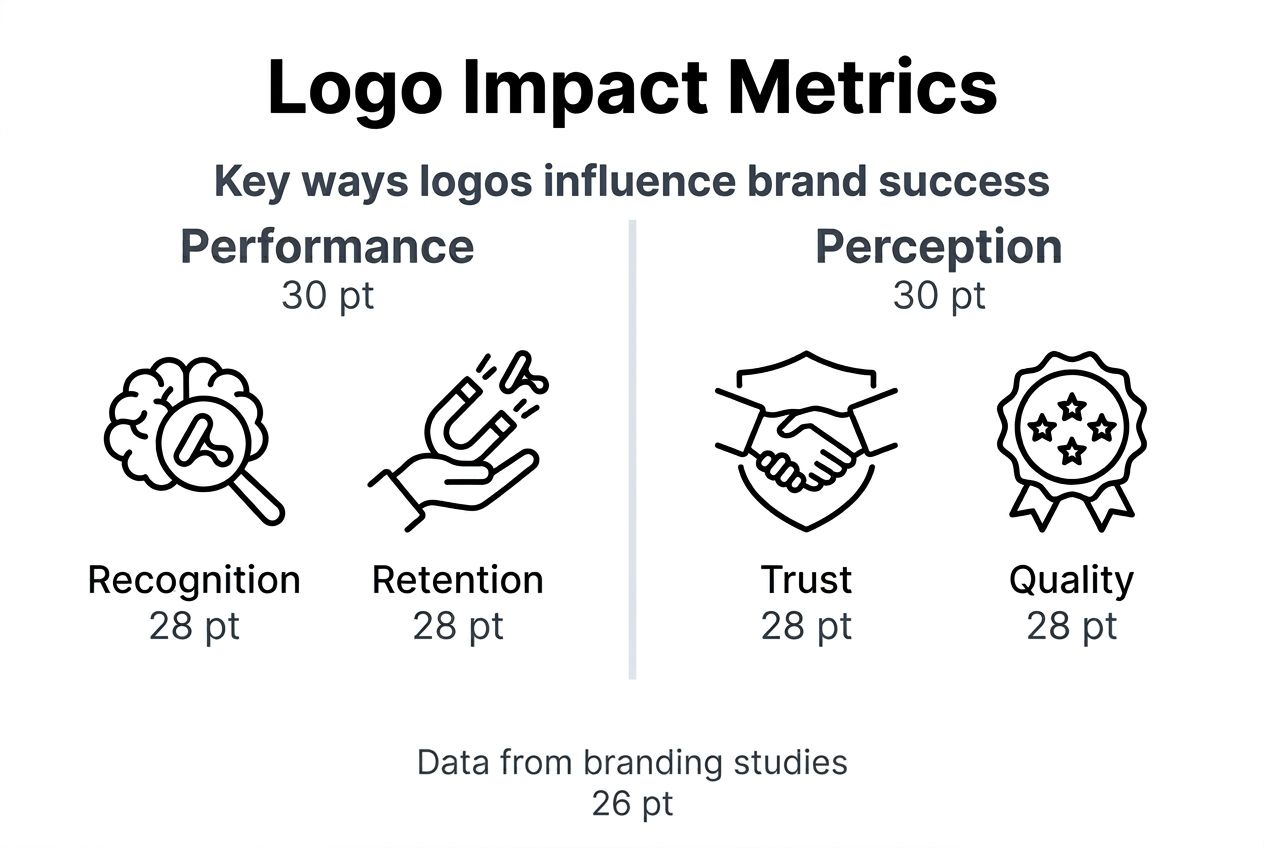
Customer retention improves significantly with professional logos. Businesses with well-designed, consistently applied logos retain 25% more customers compared to those with amateur or inconsistent visual identities. This retention advantage compounds over time, reducing acquisition costs and increasing customer lifetime value.
Logo redesigns can trigger substantial inquiry increases. Companies investing in strategic logo updates report inquiry increases of 30% following redesigns that better align with brand positioning and customer expectations. These inquiries translate into sales opportunities that directly impact revenue.
Digital marketing performance benefits from strong visual identity:
Effective logos improve digital ad click-through rates by 15-20%
Professional visual identity increases social media engagement rates
Consistent branding reduces cost per acquisition in paid campaigns
Strong logos enhance email open rates and website conversion rates
Business Metric | Impact of Professional Logo | Measurement Method |
Customer Retention | 25% improvement | Compare retention rates before and after logo implementation |
Inquiry Generation | 30% increase | Track inquiry volume pre and post logo redesign |
Digital Ad CTR | 15-20% boost | Monitor click-through rates in A/B tests with logo variations |
Brand Recognition | 80% increase | Conduct brand awareness surveys measuring aided and unaided recall |
Visual identity impacts marketing efficiency by creating recognition advantages that reduce the repetition required to build awareness. Customers remember distinctive, professional logos faster, meaning fewer impressions needed to establish brand presence. This efficiency translates into lower marketing costs per conversion.
Pro Tip: Track specific metrics before investing in logo design or redesign. Establish baseline measurements for brand recognition, customer inquiries, digital ad performance, and retention rates. After implementation, monitor these same metrics to calculate your logo’s actual ROI and justify future branding investments.
ROI justification for logo investment becomes clear when entrepreneurs measure tangible outcomes. A $2,000 logo investment that increases customer retention by 25% generates thousands in additional lifetime value. The inquiry boost from strategic redesigns can pay for branding costs within months through new sales conversions.
Integrating professional logos with comprehensive digital solutions amplifies results. Combining quality visual identity with professional website design, graphic design services, and strategic website design creates cohesive brand experiences that maximize customer engagement and conversion rates.
Applying logo strategy to your brand identity
Implementing logos strategically within your brand identity requires a structured approach that aligns visual design with business objectives and customer expectations. Follow this framework to maximize your logo’s effectiveness.
Step 1: Define your brand foundation. Clarify your brand values, personality, and positioning before designing visuals. What three words describe your brand personality? What promise do you make to customers? How do you differ from competitors? These answers guide design choices that authentically represent your business.
Step 2: Research your target audience deeply. Understand demographics, psychographics, preferences, and pain points. What visual styles resonate with your ideal customers? What colors and symbols align with their values? What cultural considerations affect perception? Audience insights ensure your logo connects emotionally and cognitively.
Step 3: Analyze your competitive landscape. Study competitor logos to identify visual patterns and differentiation opportunities. Avoid colors, symbols, or styles that create confusion with established competitors. Find distinctive visual territory that makes your brand immediately recognizable and memorable.
Step 4: Select design elements strategically. Choose shapes, colors, fonts, and symbols that authentically represent your brand while resonating with your target audience. Prioritize simplicity and versatility. Test designs across applications to ensure recognition at all sizes and contexts.
Step 5: Invest in professional design expertise. Unless you possess design skills and strategic branding knowledge, partner with professionals who understand both visual aesthetics and business strategy. Quality design pays dividends through improved recognition, trust, and business performance.
Step 6: Establish comprehensive usage guidelines. Document specific rules for logo application including minimum sizes, clear space requirements, approved color variations, and prohibited modifications. Distribute guidelines to everyone who touches your brand materials ensuring consistency.
Step 7: Maintain consistency relentlessly. Apply your logo identically across every customer touchpoint from business cards to websites to social media profiles. Consistency builds recognition exponentially faster than inconsistent application. Resist temptations to modify logos for different platforms or campaigns.
Budget considerations scale with business stage. Startups can begin with foundational packages like the brand foundation SEO starter that establish core visual identity without overextending resources. Growing businesses benefit from comprehensive solutions like AI brand insights starter that optimize brand positioning with data-driven intelligence. Established enterprises require sophisticated approaches like enterprise website design consultation integrating logos within comprehensive digital ecosystems.
ROI considerations justify investment levels. Calculate potential returns by estimating how improved recognition and trust translate into customer acquisition and retention. A logo investment generating even modest improvements in these metrics typically pays for itself within the first year through increased revenue and reduced marketing costs.
Summary and next steps for entrepreneurs
Logos function as strategic assets that drive measurable brand recognition, customer trust, and business growth when implemented thoughtfully. They serve as visual cornerstones anchoring comprehensive brand identities that differentiate businesses in competitive markets.
Key insights for entrepreneurs:
Professional logos increase brand recognition by 80% and improve customer retention by 25%
Color choices affect 90% of first impressions, making strategic color selection critical
Simple designs improve recall by 60% compared to complex logos
Logo redesigns can boost inquiries by 30% when aligned with brand strategy
Cultural relevance enhances local loyalty by 18% in diverse markets
Avoid common misconceptions that logos alone build brands. Successful businesses integrate logos within comprehensive strategies encompassing messaging, customer experience, and consistent marketing execution. This holistic approach multiplies logo effectiveness and builds sustainable brand equity.
Invest strategically in well-designed logos that align with brand personality and audience expectations. Professional design elevates perceived credibility and generates returns through improved business metrics. Calculate potential ROI to justify appropriate investment levels for your business stage and growth objectives.
Follow structured approaches when implementing logo strategy. Define brand foundations, research audiences thoroughly, analyze competitive landscapes, select design elements strategically, and maintain relentless consistency across all applications. These disciplined practices maximize logo effectiveness and accelerate brand building.
Explore professional branding solutions with LOOM Brand Designs
Transforming logo insights into competitive advantages requires expert guidance and execution. Professional branding elevates your credibility while maximizing the strategic impact of every visual element. LOOM Brand Designs offers tailored branding packages that align with your business stage and growth objectives.
Our basic branding package establishes foundational visual identity for startups and small businesses. For enterprises seeking data-driven brand intelligence, AI brand intelligence enterprise solutions optimize positioning and messaging with cutting-edge analytics. Comprehensive graphic design services ensure consistent application across all marketing materials and customer touchpoints. Partner with LOOM Brand Designs to build brands that drive measurable business growth and lasting customer relationships.
Frequently asked questions
What is the main purpose of a logo in branding?
A logo visually identifies your brand and conveys core values quickly to customers. It serves as a memorable symbol that differentiates your business from competitors and anchors your visual identity system across all marketing touchpoints.
Can a logo build my brand by itself?
No, a logo is one branding element among many including messaging, customer experience, and strategic marketing. Successful brands integrate logos within comprehensive strategies that align all touchpoints to deliver consistent brand promises and build genuine customer relationships.
How do logo colors impact consumer perception?
Colors affect 90% of first impressions based on logo appearance, making color selection strategically critical. Choosing colors aligned with your brand personality and industry expectations boosts trust and creates desired emotional responses that influence purchasing decisions.
What are the best practices when designing a logo?
Simplicity and versatility enhance recall and usability across diverse applications. Cultural relevance strengthens local brand loyalty by 18%, while professional design improves perceived credibility. Investing in experienced designers who understand strategic branding ensures your logo performs effectively and drives business results.
How can I measure the effectiveness of my logo?
Track brand recognition through awareness surveys measuring aided and unaided recall. Monitor customer retention rates, inquiry volumes, and digital ad click-through rates tied to logo implementation. Compare metrics before and after logo launches or redesigns to quantify actual business impact and calculate ROI.
Recommended
Comments