


Streamline your digital marketing workflow for 2026
- Pawan Samarakoon
- Mar 20
- 9 min read

Small business owners and digital marketers face a constant challenge: too many marketing tasks, not enough time, and scattered efforts that fail to deliver results. Without a structured approach, you waste hours on repetitive work while missing opportunities to connect with customers. A well-designed digital marketing workflow systematizes your operations, eliminates inefficiency, and positions your business for sustainable growth. This guide walks you through building an optimized, AI-informed workflow that saves time, boosts return on ad spend, and delivers measurable results in 2026.
Table of Contents
Key takeaways
Point | Details |
Phased workflows improve focus | Foundation, growth, and scaling phases keep marketing efforts manageable and effective for small businesses. |
AI automation saves significant time | Implementing AI tools can save 15+ hours weekly while dramatically improving campaign performance. |
Email delivers exceptional ROI | Email marketing generates $36-40 per dollar spent when integrated with SEO and paid advertising. |
Document before automating | Map out manual processes completely before adding automation to avoid confusion and wasted effort. |
Human oversight remains essential | AI amplifies strategy, but human judgment prevents costly mistakes in dynamic markets. |
Understanding the foundation phase: research, branding, and website optimization
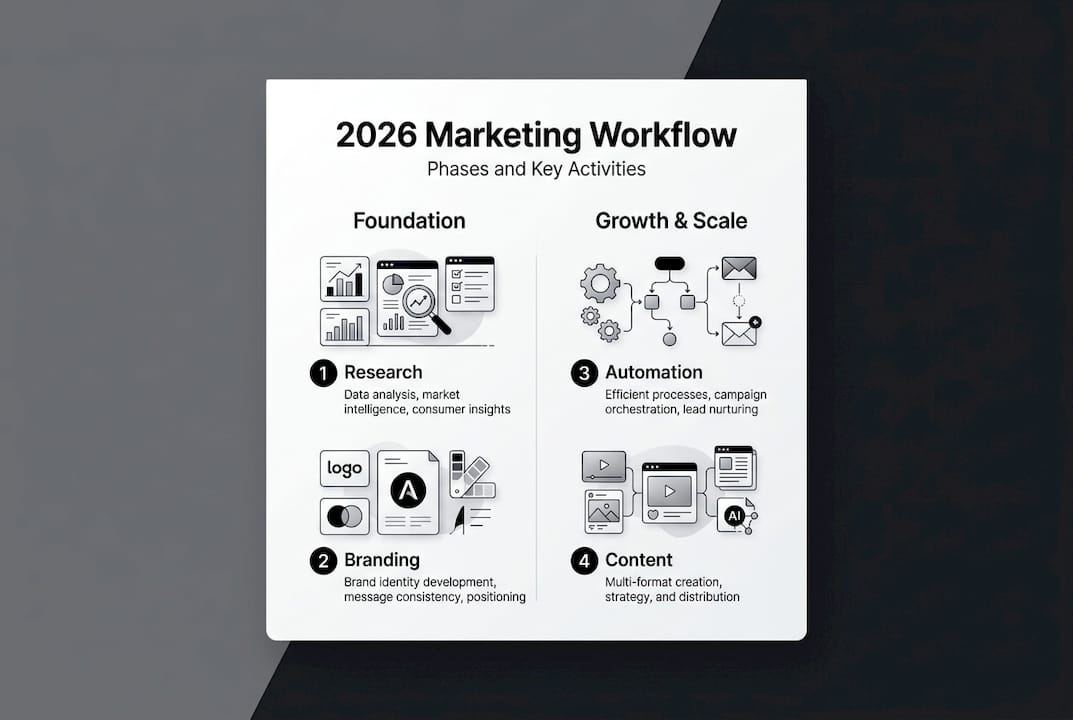
Your marketing workflow begins with a solid foundation. Digital marketing workflows for small businesses typically follow a phased approach starting with audience research, branding, and website optimization. Skipping this groundwork leads to campaigns that miss the mark and budgets that disappear without returns.
Start by identifying your ideal customer. Research their pain points, preferred channels, and buying behaviors. This intelligence shapes every downstream decision, from messaging to platform selection. Next, establish clear brand guidelines that define your voice, visual identity, and value proposition. A strong branding strategy in 2026 creates recognition and trust before you spend a dollar on advertising.
Your website serves as the hub for all marketing activities. Optimize it for speed, mobile responsiveness, and conversion paths. Every campaign you run will drive traffic here, so the site must deliver a seamless experience that turns visitors into customers. Poor website performance undermines even the best marketing efforts.

Document your foundational processes thoroughly. Create checklists for audience research, brand asset creation, and website audits. These documents become your operational playbook, ensuring consistency as you scale and making it easier to delegate tasks or onboard team members.
A phased approach keeps workflows manageable for small teams. Focus on getting the foundation right before expanding into growth tactics. This disciplined sequence prevents the overwhelm that comes from trying to execute too many initiatives simultaneously. Understanding digital marketing essentials for SMBs helps you prioritize foundational work that supports long-term success.
Key foundation phase tasks include:
Complete detailed customer persona research with demographic and psychographic data
Develop comprehensive brand guidelines covering voice, visuals, and messaging
Audit website performance for speed, mobile experience, and conversion optimization
Create documented processes for all foundational marketing activities
Set up analytics tracking to measure baseline performance before campaigns launch
Pro Tip: Spend at least two weeks on foundation work before launching any paid campaigns. This patience pays dividends by ensuring your marketing infrastructure can support growth without breaking.
Executing growth and scaling phases efficiently with AI automation
Once your foundation is solid, move into the growth phase. This stage emphasizes content marketing, social media engagement, and email campaigns that build audience relationships. Growth phase workflows focus on consistent output and nurturing prospects through the buyer journey.
Content creation becomes your primary activity. Develop blog posts, social updates, and email sequences that address customer questions and demonstrate expertise. Consistency matters more than perfection at this stage. Establish a realistic publishing calendar you can maintain long term.
Email marketing delivers exceptional returns during the growth phase. Build your list through website opt-ins and lead magnets. Segment subscribers based on interests and behaviors, then send targeted campaigns that move people toward purchase decisions. The email marketing setup process requires upfront work but generates recurring value.
Social media extends your reach and builds community. Choose platforms where your audience spends time rather than spreading yourself across every network. Post consistently, engage with followers, and use social listening to understand customer sentiment.
The scaling phase integrates paid advertising and advanced optimization. This is where AI automation workflows transform efficiency. AI tools handle repetitive tasks like content generation, A/B testing, and ad optimization, saving 15+ hours weekly while boosting return on ad spend.
Implement AI automation through these sequential steps:
Deploy AI content creation tools like ChatGPT to generate initial drafts for blogs, emails, and social posts
Use AI-powered ad platforms like Google Performance Max to automatically optimize bids and targeting
Implement personalization engines that customize website content and email messaging based on user behavior
Set up automated A/B testing that continuously experiments with headlines, images, and calls to action
Connect AI analytics tools that identify patterns and recommend strategic adjustments
Integrate AI chatbots for customer service that handle common questions 24/7
Review all AI outputs with human judgment to ensure strategic alignment and quality
Pro Tip: Start your AI automation journey with email marketing. The closed-loop nature of email makes it easier to measure results, and the time savings appear immediately. Once you master email automation, expand to social media and paid advertising.
Intelligent automation for SMB marketing platforms integrate multiple tools into unified workflows. These systems connect your content creation, distribution, and analytics, eliminating manual data transfers and reducing errors.
Balance is critical. AI excels at execution and optimization but lacks strategic judgment. Use automation to handle volume and speed while you focus on creative direction, strategic planning, and relationship building. The most effective workflows combine AI efficiency with human creativity and oversight.
Avoiding pitfalls: managing workflow complexity and ensuring human oversight
Many marketers sabotage their own success by creating overly complex workflows. Too many workflows create confusion, increase error rates, and waste time on maintenance rather than execution. Complexity becomes the enemy of effectiveness.
Document each workflow step before automating anything. Write out the manual process, identify decision points, and map data flows. This documentation reveals redundancies and gaps you need to address. Skipping this step leads to automated chaos where systems conflict and data gets lost.
Maintain human oversight of all AI-driven decisions. AI can amplify poor strategy just as easily as good strategy. In dynamic markets, human judgment catches nuances that algorithms miss. Review AI-generated content for accuracy, tone, and strategic fit before publishing.
Avoid siloed marketing channels. When email, social media, and paid ads operate independently, you lose attribution insights and create inconsistent customer experiences. Unified data and attribution across channels reveals which combinations drive results and where to invest more resources.
Separate operational workflows from campaign logic. Operational workflows handle recurring tasks like social media posting schedules or monthly reporting. Campaign workflows manage specific initiatives with defined start and end dates. Mixing these creates confusion about what should continue and what should stop.
Common workflow mistakes to avoid:
Building automation before documenting manual processes completely
Creating separate workflows for tasks that should be integrated
Failing to establish clear ownership and accountability for each workflow
Neglecting regular audits that identify outdated or broken automation
Trusting AI outputs without human review and quality control
Pro Tip: Schedule quarterly workflow audits where you review every automated process. Eliminate steps that no longer serve your goals, consolidate redundant workflows, and update documentation to reflect current practices. This maintenance prevents complexity creep.
“The most successful marketing operations balance automation efficiency with human strategic control. AI handles volume and speed, but humans provide the creative insight and market understanding that separates good campaigns from great ones.”
Understanding the digital marketing checklist for 2026 helps you identify which processes to automate and which require ongoing human attention. Not everything should be automated, and knowing the difference protects your marketing effectiveness.
Measuring success and adapting workflows for continuous improvement
Effective workflows require ongoing measurement and adaptation. Track key performance indicators that reveal whether your marketing generates real business value. Vanity metrics like follower counts or page views feel good but rarely correlate with revenue.
Focus on conversion rates across all channels. What percentage of website visitors opt into your email list? How many email subscribers become customers? What return do you generate from paid advertising spend? These metrics directly connect marketing activity to business outcomes.
Email marketing ROI reaches $36-40 per dollar spent, making it the highest-return channel for most small businesses. Google Ads typically delivers 2.5x to 3.8x return on ad spend. SEO requires longer time horizons but generates compounding returns as your content library grows.
Compare your performance against industry benchmarks. Small business marketing budgets typically range from 7% to 10% of revenue. If you invest significantly above or below this range, understand why and whether the deviation serves your strategic goals.
| Channel | Average ROI | Typical Monthly Spend | Time to Results | | — | — | — | | Email Marketing | $36-40 per $1 | $300-800 | 1-3 months | | SEO | 5-10x investment | $500-2000 | 4-12 months | | Google Ads | 2.5-3.8x spend | $1000-5000 | 1-2 months | | Social Media Ads | 2-4x spend | $500-2000 | 1-2 months |
Adapt your workflows based on performance data. If email campaigns consistently outperform social media, shift resources toward email. When certain content topics drive more engagement, create more content in those areas. Let data guide your strategic evolution.
Pro Tip: Prioritize email marketing for the fastest return on investment, then layer in SEO for long-term organic growth and paid advertising for immediate reach. This balanced approach maximizes results across different time horizons.
Review performance monthly for tactical adjustments and quarterly for strategic shifts. Monthly reviews catch underperforming campaigns quickly. Quarterly reviews reveal longer-term trends that inform budget allocation and channel strategy.
Understanding social media marketing benchmarks helps you set realistic expectations and identify when performance falls short. Different industries and business models see varying results, so compare yourself to similar businesses rather than generic averages.
Key metrics to track consistently:
Cost per lead and cost per customer acquisition across all channels
Return on ad spend for paid campaigns with monthly trend analysis
Email list growth rate and engagement metrics like open and click rates
Website conversion rates for key actions like form submissions and purchases
Customer lifetime value to understand long-term marketing effectiveness
Continuous improvement separates good marketing operations from great ones. Build experimentation into your workflows. Test new messaging, try different content formats, and explore emerging channels. Dedicate 10% to 20% of your budget to experiments while the majority funds proven tactics.
Enhance your digital marketing with LOOM Brand Designs
Building effective marketing workflows requires expertise, time, and the right tools. LOOM Brand Designs helps small businesses establish strong foundations and execute efficient campaigns that drive real results.
Our basic branding package creates the visual identity and messaging framework your marketing needs to succeed. We develop comprehensive brand guidelines that ensure consistency across all channels. Professional website design and development services build the optimized hub where your campaigns convert visitors into customers.

Our email marketing pro setup service configures your email platform, creates automated sequences, and establishes workflows that generate consistent returns. We handle the technical complexity so you can focus on growing your business. Partner with LOOM Brand Designs to streamline your digital marketing and achieve measurable success in 2026.
Frequently asked questions
How do I start building a digital marketing workflow?
Begin by researching your target audience and documenting your current marketing tasks. Define clear goals for what you want to achieve, then map out the steps needed to reach those goals. Start with foundational work like branding and website optimization before expanding into campaigns. Understanding digital marketing essentials for SMBs provides a roadmap for prioritizing your initial efforts.
What should I automate first in my marketing workflow?
Start automation with email marketing because it delivers the fastest return on investment and has the simplest workflow structure. Set up welcome sequences for new subscribers and automated campaigns triggered by specific behaviors. Once email automation runs smoothly, expand to social media scheduling and then paid advertising optimization. This phased approach prevents overwhelm while building your automation capabilities.
How do I measure success in my digital marketing workflow?
Track conversion metrics that connect directly to revenue, including cost per lead, customer acquisition cost, and return on ad spend. Compare your results against industry benchmarks to gauge effectiveness. Review performance monthly for tactical adjustments and quarterly for strategic changes. Focus on metrics that reflect actual business value rather than vanity numbers like follower counts.
What AI tools are best for automating a digital marketing workflow?
Tools like ChatGPT and Google Performance Max automate content creation, ad optimization, and customer service tasks effectively. Choose platforms with drag-and-drop builders and integrated automation capabilities like Agile CRM or HubSpot. Intelligent automation tools for SMBs combine multiple functions into unified systems that reduce complexity and improve efficiency.
How do I measure ROI from my digital marketing workflow?
Calculate cost per conversion by dividing total marketing spend by the number of customers acquired. Track return on ad spend by comparing revenue generated to advertising costs. Email marketing ROI reaches $36-40 per dollar spent, while Google Ads typically delivers 2.5x to 3.8x returns. Compare your performance against these benchmarks to evaluate effectiveness. Review social media marketing ROI benchmarks for additional channel-specific guidance.
How do I avoid overcomplicating my marketing workflows?
Document all processes manually before applying any automation. Review workflows quarterly to eliminate outdated or redundant steps. Keep operational workflows separate from campaign-specific workflows to maintain clarity. Balance AI automation with human oversight to ensure strategic effectiveness. Start simple and add complexity only when clear benefits justify the additional maintenance burden.
Recommended
Digital marketing checklist 2026: practical steps for small business success
What is digital marketing? Essential guide for small businesses 2026
omprehensive Social Media Setup & SEO for Entrepreneurs | LOOM Brand Designs
Digital Marketing Workflow for Maximum ROI Success - Ads Daddy. Advertise on All Plattforms.
Comments