


What is brand consistency? How SMBs build trust & recognition
- Pawan Samarakoon
- Apr 2
- 8 min read

Why do some brands feel instantly familiar the moment you see them, while others leave you guessing who they are? The answer usually isn’t a bigger budget or a flashier product. It’s consistency. For small and medium-sized businesses, brand consistency is one of the most powerful and most overlooked growth levers available. When every touchpoint tells the same story, customers remember you, trust you, and come back. This guide breaks down exactly what brand consistency means, the four pillars that hold it together, why it drives real business results, and how you can start building it today without overcomplicating the process.
Table of Contents
Key Takeaways
Point | Details |
Brand consistency defined | It’s about unifying what people see, read, and experience from your business at every touchpoint. |
Pillars to focus on | Visuals, voice, messaging, and experience all form the foundation of a strong brand. |
Benefits for SMBs | Consistency builds customer trust, strengthens loyalty, and increases marketing efficiency. |
Start simple | A basic style guide and affordable tools can make a big impact—no big budget needed. |
Mindset over perfection | Adopting small, repeatable habits is more important than achieving perfect uniformity. |
Defining brand consistency: More than just a logo
A lot of business owners hear “brand consistency” and picture a logo slapped on every document. That’s a start, but it barely scratches the surface. Brand consistency is the practice of presenting a unified brand identity, including visuals, messaging, voice, and experience, across all customer touchpoints and channels. That means your Instagram post, your email signature, your customer service call, and your invoice should all feel like they come from the same place.
The core brand elements include visual identity (logo, colors, fonts, imagery), brand voice and tone, messaging, and experiential consistency across every customer interaction. Each of these elements works together. Pull one out of alignment and the whole picture gets blurry.
Here’s a quick comparison to show what consistency looks like in practice versus what it doesn’t:
Consistent brand | Inconsistent brand |
Same logo version on every platform | Different logo crops or old versions in use |
One defined color palette used everywhere | Random colors chosen per project |
Recognizable tone in every message | Formal emails, casual social posts, no clear voice |
Reliable customer experience | Unpredictable service quality across channels |
Two of the biggest misconceptions about brand consistency are worth addressing directly:
It’s only about visuals. Many SMBs focus entirely on how things look and ignore how they sound or feel. Voice and experience matter just as much as color palettes.
It’s only for big brands. Small businesses actually benefit more from consistency because they have fewer touchpoints to manage and every impression counts more when you’re still building recognition.
“Brand consistency isn’t a luxury for large companies. It’s a trust-building tool that works hardest for businesses that are still earning their reputation.”
For a deeper look at how all these elements fit together, our brand identity guide walks through each component with practical context for small businesses.
The four pillars of brand consistency
With a clear definition in place, let’s unpack the practical building blocks that make consistency work day to day.
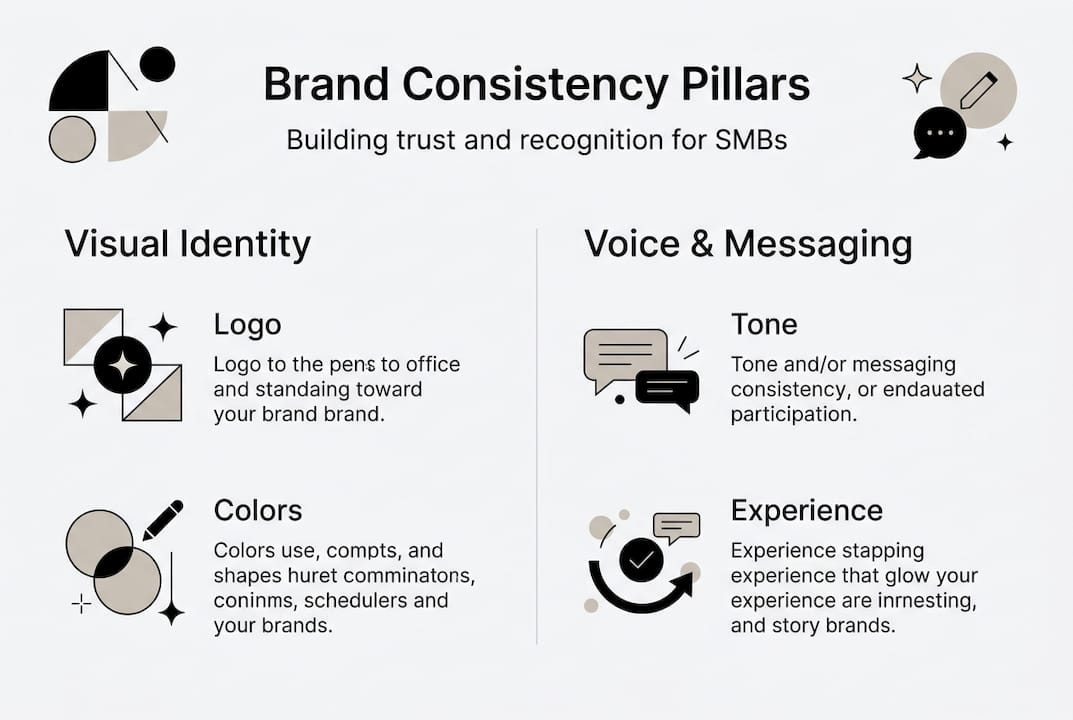
The four core pillars of brand consistency are visual identity, brand voice and tone, messaging, and customer experience. Each one plays a distinct role, but they all reinforce each other.

Pillar | What it covers | Why it matters |
Visual identity | Logo, colors, fonts, imagery | Instant recognition |
Voice and tone | How you write and speak | Emotional connection |
Messaging | Value proposition, promises, story | Clarity and trust |
Experience | Every customer interaction | Loyalty and advocacy |
Here’s how to think about each pillar in order of priority:
Lock down your visual identity first. Choose a logo, a color palette of two to four colors, and one or two fonts. Stick to them everywhere. This is the fastest win.
Define your brand voice. Are you friendly and conversational, or precise and professional? Write it down. Your social media manager and your sales rep should sound like they work for the same company.
Clarify your core message. What do you do, who do you do it for, and why does it matter? Your answer should be the same whether you’re on your homepage or at a networking event.
Align your customer experience. From the first inquiry to post-sale follow-up, every interaction should reflect your brand’s promises. This is where consistency becomes loyalty.
Our visual branding process guide goes deeper on how to build out your visual identity step by step. And if you want to understand the personality behind your brand, exploring brand personas can help you define a voice that resonates authentically.
Pro Tip: Don’t try to perfect all four pillars at once. Start with visual identity and voice, get those consistent, then layer in messaging and experience improvements over the next 90 days.
Why brand consistency matters for SMBs
Understanding the pillars is useful, but why do these details actually matter for your business growth?
Consistency builds trust and loyalty as much as logos or taglines do, and this is especially important for SMBs working with limited resources. When customers see the same brand experience repeatedly, they build confidence. That confidence shortens the sales cycle and increases repeat purchases.
Here’s what strong brand consistency delivers for small businesses:
Higher customer retention. Familiar brands feel safer. Customers return to what they recognize.
More efficient marketing. Every new ad, post, or email reinforces what you’ve already built. You’re not starting from zero each time.
Stronger word-of-mouth. A clear, consistent brand is easier for customers to describe and recommend to others.
Easier sales conversations. When your brand communicates clearly and consistently, prospects arrive already understanding your value.
Greater perceived credibility. Consistent brands look more established, even if they’re only two years old.
Tracking whether your consistency efforts are working is also straightforward. You can measure brand success through revenue growth attribution, branded search volume, compliance audits, customer trust surveys, and for SMBs specifically, repeat business rates and customer feedback patterns.
Neglecting consistency, on the other hand, creates real problems. A customer who sees a polished website but receives a sloppy email follow-up gets a mixed signal. That friction erodes trust before a sale even happens.
Pro Tip: Set up a simple Google Alert for your business name and review every mention quarterly. This helps you catch off-brand representations before they become habits.
Our brand strategy for SMEs breaks down how to connect your consistency efforts to broader growth goals. You can also use our SME branding checklist to audit where you stand right now.
How to implement brand consistency: Step-by-step for SMBs
If you want the benefits of brand consistency, here’s a straightforward, low-barrier way to get started.
The foundation is a brand style guide. Creating a style guide means documenting your logo rules, color hex codes, fonts, voice and tone guidelines, and core messaging. It doesn’t need to be a 40-page document. A single well-organized page works fine for most small businesses starting out.
Follow these steps to build and maintain consistency without burning hours you don’t have:
Create your style guide. Document your logo (approved versions and sizes), color palette (with hex codes), fonts (one for headings, one for body text), and three to five words that describe your brand voice.
Build templates. Use tools like Canva to create reusable templates for social posts, email headers, presentations, and proposals. Free tiers are more than enough to start.
Train your team. Share the style guide with anyone who creates content or communicates with customers. A 15-minute walkthrough prevents months of inconsistency.
Audit your existing assets. Go through your website, social profiles, email signatures, and printed materials. Flag anything that doesn’t match your guide and update it.
Centralize your files. Store your approved logo files, templates, and brand guide in one shared folder. Google Drive or Dropbox works perfectly. Everyone uses the same assets, always.
Key tools that make this affordable:
Canva (free tier) for design templates
Google Drive for centralized file storage
HubSpot free CRM for consistent email communication
Notion or Google Docs for your living style guide
Pro Tip: Treat your style guide as a living document. Review it every six months and update it when your business evolves. A guide that doesn’t reflect your current brand does more harm than good.
For more detail on building your visual system, our visual branding steps guide is a practical next read. If your brand has drifted over time, our brand refresh tips can help you realign without starting over.
Why most small businesses overcomplicate brand consistency
Here’s the uncomfortable truth: most SMBs don’t fail at brand consistency because it’s hard. They fail because they believe it has to be perfect before it can be useful.
We’ve seen business owners spend months waiting to launch a style guide because they haven’t finalized a font pairing. Meanwhile, their team sends out emails with three different logo versions and no one notices the real problem. Incremental, imperfect action beats polished inaction every time.
Another trap is confusing consistency with rigidity. Your brand doesn’t need to sound robotic to be consistent. Flexible consistency, meaning clear guidelines with room for human expression, actually builds more authentic connections than a locked-down rulebook. The goal is recognizable, not identical.
The biggest wins we see for small businesses come from aligning the team’s mindset first. When your front desk, your social media manager, and your sales rep all understand what the brand stands for, consistency happens naturally. No tool fixes a culture gap. Finally, remember that your SMB branding strategy should fit your resources, your customers, and your culture. There is no universal template.
Take your brand consistency further with LOOM Brand Designs
Building brand consistency on your own is absolutely possible, and this guide gives you the framework to start. But if you want to move faster, avoid common mistakes, and get a brand that truly reflects your business, professional support makes a real difference.

At LOOM Brand Designs, we work with small and medium-sized businesses at every stage of their brand journey. Whether you’re starting from scratch or tightening up what you already have, our basic branding package and standard branding package are built to deliver real results without enterprise-level costs. Need ongoing visual support? Our graphic design services keep your brand looking sharp and consistent across every channel.
Frequently asked questions
How does brand consistency create trust with customers?
Consistency signals reliability, making customers feel confident they’ll get the same quality and experience every time they interact with your business. Trust grows from repeated, predictable impressions.
Can a small business achieve brand consistency with a tight budget?
Yes. A simple one-page style guide and free tools like Canva and Google Drive are enough to keep a small business consistent across all channels without spending a dollar.
What should a basic brand style guide include?
It should cover your logo usage rules, color palette with hex codes, approved fonts, core messaging, and a short description of your brand voice and tone.
How often should you audit your brand assets for consistency?
Review your brand assets at least twice a year to catch drift early and make sure everything still aligns with your current guidelines and business direction. Regular audits prevent small inconsistencies from becoming big problems.
Recommended
Comments