


What is branding? A guide for small business owners 2026
- jayanipiumika
- 14 hours ago
- 8 min read

71% of people make more purchases from brands they trust. Yet many small business owners still see branding as just a logo or color scheme. This guide breaks down branding fundamentals, showing how strategic branding drives customer trust, loyalty, and revenue growth. You’ll learn what branding truly means and how to leverage it for sustainable business success.
Table of Contents
Key takeaways
Point | Details |
Branding builds trust | Strong branding creates customer confidence, leading to higher conversion rates and repeat purchases. |
More than visuals | Branding encompasses identity, values, messaging, and the complete customer experience. |
Consistency wins | Unified branding across all touchpoints strengthens recognition and fosters long-term loyalty. |
Strategic investment | Professional branding support accelerates market presence and delivers measurable ROI. |
Trust drives sales | Customers actively seek brands they recognize and trust before making purchasing decisions. |
What is branding? Understanding the basics
Branding goes far beyond picking a logo or choosing colors. It’s the complete identity your business projects to the world, encompassing your values, messaging, customer interactions, and the overall experience people associate with your company.
Many small business owners mistakenly focus only on visual elements. While important, true branding includes how you communicate, the problems you solve, and the feelings customers have when they interact with your business. Every touchpoint, from your website to customer service calls, contributes to your brand perception.
The stakes are high. Trust built through branding directly influences whether prospects become paying customers. Research shows 71% of people make more purchases from brands they trust, demonstrating the tangible revenue impact of strategic branding.
Key components of comprehensive branding include:
Visual identity like logos, colors, and typography that create instant recognition
Brand voice and messaging that communicates your unique value proposition
Customer experience standards that define every interaction point
Company values and mission that guide business decisions
Market reputation built through consistent delivery and engagement
Understanding the strategic role of logos in branding success helps illustrate one piece of the larger puzzle. Your logo serves as a visual anchor, but it must work alongside messaging, customer experience, and reputation management to create a cohesive brand.
In competitive markets, strong branding becomes your differentiator. When multiple businesses offer similar products or services, customers choose based on which brand they trust and connect with emotionally. This emotional connection transforms one-time buyers into loyal advocates who recommend your business to others.

How branding drives trust and customer loyalty
Trust forms the foundation of every lasting customer relationship. Without it, prospects hesitate, compare endless alternatives, and often choose competitors solely based on price. With strong branding, you establish credibility before the first conversation begins.
A recognizable brand attracts more attention, leading to increased leads and higher conversion rates. When potential customers repeatedly see consistent branding across multiple channels, familiarity builds. This familiarity reduces perceived risk, making prospects more comfortable investing in your solutions.
Consistent branding creates mental shortcuts. Customers develop positive associations with your colors, messaging style, and overall presence. These associations become triggers that make your business their first choice when needs arise.
The psychology behind brand loyalty reveals several key drivers:
Reliability signals through consistent visual identity and messaging
Professionalism communicated via polished, cohesive brand elements
Emotional connections formed through authentic storytelling and values alignment
Familiarity built through repeated exposure across customer touchpoints
Quality expectations reinforced by delivering on brand promises
Consider how branding impacts the customer journey. A prospect discovers your business through social media, visits your website, receives a welcome email, and attends a consultation. At each stage, consistent branding reassures them they’re dealing with a legitimate, professional organization worth their investment.
Strong branding doesn’t just look good. It fundamentally changes how prospects evaluate your business, shifting focus from price comparison to value recognition.
Investing in your brand foundation SEO starter package creates this trust foundation while improving your discoverability. When branding and visibility strategies align, lead generation accelerates naturally.
Loyalty emerges when customers feel confident in their choice. They become repeat buyers not because switching is difficult, but because your brand consistently delivers the experience they value. These loyal customers often spend more over time and actively promote your business through word-of-mouth referrals.
The revenue implications are substantial. Businesses with strong branding command premium pricing, enjoy lower customer acquisition costs, and benefit from higher lifetime customer values. Trust converts browsers into buyers and transforms buyers into brand advocates.
Key elements of a strong brand identity
Building a cohesive brand identity requires coordinating multiple elements that work together to create a unified impression. Each component reinforces your overall brand personality and value proposition.
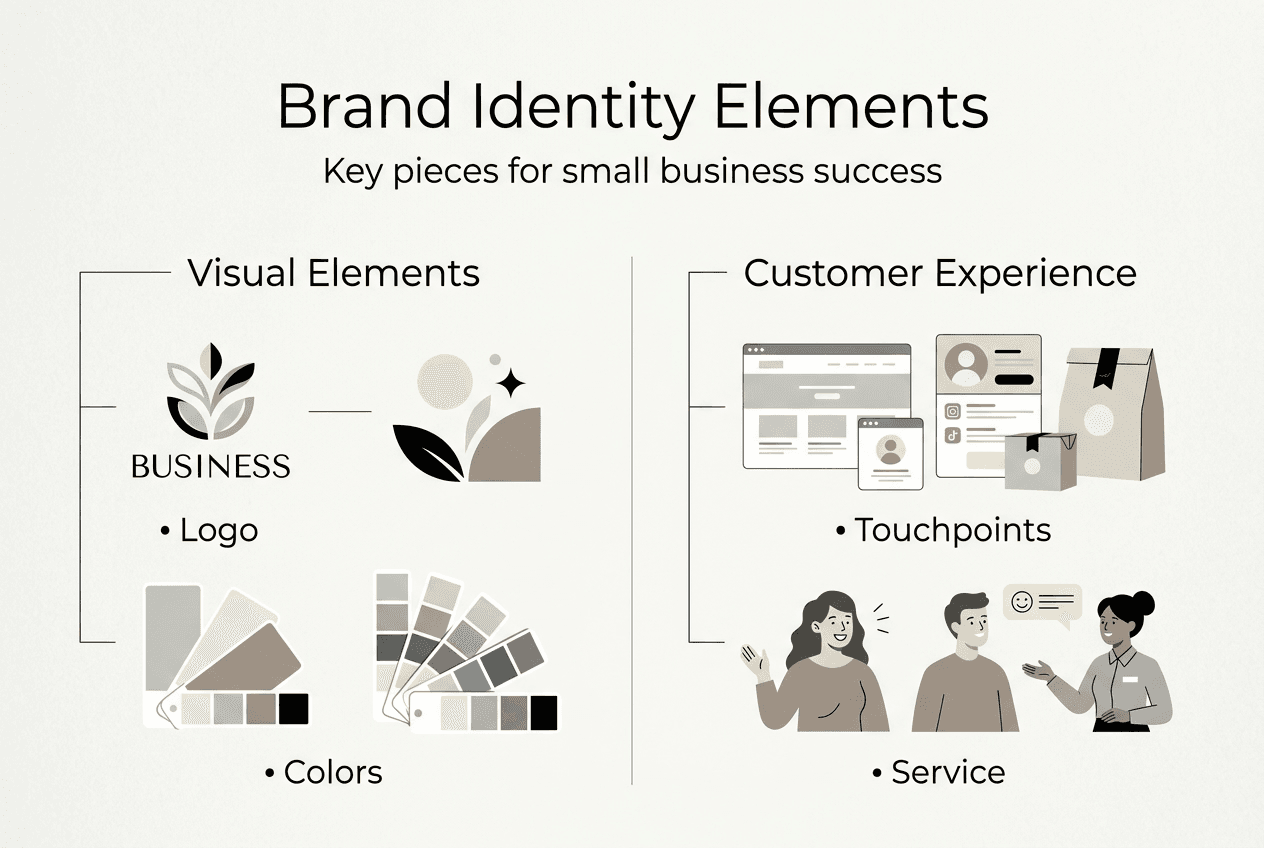
Your visual identity includes your logo, color palette, typography, imagery style, and design patterns. These elements create instant recognition and emotional responses. When applied consistently, they make your business immediately identifiable across all platforms and materials.
Messaging encompasses your brand voice, tagline, value propositions, and communication style. This determines how you talk to customers, whether formal and authoritative or casual and friendly. Consistent messaging ensures customers know what to expect from every interaction.
Customer experience often gets overlooked but significantly impacts brand perception. Every touchpoint from initial contact through post-purchase support shapes how people feel about your brand. Exceptional service reinforces positive brand associations while poor experiences damage even the strongest visual identities.
Pro Tip: Document your brand guidelines in a simple reference guide. Include approved colors with hex codes, logo usage rules, brand voice examples, and customer service standards. This ensures consistency even as your team grows.
Brand Element | Primary Role | Impact on Customers |
Logo & Visuals | Instant recognition | Creates memorable first impressions and recall |
Color Palette | Emotional connection | Triggers specific feelings and associations |
Typography | Personality expression | Communicates tone (modern, traditional, playful) |
Messaging | Value communication | Clarifies benefits and differentiates from competitors |
Customer Experience | Trust building | Determines loyalty and referral likelihood |
Understanding the visual branding process helps small businesses create professional identities without enterprise budgets. The key is starting with strategy before jumping into design execution.
The role of logos in branding demonstrates how this single element anchors your entire visual system. Your logo appears on everything from business cards to social media profiles, making it your most visible brand asset.
Research confirms brand elements impact leads and conversion rates directly. Recognizable branding captures attention in crowded markets, increasing the likelihood prospects engage with your content and offers.
Consistency across elements matters more than perfection in any single component. A simple logo applied consistently outperforms a complex design used sporadically. Focus on creating alignment between all brand elements so they reinforce rather than contradict each other.
Your brand personality should reflect your target audience’s preferences and your unique market position. A law firm needs different brand elements than a creative agency, even if both target small business owners. Authenticity resonates more than following generic best practices.
Implementing your brand strategy for small business growth
Knowing branding fundamentals means nothing without implementation. These practical steps help you apply insights and build a brand strategy that drives measurable business growth.
Define your brand foundation by clarifying your mission, vision, and target audience. Write down specifically who you serve, what problems you solve, and why customers should choose you over alternatives. This clarity guides every branding decision that follows.
Develop your visual identity system including logo, colors, fonts, and design templates. You don’t need dozens of variations, just core elements you can apply consistently. Create templates for common materials like social posts, presentations, and email signatures.
Establish your brand voice and key messaging. Decide how you’ll communicate, what topics you’ll address, and what tone matches your audience. Document example phrases and messaging frameworks your team can reference.
Apply branding consistently across all customer touchpoints. Update your website, social profiles, email signatures, proposals, and any customer-facing materials. Consistency builds recognition faster than sporadic perfect execution.
Engage customers and gather feedback to refine your approach. Monitor how people respond to your branding, what resonates, and what confuses them. Use these insights to make strategic adjustments while maintaining core consistency.
Leverage professional support when feasible to accelerate results. Quality branding requires expertise most small business owners don’t possess. Strategic investment in professional services often delivers better ROI than DIY approaches.
Pro Tip: Start with one channel and perfect your branding there before expanding. Master your website and primary social platform, then systematically roll out consistent branding to additional channels. This focused approach prevents overwhelm and ensures quality.
The data supporting strategic branding is clear. 71% of people make more purchases from brands they trust, making trust-building through branding a direct revenue driver. Every dollar invested in creating recognizable, trustworthy branding returns through higher conversion rates and customer lifetime values.
Exploring branding strategy 2026 trends helps ensure your approach remains current and competitive. While core branding principles stay constant, implementation tactics evolve with technology and customer expectations.
Monitor your brand’s performance through metrics like brand awareness surveys, customer feedback, conversion rate changes, and customer acquisition costs. These indicators reveal whether your branding investments deliver the expected business impact.
Remember that branding is iterative, not static. As your business grows and markets shift, your brand should evolve while maintaining core consistency. Plan annual brand reviews to assess what’s working and identify improvement opportunities.
Consider packages like the basic branding package that provide professional foundation elements without enterprise costs. The right support accelerates implementation and ensures quality that DIY approaches often struggle to achieve.
How LOOM Brand Designs can elevate your branding
Building a strong brand requires expertise, time, and strategic thinking that most small business owners lack. That’s where professional support transforms good intentions into market-ready brand identities.
LOOM Brand Designs specializes in creating tailored branding solutions for small businesses. Our basic branding package provides essential identity elements including logo design, color systems, and brand guidelines at accessible price points. You get professional quality without enterprise budgets.

For businesses seeking data-driven insights, our AI brand intelligence enterprise solution analyzes market positioning and identifies strategic opportunities. This technology uncovers competitive advantages traditional approaches miss.
Our comprehensive graphic design services ensure brand consistency across all marketing materials. From social media graphics to presentation templates, we maintain visual cohesion that strengthens recognition and trust.
Professional branding support accelerates your market presence, builds customer confidence faster, and delivers measurable ROI through improved conversion rates and customer loyalty.
What is branding? Frequently asked questions
What exactly is branding for small businesses?
Branding is the complete identity your business projects, including visual elements, messaging, values, and customer experiences. It’s how people perceive and remember your business, encompassing everything from your logo to how you answer the phone. Strong branding differentiates you from competitors and builds trust that drives purchasing decisions.
Why does consistent branding matter so much?
Consistency creates familiarity and trust, which are essential for customer confidence. When prospects see unified branding across touchpoints, they perceive your business as professional and reliable. Inconsistent branding confuses customers and suggests disorganization, undermining the trust necessary for sales.
How do logos fit into overall branding efforts?
Logos serve as visual anchors for your brand identity but represent just one component. They create instant recognition and appear on all brand materials, making them highly visible. However, logos must work alongside messaging, customer experience, and values to create comprehensive branding that builds loyalty and drives growth.
What branding steps should startups prioritize first?
Start by defining your target audience, mission, and unique value proposition clearly. Then develop core visual elements like logo and colors, and establish your brand voice. Apply these consistently to your website and primary marketing channel before expanding. Focus on quality execution in fewer places rather than mediocre presence everywhere.
Is professional branding worth the investment for small businesses?
Absolutely. Professional branding pays for itself through higher conversion rates, premium pricing ability, and increased customer lifetime values. Research shows trusted brands generate significantly more purchases, making branding a revenue driver rather than a cost. Strategic investment in quality branding delivers measurable ROI that DIY approaches rarely achieve.
Recommended