


What is digital branding: a guide for small business
- Pawan Samarakoon
- Mar 25
- 10 min read

Many small business owners invest heavily in social media, websites, and digital ads, yet struggle to see meaningful growth. The disconnect often stems from a fundamental misunderstanding: having an online presence isn’t the same as having a digital brand. Research shows 90% of small businesses fail at digital marketing largely due to poor branding strategy and inconsistent messaging. This guide clarifies what digital branding truly means, why it matters for your bottom line, and how to build a cohesive brand identity that drives recognition, trust, and sustainable revenue growth across every digital channel.
Table of Contents
Key Takeaways
Point | Details |
Branding as strategy | Digital branding is a strategic framework shaping perception across all digital touchpoints, not just logos. |
Core branding elements | Visual consistency, brand voice, user experience, and audience targeting work together to create recognition and trust. |
Revenue impact | Consistent digital branding is linked to about a 20 percent revenue lift compared to fragmented branding. |
Channel ROI | Email yields about 36 dollars per dollar spent and SEO about 22, while paid social often underperforms relative to owned channels. |
Understanding digital branding: definition and core elements
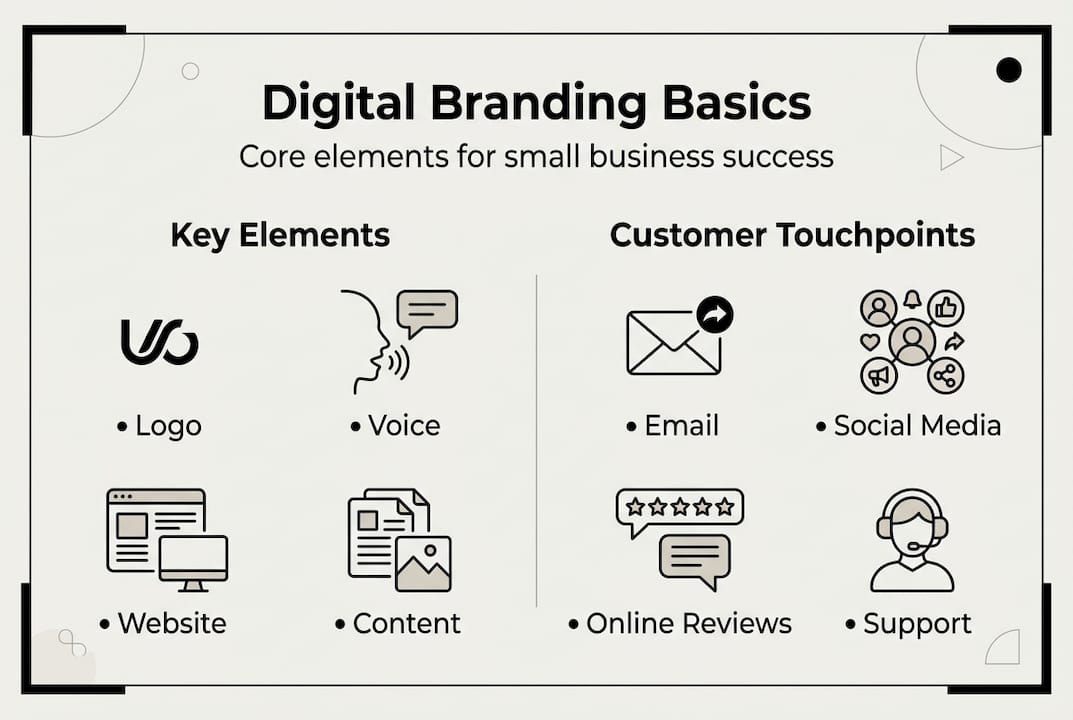
Digital branding is the strategic process of creating and maintaining a cohesive brand identity across websites, social media, email, search results, and every other digital touchpoint where customers encounter your business. Unlike traditional branding limited to physical materials, digital branding operates across interconnected channels where customers expect seamless, recognizable experiences.
Four core elements define effective digital branding:
Visual consistency: Logos, colors, typography, and imagery that remain uniform across platforms create instant recognition. When customers see your Instagram post, email newsletter, or website, they should immediately know it’s you.
Brand voice: The personality and tone in your written content, whether formal and authoritative or casual and friendly. This voice should feel consistent whether customers read your blog, social posts, or customer service responses.
User experience: How customers interact with your digital properties matters as much as what they see. Navigation patterns, page load speeds, mobile responsiveness, and intuitive design all communicate your brand’s professionalism and customer focus.
Audience targeting: Precise understanding of who you serve and what they value allows you to craft messaging that resonates. Generic content fails; targeted content that speaks directly to customer pain points builds connection.
These elements work together to differentiate your business from competitors. When a potential customer encounters five similar service providers, strong digital branding makes you memorable. It transforms casual browsers into engaged prospects by building emotional connection and trust before any sales conversation begins. Mastering graphic design fundamentals strengthens this visual foundation significantly.
Digital branding extends beyond marketing department responsibilities. Every customer interaction, from automated email responses to social media comments, either reinforces or undermines your brand identity. This requires organizational alignment around core brand values and consistent execution across teams.
Why digital branding matters: business impact and benchmarks
The financial case for digital branding is compelling. Small businesses with consistent branding see revenue increases of approximately 20% compared to those with fragmented or weak brand presence. This isn’t correlation; it’s causation. Customers pay premium prices for brands they recognize and trust, and they return more frequently.
Digital marketing delivers strong returns when executed properly. The average return is $5 for every dollar spent, but this varies dramatically by channel and strategy. Email marketing generates $36 per dollar invested, while SEO produces $22 per dollar. Paid social media advertising, despite its popularity, typically underperforms these owned media channels for sustained growth.
Channel Type | Average ROI | Best Use Case |
Email Marketing | $36:$1 | Customer retention and nurturing |
SEO | $22:$1 | Long term organic traffic growth |
Content Marketing | $16:$1 | Authority building and education |
Social Media Ads | $8:$1 | Awareness and quick conversions |
Display Advertising | $5:$1 | Retargeting and brand visibility |
Small and medium businesses now allocate 53% of marketing budgets to digital channels, with SEO consistently rated as the highest impact tactic. This shift reflects where customers spend time and make purchasing decisions. Your prospects research solutions online, compare options through search and social media, and form opinions about businesses before ever making contact.
The businesses seeing these returns share common traits: they invest in brand strategy before tactics, maintain consistency across channels, and focus on owned media properties they control rather than renting attention through paid ads alone. A comprehensive digital marketing approach balances these elements strategically.
Pro Tip: Prioritize owned media channels like your website, email list, and organic search presence over paid advertising. These assets compound in value over time and provide sustainable ROI, while paid channels require continuous spending to maintain results.
The data reveals another crucial insight: underinvestment in marketing correlates strongly with business stagnation. Many entrepreneurs spend less than 5% of revenue on marketing, far below the 7 to 12% recommended for growth stage companies. This underinvestment particularly hurts digital branding efforts, which require consistent content creation, design work, and channel management to build momentum.
Common pitfalls and expert insights in digital branding
Understanding why most small businesses fail at digital marketing illuminates the path to success. Research indicates 90% of SMBs struggle with digital marketing primarily due to three interconnected problems:
Lack of clear strategy: Jumping into tactics like social media posting or Google Ads without defining target audience, brand positioning, or success metrics wastes resources and produces scattered results.
Inconsistent messaging: When your website says one thing, your social media another, and your email campaigns a third, customers receive conflicting signals that erode trust and recognition.
Unfocused targeting: Trying to appeal to everyone means resonating with no one. Broad, generic messaging fails to connect with specific customer pain points and motivations.
Beyond tactical mistakes, strategic misunderstandings compound the problem. Many business owners focus exclusively on market penetration, measuring success by reach and impressions rather than brand capital. Brand capital represents the accumulated customer perception, loyalty, and preference your business has built. A company with strong brand capital commands premium pricing, enjoys customer advocacy, and weathers competitive pressure far better than one with equivalent market share but weak branding.
“90% of small businesses fail at digital marketing due to poor strategy and inconsistent execution. Success requires prioritizing brand capital over mere market penetration, focusing on customer perception and loyalty rather than just visibility metrics.”
User experience consistency proves equally critical. Customers form impressions based on every interaction, from website load speed to email formatting to social media response times. A beautiful website means little if your email newsletters look unprofessional or your social media presence feels abandoned. Each inconsistency chips away at the professional image you’re trying to build.

Another common mistake involves over reliance on paid social media advertising. While these platforms offer quick visibility, algorithm changes and rising costs make them unstable foundations for growth. Businesses that build primarily on rented attention through ads face perpetual treadmill pressure, requiring constant spending to maintain results. Diversifying into owned channels provides stability and compounding returns.
Crisis planning deserves attention too. A single poorly handled customer complaint that goes viral or an ill considered social media post can damage brand reputation built over years. Having clear protocols for response, empowered team members who understand brand voice, and monitoring systems to catch issues early protects your digital brand investment.
Artificial intelligence tools offer efficiency but require human oversight. AI generated content that doesn’t match your established brand voice confuses customers and dilutes brand identity. Use these tools to augment human creativity and speed production, not replace the strategic thinking that makes branding effective. Your overall branding strategy should guide tool selection and implementation.
Practical steps for entrepreneurs to build effective digital branding
Building effective digital branding doesn’t require massive budgets or specialized expertise. It requires systematic thinking and consistent execution. Here’s how to start:
Create detailed audience personas: Document your ideal customers’ demographics, challenges, goals, and online behavior. Where do they spend time online? What problems keep them awake at night? What objections prevent them from buying? Specific personas guide every branding decision.
Develop a brand style guide: Document your logo usage, color palette with hex codes, typography choices, image style preferences, and tone of voice guidelines. This reference ensures consistency even as team members change or you work with contractors.
Master one channel before expanding: Choose the platform where your target audience is most active and engaged. Build a strong, consistent presence there before spreading resources thin across multiple channels. Depth beats breadth in early stage branding.
Centralize digital assets: Use cloud storage to organize logos, images, templates, and brand documents in one accessible location. Version control prevents outdated materials from circulating and confusing your brand identity.
Implement analytics tracking: Set up Google Analytics, social media insights, and email metrics to measure what’s working. Track not just vanity metrics like followers, but engagement rates, conversion rates, and customer acquisition costs.
Schedule regular brand audits: Quarterly reviews of your digital presence across all channels catch inconsistencies and identify improvement opportunities. Look at your website, social profiles, email templates, and any other customer touchpoints with fresh eyes.
Planning your marketing activities increases success likelihood by 6.7 times compared to reactive, ad hoc approaches. This planning includes budget allocation, content calendars, campaign timelines, and clear success metrics for each initiative.
Free and affordable tools make professional branding accessible:
Canva: Design templates and brand kit features maintain visual consistency across social media, presentations, and marketing materials
Google Analytics: Tracks website performance and user behavior to inform branding decisions
Mailchimp or similar: Email marketing platforms with template builders ensure message consistency
Hootsuite or Buffer: Social media scheduling tools help maintain regular, consistent posting
Grammarly: Ensures written content maintains professional quality and consistent tone
Understanding the complete visual branding process helps you work efficiently whether handling efforts internally or partnering with professionals. Many entrepreneurs also benefit from streamlined marketing workflows that reduce time investment while maintaining quality.
Pro Tip: Focus 70% of your digital marketing budget on owned media channels like SEO, email marketing, and content creation. These assets appreciate over time and provide sustainable high ROI compared to paid advertising that stops working the moment you stop paying.
Budget allocation matters tremendously. While exact percentages vary by industry and growth stage, growth oriented small businesses typically invest 7 to 12% of revenue in marketing. Within that budget, balance immediate lead generation tactics with longer term brand building activities. The businesses that thrive invest in both, understanding that brand equity compounds while tactical campaigns deliver short term results.
Why partner with LOOM Brand Designs for your digital branding needs
Building digital branding internally works for some entrepreneurs, but many find professional partnership accelerates results while reducing stress. LOOM Brand Designs offers packages specifically designed for small business budgets and growth phases, from foundational basic branding packages to comprehensive solutions.

Our approach starts with understanding your specific audience, competitive landscape, and business goals. We then develop cohesive brand identities that work across all digital channels, from website design and development to social media presence and search optimization. This integrated approach ensures every customer touchpoint reinforces your brand rather than creating confusion.
Key benefits of professional digital branding partnership include:
Expert guidance that avoids the costly trial and error most DIY efforts experience
Consistent, professional execution across all channels from day one
Strategic frameworks that align branding with business growth objectives
Access to design and technical capabilities beyond typical small business resources
Ongoing optimization based on performance data and market changes
Our social media setup and SEO services complement branding foundations with tactical execution that drives measurable results. We handle the technical complexity while you focus on running your business, confident your digital brand is building equity and attracting ideal customers.
Pro Tip: Investing in professional digital brand design early accelerates ROI by avoiding the rebranding costs and lost momentum that come from inconsistent early efforts. The businesses that grow fastest treat branding as strategic infrastructure, not cosmetic afterthought.
Frequently asked questions
What exactly is digital branding?
Digital branding is the strategic process of building and maintaining consistent brand identity across all online channels including your website, social media, email, search results, and digital advertising. It encompasses visual elements, messaging, user experience, and the overall perception customers form through digital interactions.
How does digital branding differ from traditional branding?
Traditional branding focuses on physical touchpoints like print materials, signage, and in person experiences. Digital branding operates across interconnected online channels where customers expect immediate, personalized, and consistent experiences. Digital also allows real time measurement and optimization impossible with traditional media.
What budget should small businesses allocate to digital branding?
Growth oriented small businesses typically invest 7 to 12% of revenue in total marketing, with approximately half dedicated to digital channels. Within digital spending, prioritize owned media like website development, SEO, and content creation over paid advertising for sustainable returns. Start with foundational branding before scaling tactical campaigns.
How do I measure digital branding success?
Track both quantitative metrics like website traffic, conversion rates, email engagement, and customer acquisition costs, plus qualitative indicators like brand search volume, social media sentiment, and customer feedback themes. Understanding various branding strategies helps identify the right success metrics for your approach. Strong brands show increasing direct traffic, higher conversion rates, and improved customer lifetime value over time.
What tools do I need for effective digital branding?
Start with free or low cost essentials: Canva for design consistency, Google Analytics for performance tracking, an email marketing platform like Mailchimp, social media scheduling tools like Buffer, and project management software to coordinate efforts. As you grow, invest in premium tools for advanced capabilities, but strong branding depends more on strategy and consistency than expensive software.
Can I build digital branding myself or should I hire professionals?
Many entrepreneurs successfully build initial branding internally using available tools and resources. However, professional partnership typically accelerates results, avoids costly mistakes, and frees your time for core business activities. Consider your budget, timeline, internal capabilities, and opportunity cost when deciding. Hybrid approaches where you handle some elements while outsourcing specialized work often provide optimal balance.
Recommended
Comments