


What is rebranding? A strategic guide for growth
- Pawan Samarakoon
- Mar 26
- 9 min read

Rebranding is often mistaken for simply updating a logo or changing color schemes. In reality, it is a comprehensive strategic process that transforms your entire corporate identity, including messaging, positioning, visual elements, and customer perception. For business owners and marketing professionals, understanding what rebranding truly involves can unlock significant growth opportunities and competitive advantages. This guide breaks down the strategic nature of rebranding, explores when and why businesses undertake it, and provides actionable frameworks to execute successful rebranding initiatives that drive measurable business results.
Table of Contents
Key Takeaways
Point | Details |
Comprehensive strategy | Rebranding is a comprehensive process that reshapes messaging, positioning, visuals, and customer perception across the organization. |
Proactive vs reactive | There are proactive rebrands that plan for growth and competitiveness, and reactive rebrands triggered by mergers, crises, or market disruption. |
Audit and rollout | Successful rebrands rely on upfront research, cross functional alignment, and a coordinated rollout across all customer touchpoints. |
Risks and rewards | Common risks include miscommunication and disappointing ROI, while well executed rebrands can boost revenue and customer retention. |
Understanding the strategic process of rebranding
Rebranding is the strategic process of changing a company’s corporate image, including name, logo, visual identity, messaging, and positioning. Unlike a simple visual refresh, comprehensive rebranding reshapes how customers, employees, and stakeholders perceive your business. This transformation aligns your brand with evolving business goals, market conditions, and audience expectations.
A complete rebrand typically involves multiple interconnected components that work together to create a cohesive new identity:
Company name changes that reflect new direction or ownership
Logo redesign and updated visual identity systems
Revised brand messaging, voice, and tone guidelines
Repositioning in the market to target new audiences or differentiate from competitors
Updated mission, vision, and core values statements
New customer experience touchpoints across all channels
The distinction between a full rebrand and a brand refresh matters significantly. A refresh updates visual elements like logos, colors, and fonts while maintaining core brand identity and positioning. A full rebrand fundamentally changes how your business presents itself and what it stands for. Most businesses benefit from periodic refreshes every three to five years, while complete rebrands typically occur during major business transitions.
Strategic planning and research form the foundation of successful rebranding. Before making any visual changes, conduct thorough market analysis, competitor research, and customer surveys. Understanding your brand identity strengths and weaknesses helps you preserve what works while fixing what doesn’t. This research phase prevents costly mistakes and ensures your rebrand resonates with target audiences.
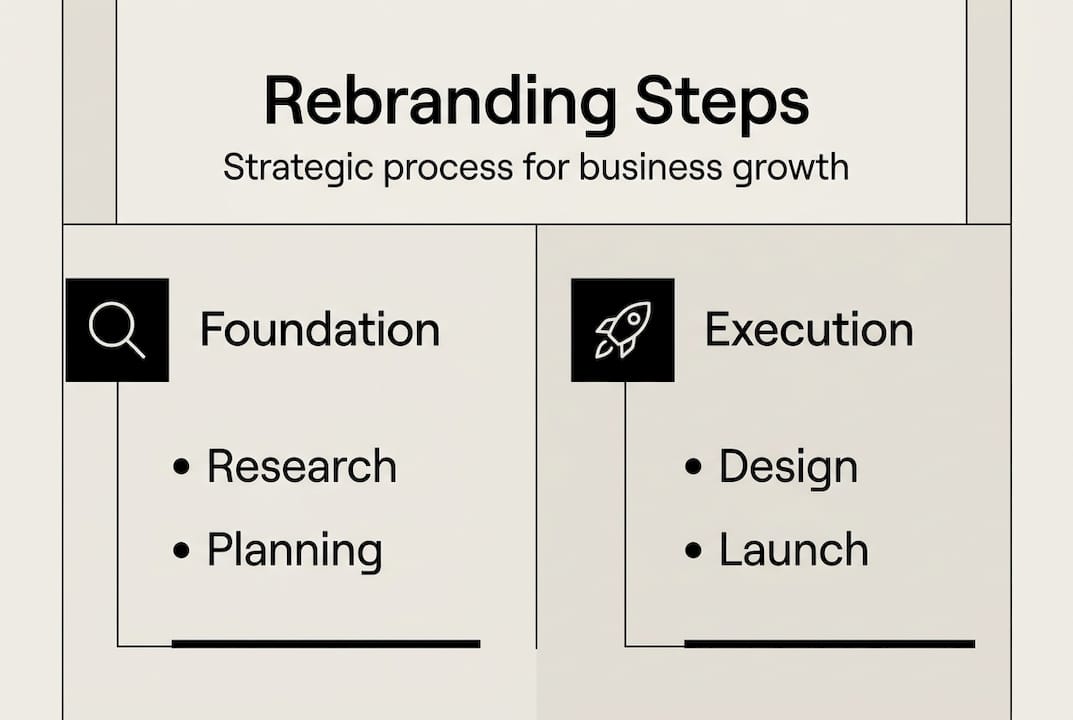
Effective rebranding requires cross-functional collaboration. Marketing, sales, product development, customer service, and leadership must align on objectives and messaging. When these teams work in silos, rebranding efforts produce inconsistent experiences that confuse customers and dilute brand equity. The most successful rebrands treat the process as an organizational transformation, not just a marketing project.
Types and motivations behind rebranding efforts
Types include proactive and reactive approaches, each serving distinct business needs. Proactive rebranding positions companies for growth, innovation, and competitive advantage before external pressures force change. Reactive rebranding responds to immediate challenges like mergers, reputation crises, or market disruption.
Proactive rebranding occurs when businesses choose to evolve their identity strategically. Companies pursuing new markets, launching innovative products, or repositioning against competitors often rebrand proactively. This approach allows time for research, testing, and careful rollout. Proactive rebrands typically achieve better results because they align with planned business initiatives rather than reacting to problems.

Reactive rebranding addresses urgent business needs. Mergers and acquisitions frequently trigger rebrands to unify separate identities under one cohesive brand. Reputation damage from scandals, product failures, or negative publicity may necessitate distancing the business from past associations. Market disruption by new competitors or technology shifts can make existing brands feel outdated, forcing reactive repositioning.
Rebrand Type | Trigger Examples | Strategic Focus | Timeline |
Proactive Full | Market expansion, product innovation, competitive differentiation | Growth and future positioning | 6 to 12 months |
Reactive Full | Merger, reputation crisis, obsolescence | Damage control and realignment | 3 to 6 months (accelerated) |
Proactive Refresh | Modernization, audience evolution | Visual updates and relevance | 3 to 4 months |
Reactive Refresh | Minor reputation issues, competitor pressure | Quick market response | 1 to 2 months |
The choice between full rebrand and refresh depends on business objectives and constraints. Full rebrands suit major strategic shifts like entering entirely new markets or fundamentally changing business models. Refreshes work when core brand equity remains strong but visual identity feels dated. Many successful companies use refreshes to stay current while preserving brand recognition built over decades.
Common business triggers for rebranding include:
Mergers and acquisitions requiring unified corporate identity
Geographic expansion into markets where current branding doesn’t resonate
Target audience shifts requiring new positioning and messaging
Product or service portfolio changes that outgrow original brand scope
Competitive pressure from brands with stronger, more modern identities
Negative associations or reputation damage requiring fresh start
Understanding your specific motivation shapes every subsequent decision in the rebranding process. Different branding strategies suit different business contexts, so aligning approach with objectives maximizes success probability.
Key steps, challenges, and best practices in rebranding
Core methodologies include brand audit, strategy, identity development, rollout, and KPI monitoring. Following these structured steps reduces risks and increases the likelihood of achieving desired business outcomes. Each phase builds on previous work, creating momentum toward successful transformation.
Conduct comprehensive brand audit and competitor analysis. Evaluate current brand perception through customer surveys, employee interviews, and market research. Analyze competitor positioning to identify differentiation opportunities. Document existing brand assets, messaging, and touchpoints to understand what needs changing.
Define clear objectives, target audience, positioning, and values. Establish measurable goals like increasing market share, attracting new customer segments, or improving brand perception scores. Create detailed audience personas reflecting who you want to reach. Articulate unique value proposition and core brand values that will guide all creative decisions.
Develop new brand identity including logo, messaging, and style guidelines. Work with designers and copywriters to create visual and verbal identity systems. Test concepts with target audiences before finalizing. Document everything in comprehensive brand guidelines that ensure consistent application across all touchpoints.
Execute internal rollout with employee training to ensure alignment. Employees are brand ambassadors who must understand and embrace changes before customers see them. Provide training on new messaging, values, and visual standards. Address concerns and gather feedback to refine implementation.
Launch external rebrand supported by integrated communication plan. Coordinate announcements across all channels simultaneously to control narrative. Explain reasons for change and benefits to customers. Update all physical and digital assets systematically to avoid confusion.
Monitor KPIs like awareness, engagement, and revenue to assess impact. Track metrics established in planning phase. Measure brand awareness, customer sentiment, website traffic, lead generation, and sales performance. Compare results against pre-rebrand baselines to quantify success.
The visual branding process requires particular attention because visual elements create immediate impressions. Investing in professional design ensures your rebrand looks credible and polished rather than rushed or amateurish.
Asset updates represent the biggest challenge in rebranding projects. Businesses must update websites, social media profiles, marketing materials, signage, packaging, uniforms, vehicles, and countless other branded items. Creating a detailed inventory and phased rollout plan prevents overwhelming teams and budgets.
Communicating changes effectively poses another major challenge. Customers who love your current brand may resist changes. Clear, transparent communication about why you’re rebranding and what stays the same helps maintain loyalty. Stakeholders including investors, partners, and suppliers also need tailored messaging explaining how changes affect relationships.
Pro Tip: Align rebranding with product improvements and cultural shifts to avoid the failure trap. Brands that change only superficial elements without addressing underlying business issues typically fail. Successful rebrands coincide with operational improvements, better customer service, enhanced products, or meaningful cultural transformations that give customers real reasons to reconsider the brand.
Preserving brand heritage while innovating creates balance that resonates with existing customers while attracting new ones. Identify core brand elements that drive loyalty and find ways to honor them in updated identity. Complete abandonment of heritage often backfires, while thoughtful evolution maintains continuity. Reference this comprehensive rebranding guide for additional strategic frameworks and case studies.
Integrating rebranding into broader digital marketing efforts amplifies impact. Coordinate rebrand launch with SEO optimization, content marketing campaigns, and paid advertising to maximize visibility and engagement during the critical introduction period.
Evaluating rebranding impact: success metrics and risks
Rebranding impacts include ROI potential of 2,000 to 3,500% over three years, yet 40% of rebrands fail to meet ROI expectations. Understanding what separates successes from failures helps you avoid common pitfalls and structure projects for optimal results.
Key performance metrics provide objective assessment of rebranding effectiveness:
Return on investment (ROI) comparing rebrand costs against revenue increases attributed to new brand
Customer acquisition cost (CAC) measuring efficiency of attracting new customers post rebrand
Net promoter score (NPS) tracking customer satisfaction and likelihood to recommend
Customer lifetime value (CLV) indicating whether rebrand attracts more valuable long term customers
Brand awareness and recall metrics from surveys and market research
Website traffic, engagement rates, and conversion metrics showing digital performance
Sales revenue and market share growth demonstrating business impact
Timeline expectations matter when evaluating success. Most rebrands require seven months from initial planning to full implementation. Meaningful business results often take 12 to 18 months to materialize as markets absorb changes and customer perceptions shift. Setting realistic timeframes prevents premature judgments about rebrand performance.
Rebrand Example | Industry | Outcome | Sales Impact | ROI |
Old Spice | Personal care | Success | 107% sales increase | High positive |
Dunkin’ | Food service | Success | Streamlined identity, expanded audience | Positive |
Tropicana | Beverages | Failure | $30 million loss in sales | Negative |
Gap | Retail | Failure | Reverted after customer backlash | Negative |
Successful rebrands share common characteristics. They align visual changes with substantive business improvements. They communicate clearly with stakeholders throughout the process. They preserve valuable brand equity while modernizing outdated elements. They invest in professional design and strategic planning rather than rushing to market.
Failed rebrands typically suffer from predictable issues:
Lack of alignment between brand promise and actual customer experience
Poor communication leaving customers confused about changes
Ignoring brand heritage and alienating loyal customers
Changing elements that weren’t broken while ignoring real problems
Insufficient research leading to tone deaf positioning
Inadequate budget forcing compromised execution
Pro Tip: Monitor business impact metrics, not just vanity metrics like social media followers or website visits. Revenue growth, customer retention rates, and profitability provide true measures of rebrand success. Beautiful design that doesn’t drive business results represents wasted investment.
Effective storytelling in branding helps customers understand and embrace changes. Craft narratives explaining your evolution, values, and vision for the future. Stories create emotional connections that pure visual changes cannot achieve alone.
Deciding between full rebrand and brand refresh requires honest assessment of what needs fixing. If core positioning remains strong and only visual elements feel dated, refresh saves resources while maintaining equity. If fundamental business direction has changed, full rebrand better serves long term objectives.
Risk mitigation starts with thorough planning. Conduct extensive research before committing to directions. Test concepts with target audiences. Create detailed project plans with clear roles and responsibilities. Budget adequately for professional execution. Build contingency plans for potential challenges. These investments in planning pay dividends by preventing expensive mistakes.
How LOOM Brand Designs can support your rebranding journey
Transforming your brand identity requires expertise across strategy, design, and implementation. LOOM Brand Designs specializes in comprehensive branding solutions that align visual identity with business objectives. Our team guides you through every rebranding phase, from initial audit and strategy development to final rollout and performance monitoring.

Our Basic Branding Package provides essential rebranding support for businesses ready to refresh their market presence. We combine strategic positioning with professional design to create cohesive brand identities that resonate with target audiences. Beyond core branding, our graphic design services ensure consistent application across all marketing materials, while our website design and development expertise creates digital experiences that bring your new brand to life. Schedule a consultation to discuss how we can help you execute a successful rebrand that drives measurable business growth.
What is rebranding? Frequently asked questions
What are the signs my business needs rebranding?
Key indicators include declining sales despite quality products, difficulty attracting your target audience, outdated visual identity that looks unprofessional compared to competitors, or major business changes like mergers or new market entry. If customer perception no longer matches your actual offerings or values, rebranding helps realign expectations with reality.
How long does a typical rebranding take?
Most comprehensive rebranding projects require six to nine months from initial planning through full implementation. This includes two to three months for research and strategy, two to three months for identity development and testing, and two to three months for rollout across all touchpoints. Rushed rebrands often fail, so adequate time investment proves essential.
Can a partial refresh be as effective as a full rebrand?
Yes, when your core brand positioning remains strong and only visual elements need updating. Refreshes cost significantly less, take less time, and preserve existing brand equity while modernizing appearance. Full rebrands suit major strategic shifts, while refreshes work for businesses that simply need contemporary visual identity.
What are the main risks of rebranding?
The biggest risks include alienating loyal customers who identify with current brand, wasting resources on changes that don’t address real business problems, and creating confusion through poor communication. Failed execution due to inadequate budget or expertise can damage credibility. Thorough planning and professional support mitigate these risks substantially.
How do I measure if my rebrand was successful?
Track revenue growth, customer acquisition costs, retention rates, and market share changes comparing pre and post rebrand periods. Monitor brand awareness and perception through surveys. Analyze website traffic, engagement metrics, and conversion rates. Successful rebrands show positive movement in business outcomes within 12 to 18 months, not just improved aesthetics or social media buzz.
Recommended
Comments