


Why brand guidelines matter: boost consistency and trust
- Pawan Samarakoon
- 7 days ago
- 8 min read

TL;DR:
Consistent branding can increase revenue by 23 to 33 percent.
Brand guidelines ensure visual and verbal consistency, building recognition and trust.
Living, flexible guidelines empower teams and prevent costly mistakes.
Inconsistent branding is quietly draining your revenue. Consistent branding increases revenue by 23 to 33%, and businesses with formal guidelines are twice as likely to maintain that consistency. Yet most small business owners treat brand guidelines as something only Fortune 500 companies need. That assumption is costing you customers, credibility, and cash. This article breaks down exactly what brand guidelines are, why they matter for businesses of every size, and how to create and enforce them so your brand works harder for you every single day.
Table of Contents
Key Takeaways
Point | Details |
Boosts consistency | Brand guidelines ensure all aspects of your brand look and feel cohesive everywhere. |
Grows revenue and trust | Consistent branding accelerates recognition, trust, and can increase revenue by up to 33 percent. |
Saves time and money | Guidelines prevent costly marketing errors and streamline work with staff and freelancers. |
Easy to start simple | An effective guide can be concise, clear, and updated as your business evolves. |
What are brand guidelines and why do they matter?
Brand guidelines are a documented set of rules that define how your brand looks, sounds, and behaves across every customer touchpoint. Think of them as your brand’s rulebook. They tell your designer, your social media manager, your printer, and even your future self how to represent your business correctly and consistently.
At their core, brand guidelines ensure visual and verbal consistency across all touchpoints, building recognition and trust with every interaction. Without them, your business can look like three different companies depending on whether a customer finds you on Instagram, your website, or a printed flyer.
Here are the core components every strong brand guide includes:
Logo usage: Approved versions, sizing rules, clear space requirements, and what not to do
Color palette: Exact hex codes, CMYK, and RGB values so colors never drift between platforms
Typography: Primary and secondary fonts, sizes, and hierarchy rules
Brand voice and tone: The personality and language style your brand uses in writing
Imagery style: The types of photos, illustrations, or graphics that fit your brand
Do’s and don’ts: Clear examples of correct and incorrect usage to prevent common errors
Understanding brand identity basics helps you see why each of these elements works together as a system, not a collection of separate choices. When one element is off, the whole brand feels off.
Small businesses often skip guidelines because they assume the founder just knows the brand. But the moment you hire a contractor, bring on a part-time social media manager, or work with a print vendor, that tribal knowledge disappears. What gets communicated instead is guesswork.
The good news is that branding explained at its most practical level shows that guidelines do not need to be complex to be effective. A clear, concise document can give your entire team the confidence to represent your brand correctly without checking with you every five minutes.
Pro Tip: Start with a one-page brand summary covering your logo, colors, fonts, and voice. Even this simple document will dramatically reduce inconsistencies across your marketing materials.
Brand guidelines are not a luxury reserved for big budgets. They are a growth tool that levels the playing field for small businesses competing against larger, more established brands.
The real business impact of brand consistency
Numbers tell the story better than any opinion. Consistent branding increases revenue by 23 to 33%, while loyal customers spend 67% more than new ones. On the flip side, inconsistency costs businesses 10 to 20% of their marketing spend in wasted effort, rework, and lost trust.

Here is a snapshot of what the data shows:
Metric | With consistent branding | Without brand guidelines |
Revenue impact | Up to 33% increase | 10-20% revenue loss |
Customer trust | 2.3x higher | Fragmented perception |
Marketing efficiency | Streamlined, reusable assets | Frequent rework and reprints |
Customer loyalty | 67% higher spend | Lower retention rates |
Beyond the numbers, there is a psychological layer that most business owners overlook. Consistent brand presentation reduces cognitive load by 40%, meaning customers recognize and process your brand much faster. Faster recognition means faster trust. Faster trust means faster purchasing decisions.
“Customers do not consciously think about brand consistency. They just feel more comfortable buying from brands that feel familiar and reliable.”
This is why you recognize a McDonald’s sign from a quarter mile away or feel instantly at home on an Apple product page. The consistency does the selling before a single word is read.
For small businesses, this psychological advantage is especially powerful. You may not have the ad budget of a national chain, but you can absolutely control how consistent your brand feels. That consistency compounds over time. Every touchpoint that matches your guidelines reinforces recognition. Every mismatched touchpoint chips away at it.
Here is what brand consistency explained in practical terms means for your bottom line:
Customers who recognize your brand are more likely to engage
Consistent visuals reduce the time and cost of creating new marketing materials
A unified brand voice builds emotional connection, not just awareness
Consistent brands attract better referrals because they are easier to describe and remember
The strongest branding strategies for small businesses always start with consistency as the foundation. Everything else, including ads, content, and promotions, performs better when built on a consistent brand.
Key components of effective brand guidelines
Now that you understand the impact, let’s look at what actually goes inside a strong brand guide. The good news is that effective guidelines do not require a 100-page document. Most small businesses do very well with a focused 10 to 20 page PDF or a simple digital hub.
Here is a comparison of two common formats:
Format | Best for | Pros | Cons |
PDF brand guide | Early-stage businesses | Easy to share, simple to create | Can become outdated quickly |
Digital brand hub | Growing teams and agencies | Always current, easy to update | Requires more setup time |
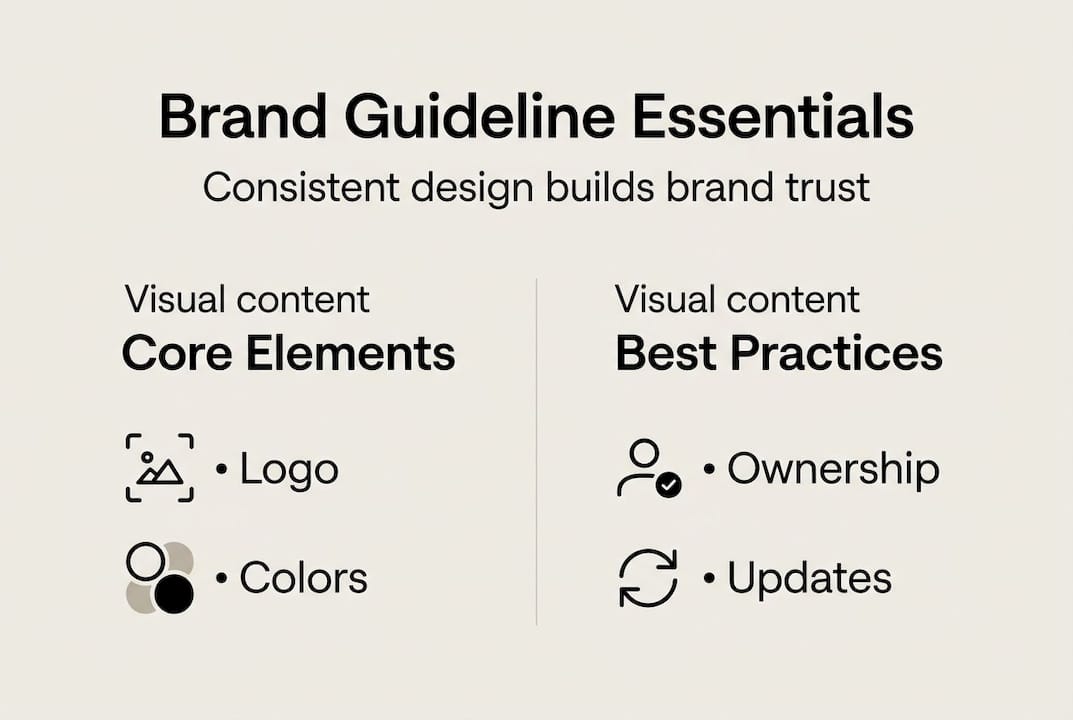
The mechanics of effective brand guidelines include logo variations, color palettes, typography rules, tone of voice, and clear do’s and don’ts. Formats range from simple PDFs to full digital hubs depending on your team size and complexity.
Here is a numbered list of what every small business brand guide should include:
Logo variations: Full color, black and white, reversed, and icon-only versions
Color codes: Hex, RGB, and CMYK values for every brand color
Typography rules: Font names, weights, sizes, and hierarchy (headings vs. body text)
Brand voice: 3 to 5 adjectives that describe your tone, with written examples
Imagery guidelines: Photo style, illustration rules, and what to avoid
Do’s and don’ts: Side-by-side visual examples of correct and incorrect usage
Following a clear visual branding process helps you build each of these elements in the right order so nothing gets skipped.
One critical best practice that most guides skip: assign ownership. Someone on your team needs to be responsible for maintaining and updating the guidelines. Without clear ownership, the document gets ignored and outdated within months.
Pro Tip: Use a branding checklist to audit your current materials against your brand guide every quarter. You will catch inconsistencies before they become expensive problems.
Living guidelines that get updated regularly are far more valuable than a perfect document that nobody uses. Build for clarity and accessibility first, perfection second.
Applying and enforcing brand guidelines: real-world strategies
Creating guidelines is the easy part. Getting your team, contractors, and partners to actually follow them is where most small businesses struggle. Here is how to make enforcement practical and sustainable.
Share guidelines immediately: Every new hire, contractor, or vendor should receive your brand guide on day one, not after the first mistake
Create a shared asset library: Store approved logos, fonts, and templates in a shared folder so there is no excuse for using outdated files
Run a short brand onboarding: A 15-minute walkthrough of your guidelines saves hours of corrections later
Assign a brand owner: One person is responsible for approving off-brand materials before they go public
Schedule quarterly reviews: Set a calendar reminder to review and update your guidelines as your business evolves
For small businesses, guidelines prevent costly mistakes, enable delegation, and speed up credibility-building by giving every team member a clear reference point.
“Brand guidelines are not about control. They are about giving your team the confidence to act independently without going off-brand.”
Here is a sobering reality: 95% of businesses have brand guidelines but only 25 to 30% actually enforce them. That enforcement gap is where 10 to 20% of revenue quietly disappears.
Edge cases require special attention. Co-branding partnerships, product line extensions, and seasonal campaigns all create moments where your guidelines get tested. Document how your brand should behave in these situations before they happen, not during.
Learning how to align branding and marketing ensures your guidelines translate directly into your campaigns, so every ad, email, and post reinforces the same brand story. Strong brand positioning for small business becomes much easier when your guidelines give your positioning a visual and verbal foundation to stand on.
The overlooked truth about brand guidelines for small business
Here is something most branding articles will not tell you: overly rigid guidelines can actually hurt your brand. Over-rigid guidelines stifle creativity when they are not made practical and accessible for the people using them.
We have seen small businesses spend weeks creating a 60-page brand bible that nobody reads. The document becomes a monument to effort, not a tool for growth. The most effective guidelines we have worked with are the ones that feel like a helpful reference, not a legal contract.
The real goal is clarity, not control. Your guidelines should empower your team to make good brand decisions independently. That means writing them in plain language, including real examples, and leaving room for creative judgment on edge cases.
Knowing when to bend your own rules without breaking your brand is a skill. A slightly different color treatment for a seasonal campaign is not a brand crisis. Using a completely different font family across your entire website is. Guidelines should make that distinction obvious.
Exploring digital branding tips will show you how living, adaptable guidelines perform better in fast-moving digital environments than static documents that get ignored. Build guidelines that grow with your business, and your brand will grow with them.
Get expert help building your brand guidelines
Building brand guidelines that your team will actually use takes more than a template. It takes a clear strategy, a deep understanding of your audience, and design expertise that translates your vision into a usable system.

At LOOM Brand Designs, we help entrepreneurs and small business owners create brand guidelines that are clear, practical, and built for real-world use. Whether you are starting from scratch or cleaning up an inconsistent brand, our Basic Branding Package gives you a professional foundation without the enterprise price tag. If you want a more hands-on approach, our Brand Development Consultation connects you directly with our branding team to build a strategy tailored to your business goals. Stop leaving revenue on the table and start building a brand that works.
Frequently asked questions
What is the main purpose of brand guidelines?
Brand guidelines ensure visual and verbal consistency across every customer touchpoint, helping your business build recognition, trust, and credibility over time.
How do brand guidelines save money for small businesses?
By preventing design errors, mismatched assets, and costly reprints, guidelines prevent costly mistakes and reduce the time your team spends making decisions from scratch.
How often should brand guidelines be updated?
Best practices recommend updating guidelines regularly as your business grows, typically every one to two years or whenever you refresh your messaging or visual identity.
Can brand guidelines be flexible?
Absolutely. Living guidelines that evolve with your business encourage creativity and keep your brand relevant without losing consistency.
Who should enforce brand guidelines in a small business?
Assign clear ownership to one person, often the founder or brand manager, to ensure guidelines are followed, updated, and applied consistently across all materials.
Recommended
Comments