


Brand refresh guide for SMEs: boost relevance in 2026
- jayanipiumika
- 5 days ago
- 10 min read

Your brand feels outdated, but a full rebrand seems too expensive and risky. Many SME owners face this dilemma, confusing brand refresh with costly complete overhauls. A strategic brand refresh modernizes your visual identity and messaging while preserving the equity you’ve built. This guide provides a clear roadmap to confidently execute a refresh that enhances market presence and customer engagement without breaking the bank.
Table of Contents
Key takeaways
Point | Details |
Brand refresh modernizes without losing identity | Updates visual and messaging elements while preserving core brand equity and customer recognition. |
Prerequisites ensure focused refresh | Brand audits and market research prevent costly mistakes and align refresh with business goals. |
Clear process drives success | Sequential steps from strategy to rollout keep refresh on track within 3 to 6 months. |
Avoid common pitfalls | Chasing trends and ignoring feedback cause 65% of refresh failures; strategic grounding matters. |
Measure with KPIs | Track brand awareness, retention, and engagement over 3 to 6 months to verify refresh impact. |
Understanding brand refresh: definition and strategic value
A brand refresh updates brand elements like your logo, color palette, typography, and messaging to modernize your image while keeping your core identity intact. Unlike a full rebrand that changes everything from strategy to visual identity, a refresh preserves what customers already recognize and trust. This distinction matters because your existing brand equity represents years of customer relationships and market positioning you don’t want to lose.
The benefits extend far beyond aesthetics. Brand refreshes improve market relevance and customer trust, which can increase brand awareness and enhance competitive edge. SMEs particularly benefit because refreshes cost significantly less than full rebrands while delivering measurable improvements in customer retention and engagement. When your competitors evolve their brands, staying static signals stagnation to your target audience.
Many business owners mistakenly view brand refresh as superficial window dressing. The reality is different. A strategic refresh addresses changing customer expectations, market trends, and competitive pressures that naturally emerge over time. Your brand must stay relevant to maintain its position in evolving markets.
A well-executed brand refresh signals growth and adaptation without abandoning the trust you’ve earned.
Consider these strategic advantages for SMEs:
Strengthens market positioning against larger competitors
Modernizes digital presence to meet current user expectations
Aligns brand perception with evolved business offerings
Increases customer confidence through visual professionalism
Supports expansion into new market segments
The misconception that refresh is purely cosmetic ignores its strategic impact on business growth and customer psychology. When executed properly, refresh transforms how customers perceive your brand’s relevance and credibility in 2026’s competitive landscape.
Prerequisites before starting your brand refresh
Rushing into visual updates without proper groundwork causes most refresh failures. Start with a comprehensive brand audit examining visual consistency, audience resonance, and technical performance across all touchpoints. A comprehensive brand audit uncovers broken elements and misaligned market positioning critical to success. This diagnostic phase reveals exactly what needs updating and what should remain unchanged.

Market research provides essential context for strategic decisions. Analyze current branding trends in your industry, study competitor positioning, and validate customer personas against your actual audience. Customer feedback through surveys, social listening, and sales conversations reveals perception gaps between your intended brand message and how the market actually views you.
Prepare a complete digital asset inventory before starting design work. Catalog existing logos, fonts, color codes, image libraries, and brand guidelines. This inventory prevents inconsistencies and helps designers understand your current brand ecosystem. Clear documentation saves time and reduces revision cycles during implementation.
Pro Tip: Create a shared folder with high-resolution versions of all brand assets tagged by platform and use case. This organization accelerates refresh execution and ensures nothing gets overlooked.
Establish realistic budget and timeline constraints upfront. Most SMEs underestimate the coordination required across marketing channels, web properties, and physical materials. Define what’s included in scope and what will wait for future phases.
Preparation element | Time required | Key outputs |
Brand audit | 2 to 4 weeks | Visual consistency report, performance metrics |
Market research | 2 to 3 weeks | Competitor analysis, trend insights |
Customer feedback | 1 to 2 weeks | Perception gaps, improvement priorities |
Asset inventory | 1 week | Cataloged files, usage documentation |
This groundwork phase typically takes 6 to 9 weeks but prevents expensive mistakes and ensures your refresh addresses actual strategic needs rather than subjective preferences. Businesses that skip these steps often realize mid-project they’re solving the wrong problems. Consider SME automation resources to streamline the audit and research phases efficiently.
Step-by-step brand refresh process for SMEs
Transform your brand audit and research into an actionable refresh strategy aligned with specific business goals. Define clear objectives like increasing market share in a new demographic or modernizing to compete with digital-first competitors. Your strategy document should connect each visual or messaging change to a measurable business outcome.
Define refresh strategy and objectives. Use audit findings to identify priority updates. Document specific goals like improving website conversion rates or increasing social media engagement. Create a project roadmap with milestones and success metrics.
Update visual identity elements. Modernize your logo while maintaining recognizable core elements customers associate with your brand. Refresh color palettes to reflect current design standards without abandoning brand recognition. Update typography for better digital readability across devices. Test updated visuals with customer focus groups before finalizing.
Refresh messaging and brand voice. Align your tone with current audience expectations and cultural context. Update value propositions to emphasize what matters most to customers in 2026. Revise your brand story to reflect business evolution while honoring your origins. Ensure messaging consistency across all customer touchpoints.
Implement systematically across touchpoints. Roll out refreshed brand to digital properties first: website, social profiles, email templates. Update physical materials like business cards and signage in coordinated phases. Coordinate timing to minimize customer confusion from inconsistent branding. Create implementation checklists for each channel.
Develop updated brand guidelines. Document exact specifications for logo usage, color codes, typography, and tone. Include do’s and don’ts with visual examples. Distribute guidelines to all team members and external partners. Guidelines ensure consistency as your brand scales.
Pro Tip: Launch your refresh with a customer communication campaign explaining the evolution. Transparency builds excitement and prevents confusion about whether you’re a new company.
Effective brand refresh timelines for SMEs range from 3 to 6 months depending on project scope and team size. Budget constraints often determine whether you tackle everything simultaneously or phase implementation across quarters. Most SMEs find hiring freelancers for specific tasks like logo redesign or website updates more cost-effective than agency packages.
Refresh phase | Duration | Budget allocation |
Strategy and planning | 4 to 6 weeks | 15 to 20% |
Visual identity updates | 6 to 8 weeks | 35 to 40% |
Messaging refresh | 3 to 4 weeks | 15 to 20% |
Implementation rollout | 4 to 8 weeks | 25 to 30% |
Consider strategic website design as your anchor implementation project because your website serves as the primary brand touchpoint for most customers. Starting with a brand development consultation helps clarify strategy before investing in execution. Pair visual updates with brand foundation SEO starter services to ensure your refreshed brand reaches target audiences effectively.
Common mistakes in brand refresh and how to avoid them
Chasing trendy design elements without strategic justification represents the most frequent refresh failure. Brands that adopt minimalism, gradients, or other visual trends purely because competitors use them end up looking generic rather than distinctive. Design trend chasing causes 65% of brand refresh failures when decisions ignore strategic fit. Instead, select design directions that authentically reflect your brand personality and resonate with your specific audience.
Ignoring customer input during refresh planning creates dangerous perception gaps. Your customers have existing associations with your brand that shouldn’t be dismissed. Integrating customer feedback throughout the refresh process reduces misalignment risks by approximately 50%. Survey customers about proposed changes and test new visual directions before full implementation.
Your brand belongs partly to your customers. Their perceptions matter as much as your strategic intentions.
Inconsistent implementation across channels confuses customers and dilutes refresh impact. When your website shows updated branding but social media, email, and physical materials lag behind, you signal disorganization rather than strategic evolution. Create detailed rollout timelines ensuring all touchpoints update within a compressed timeframe.
Pro Tip: Build a brand refresh launch calendar coordinating updates across all channels within a two-week window. Simultaneous rollout maximizes impact and minimizes confusion.
Additional critical mistakes to avoid:
Refreshing without measurable KPIs makes success evaluation impossible
Neglecting mobile-first design in visual updates alienates majority users
Underestimating implementation complexity leads to budget overruns
Failing to train team members on new brand guidelines causes inconsistency
Skipping legal trademark checks on updated logos risks infringement issues
Establish clear performance indicators before launch and monitor them rigorously for 3 to 6 months post-refresh. Track metrics like brand awareness, website traffic, conversion rates, and customer sentiment. Regular performance reviews enable quick adjustments if certain refresh elements underperform expectations.
Timeline, costs, and expected outcomes of a brand refresh
Set realistic expectations by understanding typical refresh parameters for businesses similar to yours. Most SMEs complete refreshes in 3 to 6 months with budgets running $5,000 to $20,000 using freelancers effectively. Timeline depends on project scope, team availability, and implementation complexity across your marketing channels.
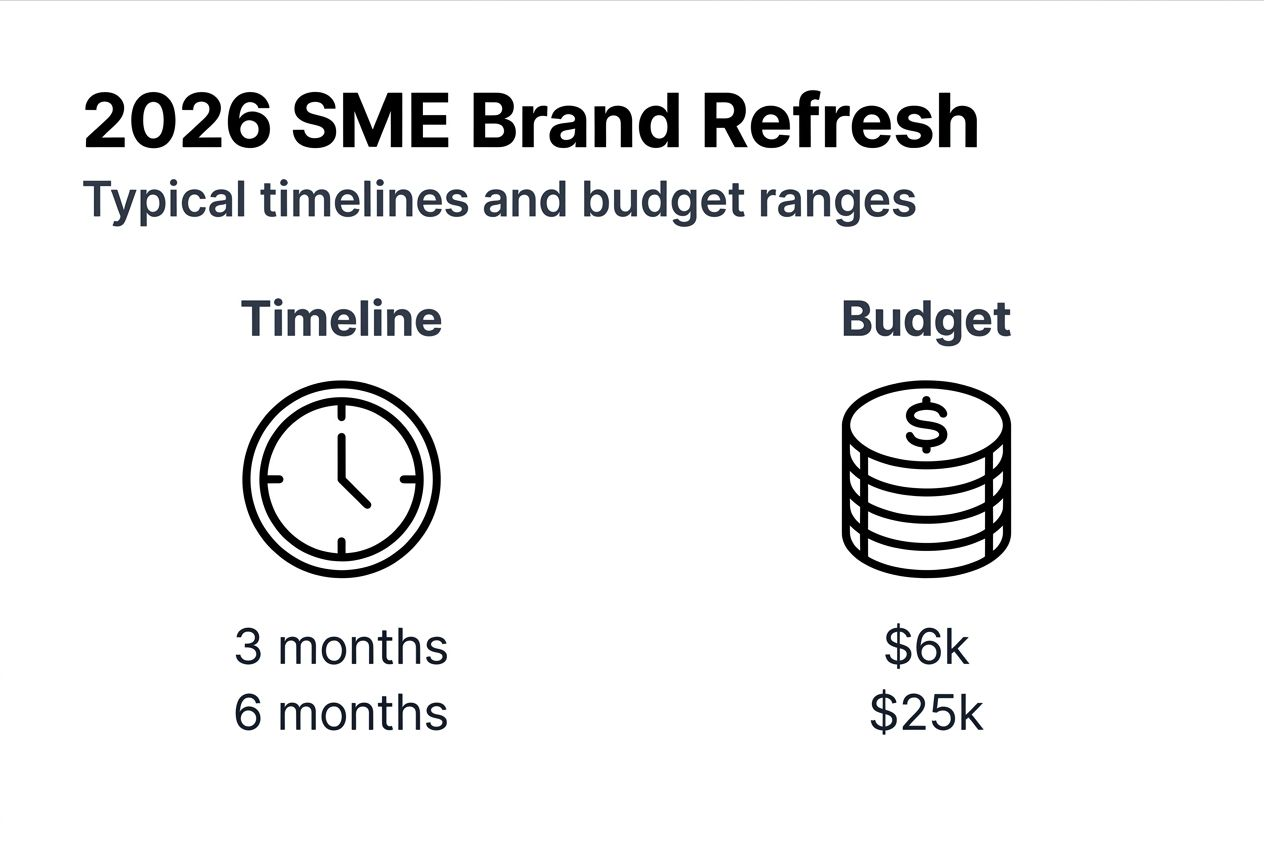
Smaller refreshes focusing on logo modernization and updated color palettes often complete in 3 months with budgets around $5,000 to $8,000. Comprehensive refreshes including website redesign, messaging overhaul, and complete guideline development typically require 5 to 6 months with budgets reaching $15,000 to $20,000. Agency partnerships cost more but provide managed services and faster timelines.
Approach | Typical cost | Timeline | Best for |
Freelance specialists | $5,000 to $12,000 | 4 to 6 months | Budget-conscious SMEs with internal project management |
Boutique agencies | $15,000 to $35,000 | 3 to 4 months | SMEs wanting hands-off managed services |
Full-service agencies | $30,000+ | 2 to 3 months | Larger budgets requiring comprehensive services |
Expected outcomes justify the investment when executed strategically. Brand consistency across digital platforms during a refresh can increase revenue by 10 to 20%. Beyond revenue growth, successful refreshes improve brand awareness metrics, strengthen customer retention rates, and boost digital engagement across channels. Customer trust indicators like Net Promoter Score typically increase 15 to 25% within six months of a well-executed refresh.
Measure success through these key performance indicators:
Brand awareness: aided and unaided recall in target markets
Customer retention: repeat purchase rates and customer lifetime value
Digital engagement: website traffic, social media interactions, email open rates
Conversion performance: lead generation and sales conversion improvements
Sentiment analysis: customer perception through surveys and social listening
ROI calculation should account for both quantitative metrics and qualitative improvements in market positioning. While revenue increases provide clear financial returns, enhanced brand perception creates long-term competitive advantages that compound over time. Most SMEs see full ROI within 12 to 18 months when refresh aligns with broader business growth strategies.
Leveraging 2026 branding trends and technology in your refresh
Contemporary branding prioritizes adaptive experiences over static visual systems. Your brand must flex across contexts, from social media stories to formal presentations, while maintaining recognizable consistency. This adaptability requires designing modular brand elements that work in various configurations rather than rigid templates applied uniformly everywhere.
Authenticity and humanized messaging continue gaining importance as customers grow skeptical of corporate polish. Brands that share genuine stories, admit imperfections, and communicate transparently build stronger emotional connections. Your refresh should incorporate authentic elements like behind-the-scenes content, founder stories, and real customer testimonials rather than stock photography and generic claims.
AI-driven brand credibility and search influence are top trends shaping brand refresh strategies in 2026. Search engines and AI assistants now evaluate brand consistency, authority signals, and digital presence when recommending businesses to users. Your refresh must optimize for AI recognition through consistent schema markup, comprehensive brand information, and authoritative content across platforms.
Pro Tip: Audit your brand’s presence across AI platforms like ChatGPT, Google’s AI overviews, and voice assistants. Inconsistent information damages credibility in AI-mediated searches.
Key technology considerations for your refresh:
Implement AI-powered personalization delivering customized experiences based on user behavior
Ensure digital consistency across platforms for improved AI recognition and recommendation
Optimize brand assets for voice search and conversational AI interfaces
Leverage data analytics predicting customer preferences and behavior patterns
Create interactive brand experiences using augmented reality or immersive web technologies
The shift toward AI integration doesn’t mean abandoning human connection. Instead, use technology to scale personalized experiences while maintaining authentic human touchpoints. Consider AI brand insights tools that analyze customer data to inform refresh decisions with actual behavior patterns rather than assumptions. Explore AI hyper-personalization marketing approaches that deliver tailored content matching individual customer journeys.
Your refresh should balance timeless brand elements with contemporary technology that enhances customer experience. Focus on solving actual customer problems through your brand rather than adopting technology for novelty. Strategic technology integration differentiates forward-thinking brands from those merely updating surface aesthetics.
Get expert support for your brand refresh
Executing a strategic brand refresh requires specialized expertise across design, messaging, and digital implementation. LOOM Brand Designs offers cost-effective packages specifically designed for SME budgets and timelines. Our team understands the unique challenges mid-sized businesses face balancing professional branding with practical budget constraints.
We provide comprehensive services from foundational brand strategy through final implementation across all your marketing channels. Our basic branding package delivers essential refresh elements including logo modernization, color palette updates, and core brand guidelines. For visual content needs, our professional graphic design services create cohesive materials maintaining your refreshed brand identity across all touchpoints.
Advanced options incorporate AI-powered tools that optimize your brand for 2026’s digital landscape. Our AI brand intelligence solutions analyze market positioning, competitor strategies, and customer sentiment to inform strategic refresh decisions with data rather than assumptions. Partnering with experienced professionals ensures your refresh drives measurable business results while staying within realistic SME budgets.
FAQ
What is the difference between a brand refresh and a full rebrand?
A brand refresh updates visual and messaging elements to modernize without changing core identity, while a rebrand is a complete overhaul often involving new brand strategy and identity. Refreshing preserves existing customer trust and brand equity you’ve built over years. Rebranding essentially starts from scratch and risks losing established market recognition.
How long does a typical SME brand refresh take?
Most SME brand refreshes take between 3 to 6 months depending on project scope and team size. Smaller updates focusing on visual elements complete faster, while comprehensive refreshes including messaging and full implementation require longer timelines. Proper planning and dedicated resources keep projects on schedule and prevent scope creep.
What are common mistakes to avoid during a brand refresh?
Chasing fleeting design trends without strategic grounding leads to generic rather than distinctive brands. Ignoring customer feedback creates misaligned brand perception that damages rather than improves market position. Poor implementation causing inconsistencies across channels confuses customers and dilutes refresh impact. Not measuring success with clear KPIs makes it impossible to evaluate whether your refresh achieved intended business objectives.
Can SMEs afford an effective brand refresh?
Yes, SMEs can afford effective brand refreshes often between $5,000 and $20,000 depending on scope and approach. Hiring skilled freelancers offers cost-effective alternatives to expensive agency packages while maintaining quality. Focused, strategic refresh maximizes return on investment by addressing priority brand elements that most impact customer perception and business growth.
Recommended
Comments