


Unlock efficiency: the role of automation in marketing
- Pawan Samarakoon
- 1 day ago
- 8 min read

TL;DR:
Automation enhances personalized marketing by freeing teams from repetitive tasks.
Proper implementation requires careful data unification, targeted workflows, and ongoing monitoring.
Over-automation and ethical missteps can erode customer trust; human oversight remains crucial.
Marketing automation has a reputation problem. Many SME owners assume it means swapping their team for robots and blasting generic emails at scale. The reality is almost the opposite. When implemented with intention, automation makes your marketing more personal, not less. It frees your team from repetitive tasks so they can focus on strategy, creative thinking, and genuine relationship building. This guide breaks down the core components of automation, the real benefits it delivers, the risks to watch for, and a practical roadmap for getting started without losing the human touch that makes your brand worth knowing.
Table of Contents
Key Takeaways
Point | Details |
Start small and scale | Automate basic workflows first, then expand with feedback for best results. |
Human touch matters | Avoid over-automation to protect trust and customer value. |
Measure for improvement | Regularly track KPIs like conversion rates and customer retention. |
Ethics are crucial | Respect consent and avoid tactics that could risk your reputation. |
Core components and evolution of marketing automation
Marketing automation is the use of software to handle repetitive marketing tasks, trigger actions based on customer behavior, and measure campaign results without manual intervention every step of the way. For SMEs, it is not about replacing your team. It is about giving them leverage.
At its core, a solid marketing automation guide confirms that automation covers five pillars: data collection, segmentation, lead scoring, workflow automation, and reporting. Understanding each one helps you invest in the right tools.
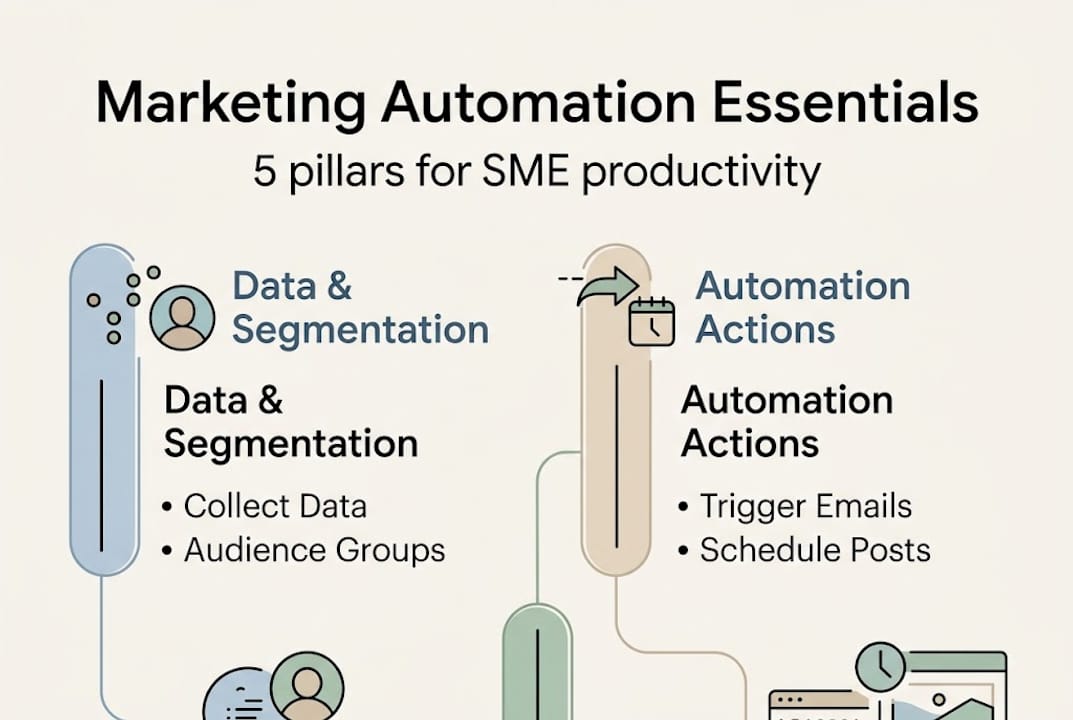
Component | What it does | SME example |
Data collection | Gathers customer info from web, email, CRM | Sign-up forms, site tracking |
Segmentation | Groups contacts by behavior or profile | First-time buyers vs. repeat customers |
Lead scoring | Ranks leads by purchase readiness | High score = sales outreach priority |
Workflow automation | Triggers actions based on set conditions | Welcome email after sign-up |
Reporting | Tracks results and campaign performance | Open rates, conversions, ROI |
Today’s platforms have made these capabilities remarkably accessible. Tools like HubSpot, Mailchimp, and ActiveCampaign offer tiered pricing that works for businesses with small teams and tight budgets. The barrier to entry has dropped significantly over the last five years.
Here are real examples of what automation looks like in practice for an SME:
An automated welcome email sent within minutes of a new subscriber joining your list
A birthday discount delivered automatically to loyal customers
Lead scoring that flags hot prospects for your sales team to prioritize
A re-engagement sequence triggered when a contact has not opened emails in 90 days
Abandoned cart reminders that recover lost revenue without any manual effort
For SMEs exploring how technology can elevate their marketing, AI marketing use cases are worth understanding alongside automation since they often work hand in hand. Similarly, streamlining marketing workflows is a natural next step once your automation foundation is in place.
Pro Tip: Start with one or two high-impact automations like a welcome sequence or a lead follow-up flow before expanding. Trying to automate everything at once is how strategies break down.
Benefits automation delivers to growing businesses
With the fundamentals covered, it is time to see what automation can really do for your business.
The most immediate benefit is time. When your tools handle scheduling, follow-ups, and reporting automatically, your team gets hours back every week to focus on work that requires human creativity and judgment. But the advantages go well beyond saving time.

Research confirms that digital transformation boosts SME marketing performance, with social media serving as a key channel where automation amplifies results. Consistent posting, automated responses, and behavior-triggered ads all become possible without hiring extra staff.
Here is how manual and automated marketing tasks compare side by side:
Task | Manual approach | Automated approach |
Campaign setup | Hours of manual entry | Template-based, launches in minutes |
Lead follow-up | Sales rep sends emails individually | Triggered sequence based on behavior |
Reporting | Pulled manually from multiple sources | Dashboard auto-updates in real time |
Audience segmentation | Done periodically, prone to error | Updated dynamically as data changes |
Social media posting | Scheduled one post at a time | Queued weeks in advance, auto-published |
The measurable benefits SMEs report most often include:
Higher lead conversion rates due to timely, relevant follow-up
Reduced human error in campaign execution
Greater consistency across email, social, and ad channels
Faster campaign launches with reusable templates
Better customer retention through automated loyalty and re-engagement programs
If you are building out your broader marketing approach, reviewing core digital marketing tactics will help you see where automation fits into the full picture. You can also dig into AI in marketing ROI to understand how these tools measure and multiply your returns.
Pitfalls and ethical considerations in automation
While automation offers many advantages, it also carries risks and ethical responsibilities that every business must consider.
Over-automation is more common than you might think. When businesses automate too aggressively, they stop feeling like businesses run by people and start feeling like machines processing transactions. Customers notice. And when they do, they leave.
Over-automation erodes trust and reduces customer lifetime value. High-stakes interactions like complaints must never be automated, and human feedback loops must remain in place.
Here are the top pitfalls to avoid when building out your automation strategy:
Automating sensitive interactions. Customer complaints, billing disputes, or any high-emotion situation must be handled by a real person. An automated response to a frustrated customer makes things worse, not better.
Skipping consent. Sending automated messages to contacts who did not explicitly opt in is both unethical and illegal in many states. Always build permission into your data collection process.
Manufacturing urgency. Fake countdown timers or “limited time” claims generated by automation damage trust the moment customers figure it out. And they always figure it out.
Replacing judgment with rules. Automation runs on logic: if this, then that. It cannot read context. Relying on it to handle nuanced situations without human oversight leads to tone-deaf responses that alienate your audience.
Ignoring feedback signals. If your unsubscribe rates climb or engagement drops, automation will keep sending anyway unless a person reviews the data and adjusts the strategy.
Ethical marketing automation requires businesses to ask a simple question before deploying any sequence: would you be comfortable if your customers could see exactly how this message was generated? If the answer is no, it needs a second look.
A strong SME brand strategy builds trust over time, and your automation practices either reinforce or undermine that trust at scale.
Pro Tip: Reserve 20 to 30 percent of customer interactions for genuine human connection, especially with high-value accounts, new clients, and anyone expressing dissatisfaction.
How to implement marketing automation for maximum results
Knowing the risks and rewards makes it far easier to start implementing automation confidently.
The biggest mistake SMEs make is jumping straight to complex workflows before they have clean data or a clear goal. A thoughtful rollout beats a rushed one every single time. Gradual implementation with feedback loops consistently outperforms big-bang automation launches.
Follow these steps to build your automation the right way:
Unify your customer data. Pull contact data from your CRM, website, email platform, and social channels into one place. You cannot segment or personalize effectively if your data lives in silos.
Define your audience segments. Group contacts by behavior, purchase history, or lifecycle stage. Even two or three segments will dramatically improve message relevance.
Set up your first simple workflows. A welcome email sequence and a lead nurture flow are the best starting points. The 2025 state of marketing trends confirms that SMEs should start with simple workflows before layering in AI or complex branching logic.
Measure what matters. Track lead quality, conversion rates, and email engagement from day one. These numbers tell you whether your automation is working or just running.
Gather feedback and iterate. Ask your sales team what leads look like after automation touches them. Ask customers how they feel about your communication frequency. Use that input to refine your flows.
Tools and tactics to consider at each stage:
Data unification: HubSpot CRM, Zoho CRM, or a simple spreadsheet to start
Email automation: Mailchimp, ActiveCampaign, or Klaviyo for e-commerce
Social scheduling: Buffer or Hootsuite for consistent posting
Lead scoring: Built into most mid-tier CRM platforms
Reporting: Google Analytics connected to your automation platform
For SMEs looking at AI use cases for SMEs, AI-driven personalization is a natural expansion once your basic automation is running smoothly. If you want hands-on help building your first flows, the automation kickstart package is designed specifically for small business teams.
Why automation is a mindset shift, not just a tool
Here is something most automation guides will not tell you: the technology is the easy part.
The real transformation happens when your team stops thinking of automation as a shortcut and starts treating it as a system that needs oversight, empathy, and continuous refinement. We have seen businesses invest in sophisticated platforms and get disappointing results because no one stopped to ask what the customer actually needs at each touchpoint.
Automation works best when a marketer with genuine customer understanding is steering it. It should surface insights, handle repetition, and free up your people to have better conversations, not replace those conversations entirely.
The businesses that win with automation are not the ones with the most complex workflows. They are the ones who use it to show up consistently, respond quickly, and create space for the human moments that build real loyalty. Understanding the broader AI impact on marketing helps frame automation not as a threat to authenticity but as the infrastructure that makes authentic connection scalable.
Treat automation as a partnership between your tools and your team. That mindset shift is what separates businesses that scale from businesses that stall.
Amplify your marketing with the right automation tools
If you are ready to put these strategies into practice, the right support makes all the difference. At LOOM Brand Designs, we work with SMEs to build automation systems that save time, generate better leads, and maintain the brand voice your customers trust.
Our kickstart automation journey package gives your team a proven starting point without the guesswork. We also offer website design solutions that integrate with your automation stack from day one, and branding package options that ensure every automated touchpoint reflects a consistent, professional identity. Automation performs best when the brand behind it is strong. Let us help you build both.
Frequently asked questions
What are examples of marketing automation for small businesses?
Examples include automated welcome emails, abandoned cart reminders, birthday discounts, and lead follow-up sequences tailored to customer behavior. These are all driven by workflow automation and behavior-triggered communications.
How do I measure the ROI of marketing automation?
Track metrics such as lead quality, conversion rates, and customer retention to assess the impact of your automations. Lead quality and conversion rates are the clearest signals of real ROI.
What should not be automated in marketing?
Never automate high-stakes or sensitive interactions such as customer complaints or complex feedback situations. These require a human touch, as high-stakes interactions handled by automation almost always damage trust.
Are there ethical risks associated with automation?
Yes, overuse can lead to impersonal experiences, consent issues, or manufactured urgency. Ethical pitfalls include poor consent handling and replacing human judgment with rigid rules, so always review your practices with ethics in mind.
How should SMEs begin their marketing automation journey?
Start small with unified customer data and simple workflows, then expand gradually while measuring impact and getting team feedback. Starting with simple workflows before adding complexity is the approach most likely to deliver lasting results.
Recommended
Comments