


Why Social Media Ads Matter: Grow Your Business Online
- Pawan Samarakoon
- 2 days ago
- 9 min read
TL;DR:
Organic social reach is declining, making paid social ads essential for targeted visibility.
Social media ads deliver measurable growth through precise targeting and retargeting strategies.
Successful advertising requires clear branding, aligned messaging, and integration with overall marketing efforts.
Most small business owners pour time into organic social media posts, believing consistency alone will build their audience. It won’t. Organic social reach is declining across every major platform, and the businesses that keep relying on it are slowly becoming invisible. Social media ads change that equation fast. They put your brand in front of the exact people who are ready to buy, not just whoever happens to scroll past. In this article, you’ll learn why organic strategies have real limits, how paid social ads deliver measurable growth, and how to use them strategically to grow your business online in 2026.
Table of Contents
Key Takeaways
Point | Details |
Ads expand reach | Paid social ads help small businesses reach more customers than organic posts alone. |
Targeting boosts ROI | Advanced targeting options ensure your ads reach the right audience for better results. |
Integration maximizes impact | Combining social ads with other marketing strategies leads to greater business growth and brand recognition. |
Expert advice pays off | Consulting professionals prevents costly ad mistakes and accelerates success. |
The limitations of organic social media
Organic social media feels free, so it’s easy to assume it’s a sustainable growth engine. But that assumption costs businesses more than they realize. Understanding what social media marketing means in 2026 requires accepting a hard truth: platforms are businesses too, and they prioritize content that generates ad revenue, not content that benefits your brand.
Algorithms on Facebook, Instagram, and LinkedIn have systematically reduced the organic reach of business pages over the past decade. A post that reaches 1,000 followers organically might have reached 10,000 just five years ago. The math simply doesn’t favor the small business owner who’s posting three times a week hoping for viral traction.
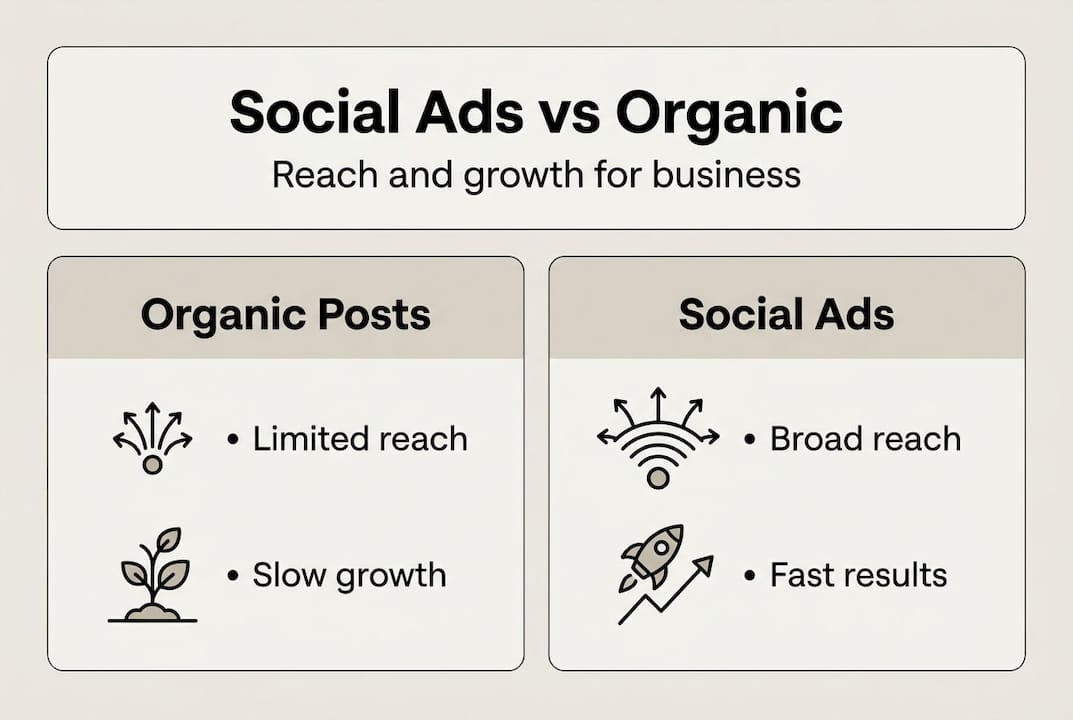
Here’s a quick look at what organic vs. paid reach typically looks like across key platforms:
Platform | Average organic reach | Average paid reach potential |
2-5% of followers | Up to 100% of target audience | |
5-10% of followers | Highly scalable with budget | |
10-15% of followers | Precise B2B targeting available | |
TikTok | Variable, trend-dependent | Broad reach with low CPM |
The numbers make the case. Even on LinkedIn, where organic reach is relatively higher, you’re still only touching a fraction of your audience. And there’s another layer to this problem: social media and mental health research shows users are becoming more selective about the content they engage with, making it even harder for business posts to stand out organically.
Here are the most common pitfalls SMBs run into when skipping paid ads:
Spending hours creating content that fewer than 5% of followers ever see
Relying on hashtags and trends that change faster than your posting schedule
Missing high-intent buyers who aren’t yet following your account
Losing ground to competitors who are running consistent paid campaigns
Having no reliable way to test messaging or creative at scale
Pro Tip: Posting consistently still matters for credibility, but it should be the floor, not the ceiling, of your strategy. Even a modest paid amplification budget can multiply the reach of your best-performing organic posts without starting from scratch.
After understanding why organic strategies fall short, we can explore how social media ads fill these gaps and deliver targeted results.
How social media ads drive business growth
Paid social ads don’t just boost visibility. They create a direct, measurable path from audience attention to business revenue. That’s a fundamental difference from organic content, where the connection between a post and a sale is fuzzy at best.
Social ads provide scalable exposure and boost business expansion in ways organic content simply cannot replicate. When you run a paid campaign, you choose exactly who sees it, when they see it, and what action you want them to take next. That level of control is powerful for any SMB trying to grow efficiently.
Businesses that incorporate digital marketing tactics like paid social consistently report higher engagement rates, better lead quality, and shorter sales cycles compared to organic-only strategies. And the visual side matters too: strong graphic design for engagement can amplify ad performance significantly, with well-designed creatives driving up to 650% higher engagement compared to generic imagery.
Here are three core ways social media ads help SMBs grow:
Brand growth: Ads put your business in front of cold audiences who’ve never heard of you, building recognition at scale without waiting for an algorithm to favor your content.
Lead generation: With lead-capture ad formats on Facebook and LinkedIn, you can collect prospect information directly inside the platform, reducing friction and increasing conversion rates.
Retargeting: Showing ads to people who already visited your website or engaged with your content keeps your brand top-of-mind and dramatically improves purchase likelihood.
Let’s look at what makes paid social performance stand apart:
Immediate results: You can launch a campaign today and have data tomorrow
Budget flexibility: You control daily spend and can pause anytime
A/B testing: Test two versions of an ad simultaneously to identify what works
Cross-platform reach: Run coordinated campaigns across Facebook, Instagram, and LinkedIn from a single dashboard
Organic content builds trust slowly. Paid ads accelerate that trust by putting your message in front of the right people at the right moment. Understanding the power of paid ads, let’s break down how to craft campaigns that maximize your business’s unique goals.
Targeting strategies for effective social ads
The biggest advantage social media ads have over traditional advertising is targeting. You’re not buying a billboard and hoping the right person drives past. You’re selecting exactly who sees your ad based on detailed audience data.
Advanced targeting is a critical factor for ROI in social media advertising. Platforms like Facebook and LinkedIn give advertisers access to audience filters that would have been impossible a decade ago. A marketing strategy course might call this segmentation, but in practice it’s simply about knowing your customer and using the platform’s tools to find more people who look like them.

Here’s how basic and advanced targeting compare:
Targeting type | Basic approach | Advanced approach |
Demographics | Age, gender, location | Income level, life events, job title |
Interests | Broad category targeting | Niche behavior-based signals |
Retargeting | Website visitors | Specific page visitors, cart abandoners |
Lookalike audiences | Basic similarity matching | Multi-layer signal modeling with AI |
A solid SME brand strategy always starts with audience clarity, and that clarity translates directly into better targeting decisions. If you know your customer is a 35 to 50 year old female small business owner in Texas interested in branding and design, you can build that exact audience in Facebook Ads Manager in about five minutes.
Key actions to sharpen your targeting:
Narrow by location, age, and income to avoid wasting budget on unlikely buyers
Use retargeting to re-engage website visitors who didn’t convert the first time
Leverage AI-powered audience suggestions built into platforms like Meta and LinkedIn
Exclude existing customers from acquisition campaigns to reduce redundant spend
Test one variable at a time so you know exactly what’s driving performance changes
Pro Tip: Lookalike audiences are one of the fastest growth levers available to SMBs. Upload your existing customer email list to Facebook or LinkedIn, and the platform will find new users who share similar characteristics. This is how a local business starts reaching genuinely high-potential prospects it never would have found through organic search.
With targeting strategies in hand, let’s see how social ad campaigns fit into the bigger picture of SMB digital marketing in 2026.
Integrating social ads into your overall marketing strategy
Running social ads in isolation is like turning on one burner and expecting the whole stove to heat up. The real power comes when paid social works in sync with your other marketing channels. That means your ads, your website, your email campaigns, and your content all tell the same story.
Omnichannel strategies elevate branding and marketing ROI consistently outperform single-channel approaches. When a potential customer sees your ad on Instagram, clicks to your website, and then receives a follow-up email with a related offer, the experience feels cohesive. That coherence builds trust faster than any single touchpoint can.
Tools powered by AI in marketing now make cross-channel coordination more accessible for SMBs than ever. Automated sequences, dynamic ad creative, and real-time analytics help smaller teams compete with enterprise-level efficiency. And avoiding branding mistakes across channels, like inconsistent logos, mismatched tone, or conflicting offers, is critical when running multi-channel campaigns.
“Businesses that align their paid social ads with their content marketing and email strategy see significantly stronger conversion rates and customer lifetime value than those running disconnected campaigns.” — Digital Marketing Integration Insight, 2026
Actionable tips for blending your strategies:
Use unified messaging across your ad copy, landing pages, and email sequences
Synchronize campaign launches so your social ads and email campaigns promote the same offer simultaneously
Track cross-channel analytics using tools like Google Analytics 4 to see the full customer journey
Repurpose high-performing organic content as paid ad creative to reduce production time
Pro Tip: Coordinate your paid social campaigns with seasonal content pushes and email promotions. When all three fire at the same time around a single offer, the combined effect is far greater than each channel working separately.
With a clear integration strategy, business owners can now discover the real-world lessons and unexpected truths about social media ads.
The uncomfortable truth about social media ads for SMBs
Here’s what most marketing guides won’t tell you: social media ads will expose every weakness in your business faster than almost anything else. If your landing page is confusing, your ads will drive traffic that bounces immediately. If your brand messaging is unclear, even the most precisely targeted campaign will underperform. Paid ads are an accelerator, not a solution.
We’ve seen SMBs blow through $2,000 in ad spend chasing viral-style video content when a simple, clear offer with a strong call to action would have outperformed it at half the budget. The obsession with looking impressive on social media is one of the most expensive mistakes in this space.
The latest digital marketing trends confirm what we’ve observed directly: brands that invest in clarity first, then scale with ads, consistently outperform those that throw budget at ads hoping they’ll fix a broken funnel. Your ad is only as strong as the destination it sends people to and the brand it represents.
Treat paid social as the amplifier that it is. Nail your message, clean up your website, tighten your offer, and then let ads pour fuel on that fire.
Enhance your online presence with expert branding and ad solutions
The strategies covered in this article only work as well as the brand behind them. If your visual identity, messaging, and website aren’t aligned, even the best-targeted ad campaign will leave money on the table.
At LOOM Brand Designs, we help SMBs build the foundation that makes every ad dollar count. From our basic branding package that gives your business a professional identity, to full website design and development that converts ad traffic into real customers, we offer end-to-end digital solutions. Our team also handles video editing and social ad creative so your campaigns look as sharp as they perform. Ready to see what a coordinated digital strategy looks like for your business? Let’s build it together.
Frequently asked questions
How much should a small business spend on social media ads?
Start with $100 to $500 per month and scale up as you identify what’s working. Social ads can be scaled incrementally, so you never have to risk more than your current results justify.
Which platforms are best for social media advertising?
Facebook and Instagram work well for most SMBs, but the right platform depends on where your audience spends time. Platform selection depends on your specific audience demographics and industry focus.
Can social media ads really boost brand awareness and sales?
Yes, consistently. Paid ads boost brand recognition and drive measurable sales growth when campaigns are built around clear objectives and strong creative.
What targeting options are available in social media ads?
You can target by age, location, interests, behaviors, and lookalike audiences. Advanced targeting increases ad effectiveness by ensuring your budget reaches only the most relevant prospects.
Should I run my own ads or hire an expert?
For SMBs new to paid social, working with an expert reduces costly trial-and-error significantly. Professional guidance boosts ad success rates and helps you avoid the most common budget-wasting mistakes.
Recommended
Comments