


SEO's role in marketing: elevate growth in 2026
- Pawan Samarakoon
- 11 hours ago
- 8 min read

TL;DR:
SEO now integrates content, technical health, authority, and user experience as a strategic whole.
AI shifts reduce organic clicks, emphasizing quality, authority, and local SEO for resilience.
Modern SEO is a long-term, adaptable infrastructure critical for sustainable marketing growth.
Search engines are changing faster than most marketing playbooks can keep up with. AI Overviews reduce clicks by up to 58%, yet many business owners still treat SEO as a simple keyword exercise. That gap between what SEO actually does and how it’s being used is costing companies real visibility and real revenue. This guide cuts through the noise. You’ll walk away with a clear picture of SEO’s true role in your marketing strategy, what’s shifting in 2026, and exactly how to position your business to capture growth others will miss.
Table of Contents
Key Takeaways
Point | Details |
SEO is foundational | Successfully marketing online starts with a strong SEO strategy that connects all channels. |
AI is changing search | Emerging AI features demand fresh SEO tactics for maintaining and growing traffic. |
Channel integration wins | Combining SEO with content, paid ads, and social is the best way to maximize growth. |
Continuous adaptation | Businesses that adapt their SEO strategies quickly will outperform those who only follow old rules. |
How SEO powers your marketing engine
Most business owners think of SEO as a checklist: stuff some keywords into a page, build a few links, and wait for Google to send traffic. That mental model is outdated. Today, SEO is the connective layer that ties your content strategy, website performance, brand authority, and every other marketing channel into one coherent signal. It doesn’t operate in a silo. It amplifies everything else.
Think of it this way: you can run the best social media campaign in your category, but if your website is slow, your pages aren’t indexed, or your content doesn’t match search intent, that traffic hits a wall. SEO removes the wall. It makes sure your investment in digital marketing tactics actually converts into discoverable, rankable, trust-building content.
Here’s what modern SEO actually covers for a marketing manager or business owner:
Technical health: Site speed, crawlability, mobile optimization, and core web vitals
Content alignment: Matching what you publish to what your audience actually searches for
Authority signals: Earning links, mentions, and engagement that tell search engines you’re credible
User experience: Making sure visitors stay, engage, and convert once they arrive
Integration: Feeding insights from search data into your paid, email, and social strategies
The industry itself reflects this shift. 59% of SEO roles are now classified as strategic or senior-level, which tells you something important: companies that are winning with SEO aren’t just hiring technical fixers. They’re hiring strategists.
“SEO has moved from the back room to the boardroom. It now informs go-to-market strategy, content investment, and competitive positioning at the C-suite level.”
The role of AI and digital marketing tools is accelerating this shift even further. Businesses that still treat SEO as a one-time technical project are falling behind those who treat it as an ongoing strategic function.
The bottom line for marketing managers: SEO isn’t one channel among many. It’s the infrastructure that makes every other channel perform better.
SEO, content, and brand visibility: What actually works
Knowing SEO powers the entire engine, let’s explore how it intersects with content and brand visibility.
Content without SEO is like a billboard on a road with no traffic. You might have excellent writing, compelling offers, and a strong brand voice. But if search engines can’t understand what your content is about, or if it lacks the trust signals Google looks for, it simply won’t reach the people who need it.

The framework powering this is called E-E-A-T, which stands for Experience, Expertise, Authoritativeness, and Trustworthiness. E-E-A-T is crucial especially for YMYL (Your Money or Your Life) topics like finance, health, and legal services. If your business operates in any of these categories, your content strategy has to prioritize demonstrable credentials, real author bios, and well-sourced claims.
Here’s what actually drives results in 2026:
Topical authority: Publishing content clusters around one core subject tells Google you’re the expert. A single great article rarely outranks a site with 20 deeply related, well-linked pieces.
Schema markup: Adding structured data like FAQ schema or review schema doesn’t directly boost rankings, but it makes your listing stand out with rich results, stars, and expanded text that attract more clicks.
Brand mentions and citations: Getting your brand name mentioned, even without a link, builds trust signals Google picks up on.
Effective communication: Strong communication skills translate directly into better content that ranks and converts.
One common pitfall we see constantly: businesses over-optimize for search engines and forget they’re writing for humans. Pages crammed with keywords, robotic phrasing, and no real insight don’t just fail to rank. They damage brand perception when someone does land on them.
Pro Tip: Build content clusters around three to five core topics that map directly to your service offerings. Link every piece back to a central pillar page. This structure signals topical depth to search engines while making your site far easier to navigate for actual visitors. Start with our SEO brand foundation package if you need a structured starting point.
Authenticity and depth win over volume every time. Two strong articles beat ten thin ones.
Comparing SEO with other key marketing channels
Once you recognize SEO’s strengths, it helps to see how it stacks up against other critical marketing channels.
Channel | Startup cost | Time to results | Longevity | Best for |
SEO | Low to medium | 3 to 6 months | Long-term | Sustainable traffic, brand authority |
Paid search | High ongoing | Immediate | Short-term | Fast leads, product launches |
Social media | Low to medium | Weeks | Medium-term | Engagement, community, awareness |
Email marketing | Low | Days | Ongoing | Retention, repeat sales |
No single channel wins across every dimension. The key is understanding what goal you’re trying to hit.
For sustainable, compounding growth, SEO is unmatched. Once a page ranks, it keeps generating traffic without ongoing ad spend. Paid search delivers speed but stops the moment you cut the budget. Social builds community but rarely drives consistent purchase intent. Email is powerful for retention but depends on a list you’ve already built.
Here’s a sequential plan for developing an integrated channel strategy:
Audit your current search visibility before spending on any paid channel
Map content to your buyer journey so SEO and email work together at every stage
Use paid search to test messaging before investing in long-form SEO content
Feed social engagement data back into your content calendar to find what resonates
Review your marketing channel tactics quarterly as search behavior shifts
Here’s the critical stat for 2026: AI Overviews reduce clicks from search results by 58%. That changes the ROI equation significantly. Organic traffic volume may shrink even if your rankings hold. This makes content quality, brand searches, and direct traffic more valuable than ever. It also makes paid ads more competitive as more brands shift spend there.
The smartest move is an integrated approach where SEO informs every other channel rather than operating separately from it.
What’s changing: AI, zero-click searches, and advanced SEO
With these channel comparisons in mind, let’s look at what’s shifting in SEO strategy right now.
Google’s AI Overviews are answering questions directly on the search results page. Users get the answer without clicking. For informational queries, this is already reshaping traffic patterns across every industry. Some niches are hit harder than others.
Industry | Estimated click rate impact after AI Overviews |
Health and wellness | High impact, up to 60% click reduction |
Finance and legal | High impact, increased scrutiny on authority |
E-commerce and retail | Moderate impact, product queries less affected |
Local services | Lower impact, map and local pack results hold |
B2B and SaaS | Variable impact, intent-specific queries still click |
So what do you prioritize? Technical SEO acts as a necessary defense in this environment, making sure your site is crawlable, fast, and eligible for featured placements. Programmatic SEO can scale if your data is unique and genuinely useful, not just templated pages stuffed with slightly different keywords.
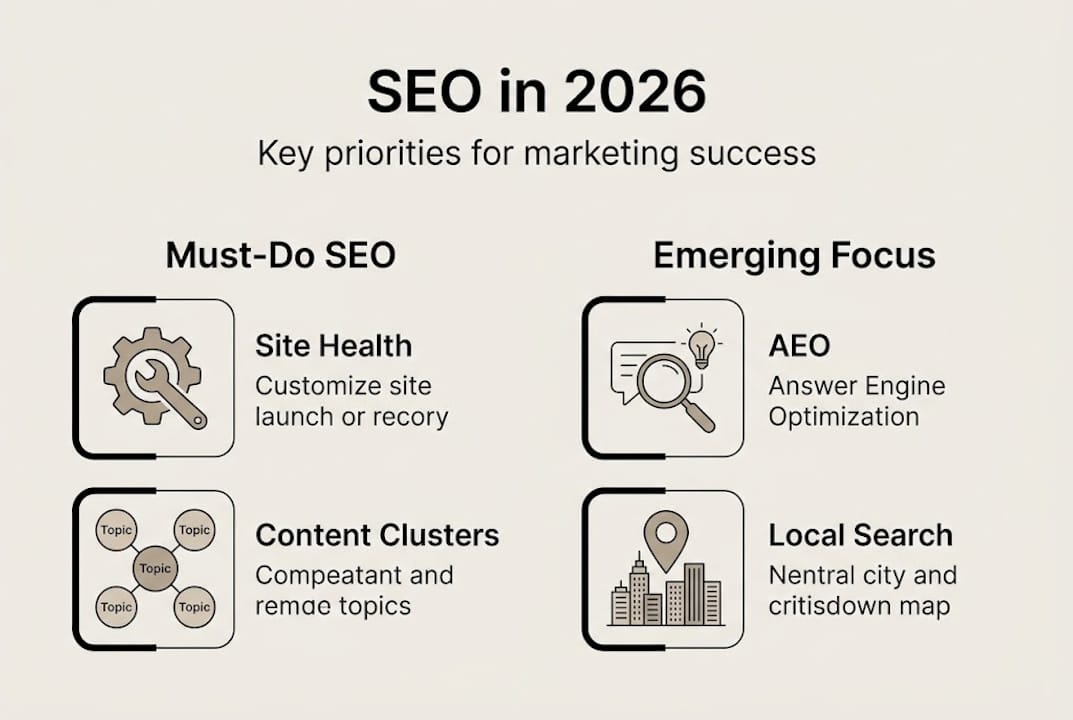
Local SEO remains one of the most resilient strategies for service businesses. Map pack results, Google Business Profile optimization, and local citation building are less disrupted by AI Overviews. If your business serves a specific geographic area, this is still a strong bet.
Answer Engine Optimization (AEO) is emerging as a complement to traditional SEO. It focuses on structuring content so AI systems pull it as a trusted source, even when users don’t click through. If your brand gets cited in an AI-generated answer, that’s visibility with no click required but still massive brand exposure.
Pro Tip: Stop obsessing over ranking positions alone. Track branded search volume, direct traffic growth, and engagement metrics on your content. These signals reveal whether your SEO is building genuine authority, which is what sustains growth even as click rates shift. Explore how AI transforms marketing to find tools that help you monitor these deeper signals effectively.
For a strong grasp of AI marketing use cases and how they apply to your specific business model, dive into resources designed for SMB growth. And always ground your strategy with solid search optimization basics before chasing advanced tactics.
Why SEO is still your marketing superpower—if you adapt fast
Here’s what most business leaders get wrong: they hear that AI is disrupting search and conclude SEO is dying. It’s not. What’s dying is the old version of SEO, the one built on keyword stuffing, generic content, and gaming algorithms.
The businesses quietly winning right now are pivoting fast. They’re investing in programmatic strategies with genuinely unique datasets, localized content that AI can’t replicate, and intent-driven pages that answer real questions with real depth. These aren’t complex moves. They require strategy, not just tactics.
The fatal error we see repeatedly is treating SEO as a checkbox: do it once, file it away, move on. SEO’s role is increasingly strategic, meaning it should sit alongside your annual marketing plan, your product launches, and your sales conversations. Not below them.
Adaptability is the real differentiator now. The businesses that win in search over the next three years won’t be the ones with the biggest budgets. They’ll be the ones who respond to algorithm shifts quickly, create content with genuine authority, and build brand growth strategies that treat SEO as a living system, not a static project.
Ready to amplify your growth with powerful SEO?
If you’re ready to move beyond theory and unlock the marketing power of SEO, we can help you get there with strategies built for how search actually works in 2026.
At LOOM Brand Designs, we pair expert-level search engine optimization with a complete digital foundation that includes website design and development and brand positioning that makes your business stand out in any search environment. Whether you’re starting fresh with a basic branding package or scaling an existing presence, we offer free consultations and custom packages designed around your specific goals. Book your strategy session today and let’s build something that performs.
Frequently asked questions
What is the main role of SEO in modern marketing?
SEO connects your business with customers actively searching for what you offer and acts as the foundation for visibility across all your marketing channels. It’s the infrastructure that makes every other channel more discoverable and effective.
How has AI impacted the effectiveness of SEO?
AI Overviews reduce clicks by up to 58%, which means traditional traffic volume from organic rankings is shrinking. This makes content quality, brand authority, and intent-matched strategy more critical, not less.
Is SEO more important than paid advertising for growth?
SEO builds compounding, long-term visibility while paid ads deliver fast but temporary results. Both serve distinct roles in a multi-channel strategy, and the strongest growth comes from using them together.
What’s the most common SEO mistake businesses make?
Most businesses focus only on keywords or technical fixes while ignoring the trust-building and authority signals that actually drive sustained rankings. SEO’s true role is strategic, not just technical.
When does schema matter for marketing results?
Schema markup helps most when you want rich results like FAQs and review stars that boost click-through rates in search, but it doesn’t directly improve where your pages rank.
Recommended
Comments